
The global fax services market was valued at $3.31 billion USD in 2024 and is projected to hit $4.48 billion by 2030, according to a 2025 market research report. That's not a shrinking industry limping toward extinction. It's a channel still earning its keep.
The problem? Many businesses run fax broadcast campaigns without understanding what's actually happening behind the scenes. That gap leads to compliance mistakes, bloated recipient lists, and wasted budget. This guide breaks down exactly what a blast fax is and how the process works, from list upload to final delivery report.
TL;DR
- A blast fax sends one document to hundreds or thousands of fax numbers in a single operation.
- The process runs through document upload, parallel transmission, automatic retries, and a final delivery report.
- It persists in regulated industries because it bypasses email spam filters and creates a paper trail.
- Legal compliance (opt-out notices, consent rules) is mandatory for commercial campaigns.
- Full-service providers like Pipeline Media send the campaign and retry failed numbers for free, so no in-house fax equipment is needed.
What Is a Blast Fax?
A blast fax, also called a fax broadcast or broadcast fax, is the near-simultaneous transmission of a single document to a large list of fax numbers in one send operation. Instead of dialing each number by hand, a platform does it automatically, at scale. PCMag's definition describes it simply: one document transmitted to multiple destinations.
Businesses adopted this method because manually faxing hundreds of contacts one at a time just isn't practical. Fax broadcasting solved that bottleneck decades ago, and industries where fax remains the standard channel for official documents never had a reason to abandon it.
Blast Fax Isn't the Same as a Single Fax or an Email Blast
Blast fax is often confused with two other methods:
- A single traditional fax sends one document to one recipient, dialed manually or through a basic fax server.
- An email blast travels entirely over the internet and lands in an inbox — no telephone network involved.
- A blast fax, by contrast, still relies on fax and telephone infrastructure (or online fax conversion services) while reaching many recipients at once.
Why It Still Exists Alongside Email
Fax broadcasting bypasses email spam filters . It also creates a tangible, timestamped record that many compliance-heavy industries still require. In the 2021 ONC data brief, 69% of responding US acute-care hospitals used mail or fax to send summary-of-care records, and 78% used it to receive them (healthit.gov, 2021). Legacy systems in hospitals and law firms simply weren't built to plug into modern email marketing tools, so fax remains the path of least resistance.
There are two flavors worth knowing:
- Fax-to-fax broadcasting — document lands on a physical machine at the destination
- Fax-to-email broadcasting — document arrives as a digital file (typically PDF) in an inbox
The sending process behind both is largely identical — only the endpoint changes, which matters when deciding which setup fits your existing workflow.
How Does a Blast Fax Work?
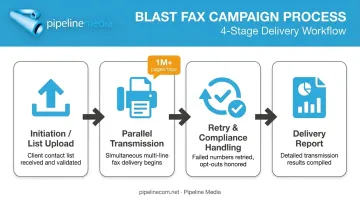
A blast fax campaign moves through four stages: initiation, core transmission, retry/compliance handling, and delivery confirmation. Each stage solves a specific operational problem.
Initiation: Uploading the List and Document
The process starts when a business submits its document and its list of recipient fax numbers to a broadcasting platform. From there, everything runs automatically — no one sits at a desk dialing numbers.
This is also where most campaigns run into trouble. Poorly formatted or unverified recipient lists cause high failure rates and, worse, compliance risk if the list includes numbers that shouldn't be contacted.
Pipeline Media handles this stage by working with virtually all file formats for both documents and recipient databases. Clients just email their list and document over, and the team takes it from there. No file conversion headaches, no format restrictions to worry about before a campaign even launches.
Core Operation: Parallel Transmission
Here's the mechanical heart of a blast fax. The platform converts the uploaded document into a fax-compatible format, then dials multiple recipient numbers in parallel rather than one at a time. Data moves over standard fax protocols, whether that's the traditional telephone network described in ITU-T T.30 or an internet-based fax conversion service.
The performance difference this makes is significant:
- One-at-a-time dialing could take days for a large list
- Parallel transmission compresses that into a single, short window
Pipeline Media's fax broadcast service, for example, transmits over 1 million pages per hour. In practice, that means most campaigns finish in under an hour, with the bulk of recipients receiving their document at essentially the same time.
Regulation and Control: Retries and Compliance
Real-world phone lines aren't perfect. Some numbers are busy. Some don't answer. A quality broadcasting platform handles this automatically through retry logic.
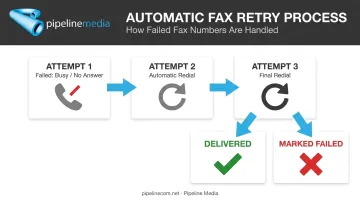
How retries typically work:
- A number fails on the first attempt (busy signal or no answer)
- The system automatically redials the number
- This repeats up to 3 times per number, at no extra cost, before the number is marked as failed
Pipeline Media's "Follow-Through" feature applies this exact standard — three free retry attempts on every problem number, whether it's a busy line or a failed connection.
Compliance sits alongside this technical layer, and it's non-negotiable. In the US, sending an unsolicited fax ad is generally unlawful unless the recipient gave prior permission, or the sender qualifies for the narrow established business relationship exception (FCC junk fax rules, 2024). That exception requires:
- A qualifying business relationship with the recipient
- A fax number obtained through a legitimate source
- A compliant opt-out notice on the first page of every fax
Opt-out requests must be honored within 30 days.
Canada follows a different framework. Business-to-business fax telemarketing is exempt from the National Do Not Call List, but CRTC Telemarketing Rules still require sender identification, permitted calling hours, and internal do-not-call list management (CRTC, 2014). Responsibility for meeting these rules rests with the business sending the campaign, so it pays to know them before hitting send.
Output: The Delivery Report
Once transmission wraps up, the platform generates a delivery report. This is where a business learns whether the campaign actually worked.
A solid report typically shows:
- Successful deliveries — who received the fax
- Failed numbers — with specific reasons for the failure
- Retry outcomes — the final result after all retry attempts
Pipeline Media provides this level of detail as a standard part of every fax broadcast, at no additional charge. That data isn't just a formality. It feeds directly into downstream decisions — updating CRM records, flagging numbers for removal before the next send, or triggering a follow-up phone call or email to recipients who didn't get through. Clean, complete reporting is also what keeps your list healthy for the next campaign.
Where Blast Faxes Are Used
Blast faxing fits naturally into workflows where fax is already the expected channel for official communication:
| Sector | Typical Use Case |
|---|---|
| Healthcare | Lab results, drug alerts, provider-to-pharmacy communication |
| Legal | Time-sensitive notices to opposing counsel or courts |
| Financial services | Compliance notices distributed across broker networks |
| Government/associations | Policy updates, member notices |
Blast faxing performs best with B2B contact lists, time-sensitive or compliance-driven messaging, and audiences that still rely on fax as their official communication channel.
Inbound handling matters just as much as the outbound send. A fax blast often generates responses — completed surveys, subscription renewals, signed forms. Without a plan for receiving those, a campaign creates more chaos than value.
Pipeline Media addresses this with a dedicated toll-free inbound fax number included in its full-service fax broadcasting. Incoming responses get received and processed, closing the loop between outbound and inbound:
- Send your list and document to Pipeline
- Pipeline executes the outbound blast
- Recipients reply to the dedicated toll-free number
- Pipeline compiles and delivers the responses back to you
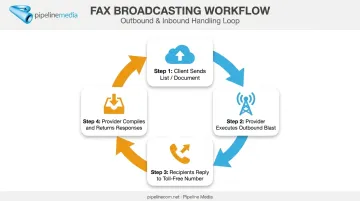
For businesses without any fax infrastructure at all, that end-to-end model means never touching a physical fax machine.
Blast Fax vs. Email Blast and Traditional Fax
Each method has a distinct role. None of them fully replaces the others.
Blast fax vs. traditional single fax: Traditional fax means manually dialing one number at a time. Blast fax replaces that with automated, parallel transmission across an entire list. Same underlying technology, completely different scale.
Blast fax vs. email blast:
- Fax bypasses spam filters entirely; email doesn't have that guarantee
- Email reaches more people for less money per contact
- Fax creates a document trail that some regulated industries specifically require
- Email delivers strong measurable engagement, with average open rates near 42%, per ActiveCampaign's 2025 benchmark report
Given these trade-offs, many businesses run both channels together rather than choosing one. A fax blast lands first, guaranteeing visibility, while an email follow-up reinforces the message at a lower cost per contact. Pipeline Media runs both services in-house, sending fax broadcasts at over 1 million pages per hour and email campaigns at millions of emails per hour, so a combined campaign doesn't mean juggling two separate vendors.
Conclusion
A blast fax works through a predictable sequence: upload your list and document, let the platform transmit in parallel, handle retries and compliance automatically, then review a delivery report showing exactly what happened.
Understanding that sequence helps you make better decisions about list hygiene, message format, and provider choice. If you'd rather skip the learning curve entirely, a full-service partner like Pipeline Media can run the whole campaign: list handling, transmission, retries, and reporting, all from just a document and a contact list.
Frequently Asked Questions
What is a fax blast?
A fax blast is the near-simultaneous transmission of one document to hundreds or thousands of recipients through an automated fax broadcasting platform. It replaces manual, one-at-a-time dialing with parallel transmission at scale.
Is blast faxing legal?
Yes, when the sender has an established business relationship or the recipient's prior consent, and every fax includes a compliant opt-out notice. Unsolicited fax ads without these protections are generally prohibited under FCC rules.
How much does a blast fax campaign typically cost?
Most full-service providers, including Pipeline Media, use quote-based pricing tied to document length and recipient volume rather than a flat per-page rate. Contact a provider directly for a campaign-specific quote.
Do I need a physical fax machine to send a blast fax?
No. Cloud-based platforms let you upload your document and list from any device with internet access. The provider handles transmission on your behalf, no hardware required.
How is a blast fax different from a regular fax?
A regular fax sends one document to one recipient through manual dialing. A blast fax automates that process across an entire list, transmitting to many numbers in parallel rather than one at a time.
How fast can a blast fax campaign be completed?
Most broadcast campaigns finish within an hour thanks to parallel transmission technology. Pipeline Media, for instance, processes over 1 million pages per hour, so even large recipient lists receive documents within minutes to an hour.


