Many businesses assume fax marketing is either extinct or as simple as hitting "send" on a machine. Neither is true. Real fax marketing follows a defined process: list building, document creation, compliant transmission, and delivery monitoring. Skip a step, and campaigns either fail quietly or create legal exposure.
This guide breaks down exactly how that process works, stage by stage — and where it fits into a modern B2B marketing mix.
TL;DR
- Fax marketing (fax broadcasting) sends one document to hundreds or thousands of business fax numbers in a single campaign.
- It runs through four stages: list building, document creation, transmission, and delivery monitoring.
- It stays popular in healthcare, legal, finance, and real estate because fax doesn't route through email spam filters.
- Pipeline Media manages setup, transmission, retries, and reporting; clients just provide a list and a document.
What Is Fax Marketing?
Fax marketing is the practice of sending promotional or informational documents — flyers, announcements, special offers — to a list of business fax numbers. It runs through a physical fax machine or, more commonly today, a cloud-based broadcast platform that dials out to an entire list at once, often reaching thousands of recipients within an hour.
It exists because email inboxes got crowded and digital ads got blocked. Fax gives businesses a way to place a message physically in front of a decision-maker, without competing against 100 unread emails.
What fax marketing is NOT:
- A single one-off business fax (that's just correspondence, not a campaign)
- Unregulated spam — legitimate fax marketing operates under strict consent and opt-out requirements
That crowded-inbox problem doesn't exist on the fax side. Transmissions bypass spam filters entirely, since they travel through a completely separate delivery mechanism — which is why many B2B sectors still budget for fax even as email dominates everywhere else.
Two Types of Fax Communications
- Promotional fax marketing — offers, announcements, and flyers sent as bulk broadcasts to a list. This is what most people mean by "fax marketing."
- Personalized or transactional-adjacent communications — account updates, policy notices, or renewal reminders sent to individual recipients. These carry different legal treatment than cold promotional broadcasts, since they're often tied to an existing business relationship.
How Does Fax Marketing Work?
Fax marketing operates as a four-stage process: list building, document creation, transmission, and monitoring. Each stage determines whether a campaign succeeds or quietly underperforms.
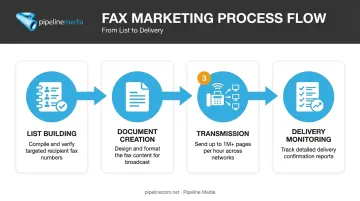
List Building (Initiation)
Every campaign starts with a list of recipient fax numbers. These typically come from:
- Direct business relationships (existing clients, past inquiries)
- Public directories
- Verified consent records
Unless a business already maintains a CRM full of past contacts, list building is manual and research-based — it's rarely something you can automate from scratch. There's no shortcut to a clean, compliant list.
The most common bottleneck here: using unverified third-party lists with no documented consent. This creates compliance risk before the first fax even goes out, regardless of how well the campaign is executed afterward.
Document Creation and Transmission (Core Operation)
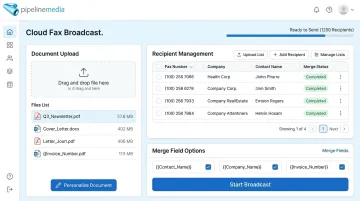
Here's the central mechanic: a single document gets uploaded once to a broadcast platform, which then converts and dials out to every number on the list nearly simultaneously — not one at a time like a physical fax machine.
What happens technically:
- The platform formats the file for fax resolution, so it prints clear and legible on the receiving end
- Fields like recipient name can be personalized through mail merge, placed anywhere on the document
- The document transmits across parallel channels rather than sequentially
Beyond the mechanics of transmission, design determines whether the fax gets read at all. Bold, high-contrast, one-page documents consistently outperform cluttered multi-page faxes in response rate. A busy decision-maker glances at a fax for a few seconds — clarity wins.
None of this requires a physical fax machine on either the sending or receiving side. A cloud platform and internet connection handle everything.
Pipeline Media's fax broadcasting service works exactly this way: clients supply a list and a document, and the platform manages formatting, personalization, and transmission from there. The service also handles an unlimited number of merge fields anywhere on the document, so a 5,000-recipient campaign can still greet each business by name.
Compliance and Delivery Control (Regulation)
Every fax in a batch must carry a compliant opt-out notice on the first page. This isn't a nice-to-have — it's a legal requirement under 47 CFR 64.1200, which governs unsolicited fax advertisements sent under the established business relationship exception.
The notice must:
- State the recipient can request no future fax ads
- Warn that ignoring a valid opt-out request within 30 days is unlawful
- Explain what a valid opt-out request must contain
- Provide a phone number, fax number, or cost-free alternative for the request
- Keep those contact channels available 24/7
Failed transmissions get handled automatically. Busy signals or unanswered lines trigger retry logic — typically two to three attempts — without any manual intervention. Pipeline Media's platform retries every problem number three times, free of charge, before logging it as a failure.
Skipping either control creates real consequences: ignoring compliance opens legal exposure, and ignoring retry logic silently shrinks how many people actually see the fax.
Delivery Reporting (Output)
The process ends with a delivery report showing:
- Which faxes succeeded
- Which failed permanently (after retries)
- Which recipients opted out
That report isn't just a receipt — it feeds the next campaign. Successful numbers stay active. Failed numbers get flagged for review. Opt-outs are permanently suppressed from future sends.
Pipeline Media's fax broadcast reports go a step further, listing the specific reason each failed fax didn't go through, whether that's a disconnected line, a busy signal after retries, or a fax machine out of paper. A clean report with a high success rate translates directly into stronger engagement compared to a list nobody's verified in three years.
Where Fax Marketing Is Used
Fax marketing fits naturally into industries that already run fax infrastructure as part of daily operations:
- Healthcare — provider and pharmacy networks, where fax already integrates with EHR systems and prior authorization workflows. MGMA's 2024 issue brief confirms fax remains an active channel medical practices use for prior authorization requests with health plans.
- Legal services — firm-to-firm notices and time-sensitive filings, where electronic fax remains common even among small firms.
- Financial services — broker and advisor networks distributing compliance-sensitive updates.
- Real estate — agent listing alerts sent across brokerage networks.
Pipeline Media's own client history reflects this pattern. Confirmed campaigns span healthcare, financial services, and government sectors, the same industries where fax infrastructure runs deepest. One healthcare client, Wendy B. of Vancouver, put it simply: "Pipeline streamlined our communications with doctors and pharmacies all over North America, extremely reliable, highly recommend!"
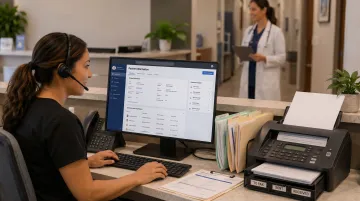
Fax marketing performs best where three conditions overlap: a B2B audience with existing fax infrastructure, a time-sensitive message, and an industry where fax already sits inside daily recordkeeping. Consumer audiences are a different story. Most people haven't owned a personal fax machine in years, which is why this channel stays firmly in B2B territory.
The Bottom Line
Fax marketing works because it follows a controlled process: list, document, transmission, compliance, and reporting. It isn't a "blast and hope" tactic. Businesses that treat each stage seriously see stronger response rates than those who buy a cheap list and skip the details.
A full-service partner removes the operational burden entirely. Pipeline Media has run fax broadcast campaigns since 2003, handling job setup, personalization, retries, and reporting so clients only need to send a list and a document.
As one client, Robert H. of Miami, described it: "Pipeline removed hours of monotonous work from my plate each month, coordinating my monthly Fax Broadcast campaigns for me." Fewer hours spent managing logistics means more time spent on the business itself.
Frequently Asked Questions
What is fax marketing?
Fax marketing is the practice of sending a promotional document to a list of business fax numbers through a broadcast platform, reaching many recipients at once. It's distinct from a single one-off fax sent to one contact.
Does anybody use fax anymore?
Yes — fax stays active in B2B sectors including healthcare, legal, and finance. The ABA's 2023 survey found 42% of solo lawyers and 40% of small-firm lawyers still use electronic fax software regularly.
Is fax marketing legal?
Yes, under the TCPA and Junk Fax Prevention Act, provided the sender has an established business relationship or prior consent from the recipient. A compliant opt-out notice on the first page is also required.
How much does fax marketing cost?
Pricing typically runs on a custom, per-campaign quote rather than a fixed per-page rate. Pipeline Media, for example, bundles list handling, personalization, retries, and reporting into that quote at no extra charge.
What industries benefit most from fax marketing?
Healthcare, legal, financial services, and real estate see the strongest results, since these sectors already run fax infrastructure for compliance, recordkeeping, or time-sensitive notices. Fax integrates naturally into their existing workflows.
Is fax marketing more effective than email marketing?
Fax transmissions don't pass through email spam filters, giving them a structural delivery advantage over email in cluttered inboxes. Direct open-rate comparisons between the two channels remain limited, but fax's near-guaranteed physical delivery is why B2B sectors still invest in it.