It's a fair question. Many litigants and business owners assume fax went the way of the pager once e-filing arrived. It didn't. Fax service remains legally valid in federal courts and most states — but only when specific, easy-to-miss conditions are met first.
This article breaks down those conditions: the federal rule, California's detailed model, how states compare, the exact steps to do it correctly, and the mistakes that get fax service thrown out entirely.
Key Takeaways
- Fax service is valid only with prior written consent from the recipient
- You must use the fax number last provided in a filed court document, not an old contact
- California requires proof of service to include a transmission report, unlike California and New York
- Fax use is declining as e-filing expands, though it remains a valid fallback when consent exists
What Is Service by Fax?
Service by fax means transmitting legal documents (pleadings, motions, notices) to an opposing party's fax machine as a formal method of legal notice. Cornell's Legal Information Institute describes it as a "substitute delivery" of litigation documents, distinct from personal service or service by mail.
That classification matters. Fax service isn't universally treated as "electronic service" or "substituted service" — it depends on how a given jurisdiction's rules define it. Some states fold fax into their electronic service provisions. Others treat it as its own category with separate rules entirely.
A critical distinction: fax service under rules like Federal Rule of Civil Procedure 5 applies only to later case documents, such as motions, briefs, and discovery notices. It does not cover the initial summons and complaint, which falls under FRCP 4 and almost always requires personal service or a court-approved alternative.
Two things are true in nearly every jurisdiction that permits fax service:
- It's only valid where a rule or statute explicitly authorizes it
- It typically requires the recipient's prior written consent
Skip either requirement, and you don't have valid service. You have a fax that happens to contain legal documents.
Legal Requirements for Valid Fax Service
Every jurisdiction that allows fax service builds in the same guardrails. Miss one, and the whole thing can unravel.
Consent Must Be Written and Confirmed
Under Federal Rule of Civil Procedure 5(b)(2)(E), electronic service — including fax, where accepted as a form of "other electronic means" — is only valid if the recipient consented to it in writing. There's no implied consent. Silence isn't consent. An old fax number on a business card isn't consent.
California's Code of Civil Procedure Section 1013(e) states this directly: fax service "shall be permitted only where the parties agree and a written confirmation of that agreement is made."
You Must Use the Correct Fax Number
CCP 1013(e) requires transmission to the fax number "last given" by the recipient in a document they filed and served in that case, not an outdated number pulled from a website or an old filing.
Service lists matter here. Under California Rule of Court 2.306(b), the first-named plaintiff or petitioner is responsible for maintaining a running list of everyone's agreed fax numbers and distributing updates to all parties. If that list isn't kept current, service to an outdated number can be challenged.
The Receiving Machine Must Be Available During Business Hours
Rules typically require the receiving fax line be operational 9 a.m. to 5 p.m. on regular court days — not around the clock. This protects recipients from being penalized for closed offices at midnight, but it also means transmissions sent late in the day may not count as same-day service (more on that below).
Some States Require a Backup Copy
Florida's current service framework requires that fax transmissions be paired with another permitted method of service — the fax alone isn't sufficient on its own. The rule exists to protect against equipment failures and transmission errors affecting critical case notices.
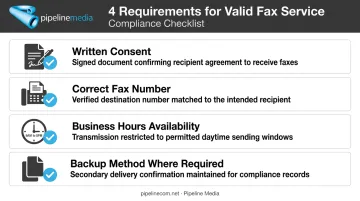
The four requirements, in short:
- Written, documented consent from the recipient
- Transmission to the most recently provided fax number
- Availability during standard business hours (9 a.m.–5 p.m.)
- A backup service method where required by the jurisdiction
Bottom line: Miss any one of these elements — consent, correct number, business-hours availability, or a required backup method — and the service isn't just late. It's void.
State-by-State Rules: The California Model
California has the most detailed fax service framework in the country, and other states often mirror its structure. CRC Rule 2.306 covers everything from consent to timing to proof requirements.
| Rule Element | Requirement |
|---|---|
| Agreement | Written confirmation required from both parties |
| Service list | Maintained by first-named plaintiff/petitioner; must be updated and shared |
| Court's role | Court may also serve notices by fax under the same rules |
| Response extension | Two court days added to response deadlines |
| Extension exceptions | Does not apply to new trial motions, CCP 663a motions to vacate, or notices of appeal |
| Machine availability | Must be available 9 a.m.–5 p.m. on court days |
| Completion timing | Complete on transmission; after 5 p.m. counts as the next court day |
| Proof requirements | Must include transmission report and error-free declaration |
The "Complete on Transmission" Rule
Service is legally complete the moment the fax transmits successfully, regardless of when the recipient actually reads it. But if that transmission finishes after 5 p.m., California treats it as served on the next court day, not the day it was actually sent. Miscalculating this detail is one of the more common ways parties get their response deadlines wrong.
Proof of Service Documentation Requirements
California's CRC 2.306(h) spells out exactly what a valid proof of service by fax must contain:
- Date and sending fax number — in place of the date and mailing address used for mail service
- Recipient's name and fax number — instead of a mailing address
- A declaration that the transmission was reported complete and error-free
- An attached copy of the transmission report generated by the sending machine
- Confirmation that the report was properly issued by that machine
Miss any of these, and under CRC 2.306(h)(5), the service itself is deemed ineffective — not just the paperwork.
For businesses managing high-volume fax communications, these transmission-report requirements underscore why accurate delivery tracking matters at every step. Here's how California compares to two other major jurisdictions:
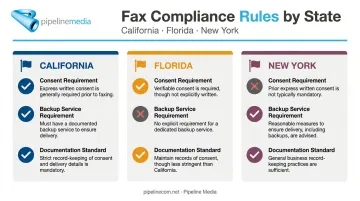
| Jurisdiction | Consent Required | Backup Service Required? | Documentation Standard |
|---|---|---|---|
| California (CCP 1013(e), CRC 2.306) | Yes, written | No | Transmission report + error-free declaration |
| Florida (Rule 2.516) | Fax listed as alternative method | Yes, must pair with another method | Cover sheet with sender details; certificate of service |
| New York (CPLR 2103(b)(5)) | Yes, written, to a designated number | No general requirement | Transmission report retained by sender |
How to Properly Serve Documents by Fax: Step-by-Step
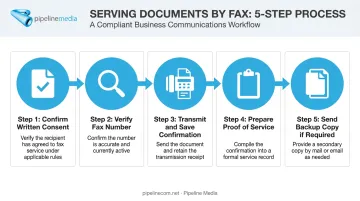
Getting fax service right isn't complicated, but it does require discipline about documentation. Here's the sequence:
- Confirm written consent exists. Check the case file for a signed agreement or stipulation allowing fax service. No consent on file means no valid fax service — full stop.
- Verify the fax number. Pull the most recently filed document containing the recipient's fax number. Don't rely on memory, letterhead, or an assistant's contact list.
- Transmit during business hours and save the confirmation. Send the complete document, then immediately retain the automatic transmission report your fax system generates. This report is not optional paperwork — it's the backbone of your proof of service.
- Prepare the proof of service. Include the date, time, both fax numbers, an error-free declaration, and the attached transmission report.
- Send a follow-up hard copy if your jurisdiction requires it. Florida and some other states mandate a second delivery method regardless of fax success.
For solo practitioners handling one notice, this is manageable with an office fax machine. It gets harder at volume. Law firms managing dozens of time-sensitive notices across multiple parties need a system that won't drop a transmission and lose the paper trail.
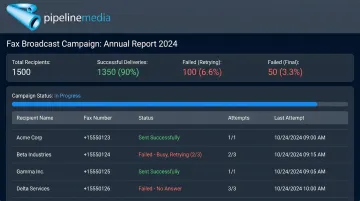
That volume problem is exactly what a managed fax broadcasting platform is built to solve. Firms researching this route should note that services like Pipeline Media's handle high-volume business fax transmission, automatically retrying any failed number three times at no extra cost, then producing a detailed report showing who received the fax, who didn't, and why. That kind of retry logic and reporting trail simplifies the operational side of sending multiple faxes, though every firm still needs to confirm independently that its consent documentation and proof-of-service filings meet the specific court's requirements.
Common Mistakes That Invalidate Fax Service
These three errors show up again and again in service disputes:
- Assuming consent isn't necessary. Courts routinely reject fax service where no written agreement exists, even if the recipient clearly received the documents. Actual notice doesn't cure a procedural defect.
- Using an outdated fax number. If the number wasn't the one "last given" in a filed document, the service can be challenged regardless of whether it went through.
- Forgetting the transmission report. Under CRC 2.306(h)(5), a proof of service missing the attached confirmation report renders the entire service ineffective, not just incomplete.
Each of these is avoidable with a simple checklist before you hit send. None of them require legal expertise to catch, just attention to the file.
Fax Service vs. Other Methods of Service
Fax sits in an odd middle ground between traditional and digital service methods.
- Personal service guarantees actual notice but costs more and takes longer to schedule
- Mail service is simple and widely accepted but adds days to response calculations
- Email service is increasingly favored by courts but, like fax, generally requires separate written consent from the receiving party
- Fax service sits between these: faster than mail, more document-friendly than a phone call, but boxed in by consent requirements
These consent requirements haven't stopped the broader shift away from fax, though. Usage overall has declined as courts roll out e-filing systems. The ABA reported that pandemic-era conditions accelerated the shift to paperless court filing, with e-filing services covering 22 states plus Washington, D.C. by 2022. Still, fax hasn't disappeared — it remains a valid, sometimes preferred, backup for firms with existing fax infrastructure or clients (healthcare and financial services are common examples) still routing documents that way.
For businesses that still depend on fax communication but no longer keep a physical machine around, cloud-based fax-to-email services solve the infrastructure gap. Pipeline Media's Fax-To-Email plans, for instance, assign a dedicated fax number and let staff send or receive faxes from a laptop or phone, starting at $10 USD/month for 100 pages in and out. That setup covers most solo practitioners and small firms handling routine service documents.
Frequently Asked Questions
How do you serve someone who is avoiding you?
Courts allow substituted service — leaving documents with a competent adult at the person's residence — or service by publication when someone actively evades personal service. Both usually require court approval first.
Can you be served via email in Washington state?
No, not automatically. Washington requires either court permission or the parties' written agreement for email service, similar to the consent standard for fax.
What happens if I don't answer the door for a process server?
Refusing to open the door doesn't block service. Process servers can complete substituted service through other legally permitted methods or by making repeated attempts.
How do I prove I wasn't served?
You can file a motion challenging service, backed by evidence such as sworn affidavits, alibi records, or inconsistencies in the process server's own proof of service.
Does the recipient's fax machine need to be on at all times for service to be valid?
No. Most rules only require the receiving machine be available during standard business hours — typically 9 a.m. to 5 p.m. — on non-holiday court days, not continuously.
Is service by fax still commonly used today?
Less than it once was, as e-filing and e-service expand across courts. But it remains a legally valid method wherever the parties have agreed to it in writing, and it's still common in industries with established fax infrastructure.