But here's the catch. Most accountants know they should be posting. Far fewer understand what happens when they put money behind those posts. If you've ever run a boosted post or a lead-gen ad and wondered whether $40 per lead is good or terrible, you've bumped into CPA — cost per acquisition.
This guide breaks down both halves of the equation: what to post so prospects trust you before they call, and how to read the numbers so your ad spend actually pays for itself.
Key Takeaways
- CPA measures what you pay for one completed lead or client, not clicks or impressions.
- Benchmarks vary by platform, objective, and audience size, so use generic averages only as a starting point.
- Educational content and gated resources tend to lower CPA more than sales-heavy posts.
- Narrow targeting and consistent retargeting are the fastest levers for cutting acquisition costs.
What Is CPA in Social Media Marketing?
CPA stands for cost per acquisition (sometimes called cost per action). It's the amount you spend on ads to generate one completed conversion: a booked consultation, a submitted contact form, or a signed client agreement.
The formula is simple:
CPA = Total Ad Spend ÷ Number of Conversions
Say a CPA firm spends $1,000 on a tax-season lead campaign and gets 25 booked consultations. That's a $40 CPA. Whether that's a good number depends entirely on what a new client is worth to your firm over their lifetime.
CPA isn't the same as CPC (cost per click) or CPM (cost per 1,000 impressions). Those two measure exposure and traffic. CPA measures results.
A campaign can have a cheap CPC and still deliver an expensive CPA if the landing page or offer fails to convert visitors into leads. For firms focused on qualified prospects (not vanity engagement), CPA is the number that actually matters.
A great ad can't fix a weak website. If your landing page loads slowly or buries the contact form, your CPA will suffer no matter how good the creative is.
Average CPA Benchmarks by Platform
There's no single, universally agreed-upon "accounting industry CPA" published by the major platforms. Most benchmark reports track CPC and CPL by broad industry category, not a finance-specific CPA. Still, the directional data is useful for setting expectations:
- Facebook lead campaigns averaged roughly $27.66 per lead across a large sample of US campaigns, according to WordStream's 2025 Facebook Ads benchmark report. Finance-related traffic campaigns showed a lower cost per click than the all-industry average.
- Instagram ads averaged around $11.31 per lead platform-wide, with cost climbing for more competitive objectives like lead forms versus traffic.
- LinkedIn typically runs a higher cost per click than Facebook in B2B comparisons, which is useful context if you're targeting business owners rather than individual taxpayers, though it doesn't automatically mean a higher final CPA.
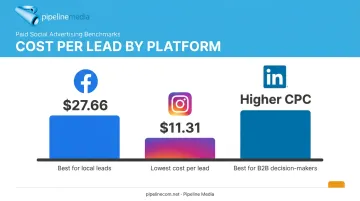
Benchmarks shift depending on your campaign objective (lead generation costs more than traffic) and your targeting radius. A hyper-local campaign in one city will behave very differently from a national advisory-services push. Use these figures as a baseline, then let your own conversion data set the real target.
Why Social Media Marketing Matters for CPA Firms Today
Client expectations have shifted. Prospects no longer call a firm cold and hope for the best. They check you out first.
96% of consumers read online reviews at least occasionally before choosing a local business, and 74% consult two or more review sites before deciding, according to BrightLocal's Local Consumer Review Survey. Your social feed is now part of that research process, whether you're actively managing it or not.
A consistent presence does something referrals alone can't:
- Builds familiarity before the first phone call, so prospects arrive already leaning toward "yes"
- Moves cautious buyers from "maybe next year" to "let's talk now" once a tax notice or audit letter shows up
- Lets a firm target very specific niches (dentists, e-commerce sellers, real estate investors) instead of waiting for whoever walks in the door
For firms that want to specialize, social media is the cheapest way to reach a defined niche at scale.
Choosing the Right Platforms and Content That Drives Conversions
Not every platform fits every client type. A solo taxpayer scrolling Instagram behaves nothing like a business owner researching advisory services on LinkedIn. Matching platform to audience is the first real decision in any CPA firm's social strategy.
LinkedIn: Best for B2B and Advisory Clients
LinkedIn works well when your target client is a business owner, CFO, or decision-maker looking for advisory, bookkeeping, or fractional CFO services. Educational posts, short case-style success stories ("How we helped a manufacturing client cut their tax liability by X"), and firm updates tend to perform best here. It's a slower-burn platform, but the leads skew higher-intent.
Instagram and Facebook: Best for Individual Clients and Local Trust
These platforms suit individual taxpayers and small local businesses. Behind-the-scenes content, simple tax tips, and client reviews build the kind of approachability that referral-based firms have relied on for decades, just at a larger scale. Reviews and local visibility do a lot of the trust-building work here.
Pipeline Media's Social Media Presence package, for example, manages a firm's presence across Instagram, Facebook, X, and LinkedIn simultaneously. It keeps content, captions, and profile branding consistent no matter which platform a prospective client happens to check.
Content That Lowers Your Client Acquisition Costs
Two content patterns consistently reduce acquisition cost:
- Gated lead magnets, such as free tax checklists and "year-end tax prep" guides, capture leads more affordably than a direct "book a consultation" ask, since the request is smaller and lower-friction.
- Short-form video typically outpaces static images on cost efficiency. Meta's testing found Reels-style ads cost roughly 34.5% less per result than still-image creative, per Meta's Reels ad guidance.
A 30-second clip on this year's tax law changes often outperforms a polished static graphic.
Proven Strategies to Lower Your CPA and Maximize Social ROI
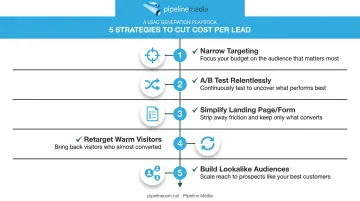
Once your content and platform choices are set, these tactics move the needle on cost:
- Narrow your targeting. Instead of "small business owners," target "restaurant owners with 10-50 employees in your metro area." Tighter targeting means less wasted spend on people who'll never book.
- A/B test relentlessly. Run two versions of the same ad: different headline, different offer. Let the data decide. Small copy changes can shift CPA by double digits.
- Simplify your landing page and lead form. A three-field mobile form converts better than a five-field desktop-first one. Every extra field is a chance for someone to abandon.
- Retarget warm visitors. Someone who read your "tax prep checklist" page but didn't convert is a far cheaper conversion than a cold stranger. Retargeting campaigns consistently cost less per result than cold-audience ads.
- Build lookalike audiences. Feed the platform a list of your best existing clients, and it will find similar prospects, often at a lower cost than broad, undefined targeting.
If your firm doesn't have the bandwidth to manage targeting, creative testing, and reporting on top of billable client work, that's a reasonable thing to outsource.
Pipeline Media's PPC Advertising & Campaign Management service builds retargeting into every campaign by design, following website visitors with ads after they leave your site. Accountants get that extra layer of follow-up without having to babysit ad accounts during busy season.
Common Mistakes That Inflate CPA for Accounting Firms
A few habits quietly drive up acquisition costs without anyone noticing until the invoice arrives:
- Using generic, sales-heavy messaging. "Contact us for all your accounting needs" gets scrolled past. Specific, useful posts get clicked.
- Sharing client details, even anonymized. This risks compliance issues under professional conduct rules and can trigger platform-level content flags that pause your campaign entirely.
- Restarting campaigns constantly. Pausing an ad set for an extended stretch, or making major targeting changes, forces the algorithm into a "learning phase" where delivery is less stable and cost climbs. Let campaigns stabilize before judging performance.
- Inconsistent posting. A firm that posts three times one week, then disappears for a month, never builds the algorithmic momentum that keeps organic reach and ad performance efficient.
Frequently Asked Questions
What is a CPA in social media marketing?
CPA stands for cost per acquisition (or action) — the amount spent on ads to generate one completed lead, sign-up, or sale. It's calculated as total ad spend divided by total conversions.
What is the average CPA for Instagram?
Platform-wide averages hover around $11 per lead, though this varies by industry, ad objective, and audience size. Lead-generation objectives typically cost more than traffic-focused campaigns.
How much should a CPA firm budget for social media marketing?
It depends on firm size and goals. Many small-to-mid-sized firms start around $500/month for organic brand management, while firms wanting active lead generation and paid ads typically budget $1,500 or more per month.
Which social media platform has the lowest CPA for accounting firms?
It varies by campaign, but Facebook often shows lower per-click costs than LinkedIn for broad-reach campaigns. LinkedIn's precise B2B targeting can cost more upfront but sometimes delivers higher-intent leads.
How often should CPA firms post on social media?
Starting with once a week and staying consistent matters more than posting daily. Consistency builds algorithmic trust and audience familiarity over time.
Do accounting firms need paid ads, or is organic content enough?
Organic content builds long-term trust and credibility. Paid ads, measured by CPA, accelerate lead generation on a shorter timeline. Most firms see the best results combining both.