Introduction
SaaS social media marketing goes beyond posting product screenshots and hoping someone clicks "book a demo." It's the strategic use of platforms to build trust, educate buyers, and create demand across sales cycles that often stretch for months and involve multiple stakeholders.
That distinction matters more heading into 2026. SaaS categories are more crowded than ever, and buyers have grown skeptical of anything that smells like a sales pitch. Brands that keep pace with how social is evolving cut through the noise, lower customer acquisition costs, and build pipeline that doesn't dry up when ad budgets get cut.
This guide breaks down the trends reshaping SaaS social strategy for 2026, what's fueling them, how they're changing day-to-day marketing operations, and what to watch next.
Key Takeaways
- AI-driven listening tools are replacing guesswork in audience and competitor research
- Founder and employee LinkedIn posts now carry more trust weight than brand accounts
- Short-form video consistently outperforms static image and text posts
- Social platforms increasingly double as search engines that feed AI answer tools
- Peer reviews and community proof serve as a measurable growth lever
Key SaaS Social Media Trends for 2026
These five shifts share a common thread: SaaS marketing is moving away from broadcast-style posting toward data-informed, community-driven strategy. Here's what's changing and why it matters.
AI-Powered Social Listening for Audience & Competitor Insight
SaaS teams are done guessing what their ideal customers care about. Instead, they're using AI listening tools to track keywords, sentiment shifts, and niche conversations happening on Reddit threads, X, and industry forums.
Hootsuite's research confirms that AI-powered listening tools can surface market and consumer intelligence in near real time, helping brands spot micro-shifts in sentiment before they show up in a quarterly report (Hootsuite Social Trends 2026).
Here's where it gets useful:
- A competitor launches a feature but forgets to address a common complaint. Listening tools flag the gap before your competitor does
- A niche pain point starts trending in a Slack community weeks before it hits mainstream SaaS blogs
- Sentiment analysis reveals your messaging is landing flat with a specific buyer segment
Why this matters more in 2026: rising SaaS competition means brands reacting to real-time signals consistently outperform those still relying on annual or quarterly research cycles.
Founder & Employee-Led LinkedIn Thought Leadership
Corporate LinkedIn pages still exist. They're just not where the trust gets built anymore. SaaS companies are activating founders and employees to post in their own voice, sharing company wins, personal takeaways, and behind-the-scenes stories that feel less scripted than official brand content.
This "internal chatter" style works because it's relatable. A founder posting about a hard lesson from a failed launch reads very differently than a polished company announcement.
According to Edelman and LinkedIn's 2024 B2B Thought Leadership Impact Report, which surveyed 3,484 management-level professionals, 73% of B2B decision-makers say thought leadership is a more trustworthy basis for assessing a company's capabilities than its marketing materials or product sheets.
That single stat explains the shift. Buyers trust individual voices over corporate accounts because expertise feels earned, not manufactured. It's a low-cost, high-trust channel, and one of the few social strategies that scales with headcount instead of ad spend.
Short-Form, Educational Video Content
Long-form promotional videos are losing ground fast. What's replacing them: bite-sized how-to clips, quick product walkthroughs, and carousel explainers that answer one question and move on.
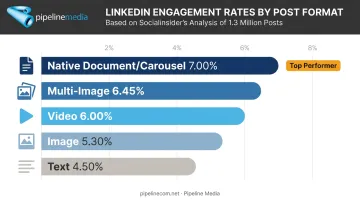
Data from Socialinsider's analysis of 1.3 million LinkedIn business posts shows exactly why:
| Post Format | Average Engagement Rate |
|---|---|
| Native document/carousel | 7.00% |
| Multi-image | 6.45% |
| Video | 6.00% |
| Image | 5.30% |
| Text | 4.50% |
Source: LinkedIn Organic Benchmarks 2026, Socialinsider
Video clearly beats static images and plain text, even if carousels edge it out slightly. Visual, digestible formats consistently outperform flat announcements, regardless of which one technically ranks first.
Why this is accelerating: buyers now self-educate long before a sales call ever happens. Short video matches how people actually consume content on mobile, squeezed in between meetings rather than during a dedicated research session.
Social Platforms as Search & Discovery Engines
Search behavior has quietly changed. Google's AI Overviews now pull directly from LinkedIn and YouTube content, not just traditional website results. A 2024 Search Engine Journal study of 100,000 keywords found 1,346 YouTube links and 1,091 LinkedIn links appeared inside Google AI Overviews.
That means a well-optimized LinkedIn post answering "best CRM for startups" can surface in search results the same way a blog article does.
Practical application:
- Write posts that directly answer buyer questions instead of showcasing features
- Choose specific, searchable phrasing over vague marketing language
- Position platform content as a discovery asset, not an afterthought
Why it matters: zero-click search is already the norm: over 58% of US Google searches end without a click. Brands invisible on social risk losing early-funnel discovery entirely, even if their website SEO is solid.
Community-Led Growth & Social Proof at Scale
Website testimonials aren't cutting it anymore. SaaS brands are pulling reviews, user-generated content, and customer success stories directly into their social feeds, and building out Slack groups, LinkedIn communities, and branded hashtags to keep customers engaged after the sale closes.
The buyer behavior data backs this up. In a TrustRadius survey of 2,058 technology buyers, 77% read user reviews during the buying journey, 54% spoke directly with a product user, and only 23% relied on vendor-supplied references.
That gap is the whole story. Peer validation now outweighs brand messaging by a wide margin, which makes organic social proof a genuine conversion lever, not just a nice-to-have.
What's Driving These SaaS Social Media Trends
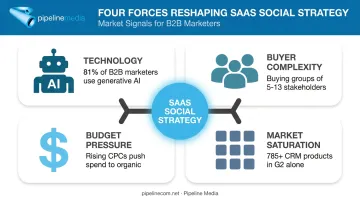
None of this happened by accident. Four forces — technology, buyer behavior, budget pressure, and market saturation — are pushing SaaS marketing teams in the same direction.
Technology is making these tactics accessible. Generative AI adoption among B2B marketing teams jumped to 81%, up from 72% just a year earlier, according to Content Marketing Institute's 2025 benchmark study. That's a real jump in one year.
It explains why listening, content creation, and analytics tools that once required a dedicated data team are now standard-issue for lean marketing departments.
Buyers are involved in more complex decisions. Research findings vary by definition, but the pattern is consistent: TrustRadius found an average technology buying group of 4.8 people, while Forrester's broader B2B research put the number at 13 internal participants.
Either way, that's multiple stakeholders who need educational, trust-building content before a deal closes, not a single decision-maker responding to an ad.
Budgets are tightening, and organic channels compound. Paid-only strategies deliver diminishing returns as costs per click rise across every major platform. SaaS teams are shifting spend toward organic and community-driven channels precisely because the ROI compounds over time instead of resetting every time a campaign ends.
Markets are saturated. G2's CRM category alone lists 785 products. When buyers can choose from hundreds of nearly identical tools, differentiation has to happen somewhere other than the feature list. Social is where that differentiation is increasingly won.
How These Trends Are Impacting SaaS Businesses
These shifts aren't staying confined to the marketing team's to-do list. They're reshaping how SaaS companies operate, spend, and staff themselves.
Operational Impact
Marketing, sales, and customer success teams are collaborating more closely on social than ever before. Integrated content calendars and shared inboxes let teams coordinate on:
- Responding to comments and DMs before they go cold
- Flagging community questions that sales can turn into conversations
- Repurposing customer success wins into social proof content
The silo between "who posts" and "who talks to customers" is disappearing.
Business Impact
Budget allocation is shifting away from paid-only campaigns toward a blended organic-plus-paid model. Social is no longer treated as a branding afterthought. It's increasingly tied to pipeline and revenue attribution metrics, meaning finance teams want to see how a LinkedIn post connects to a closed deal, not just a like count.
Workforce Impact
Here's the friction point: most SaaS companies don't have a dedicated social strategist, community manager, or content creator on staff. That skills gap is real, especially at small and mid-sized companies where marketing is often one or two people wearing five hats.
That's pushed many teams toward full-service partners instead of hiring internally. Pipeline Media, a Toronto-based business communications agency operating since 2003, offers a Social Media Presence package (starting at $500 USD/month) that manages Instagram, Facebook, X, and LinkedIn end-to-end. The service covers content creation, scheduled posting, on-brand captions, and inbox monitoring.
This keeps a brand consistent without adding headcount, making it one option among many for companies without the internal bandwidth to run this in-house.
Future Signals to Watch Beyond 2026
These trends mark a starting point, not a finish line. Over the next one to three years, keep an eye on:
- AI agents that auto-summarize listening data into real-time campaign recommendations, cutting the lag between insight and action
- Dark social's growing influence: private shares, DMs, and group chats that drive high-intent traffic but never show up cleanly in analytics
- Deeper overlap between social platforms and generative AI answer engines, making platform-native SEO a core skill for social teams rather than a separate discipline
Conclusion
SaaS social media in 2026 comes down to five things: data-driven listening, human-led authority, video-first education, search-ready content, and community-powered proof. None of these are trends you can dabble in occasionally — they require consistency.
Brands that adapt early will out-compete rivals still treating social as a place to drop product announcements. For companies without the bandwidth to manage all five strategies in-house, partnering with a social media management provider like Pipeline Media keeps your brand's presence consistent and credible across platforms without adding headcount.
Frequently Asked Questions
What makes SaaS social media marketing different from other industries?
SaaS involves longer sales cycles, multiple decision-makers, and a heavy focus on retention over one-time transactions. That means content needs to educate and build trust over months, not just drive an immediate purchase.
Which social media platform works best for B2B SaaS companies in 2026?
LinkedIn remains dominant for B2B credibility and thought leadership, while YouTube and X support video content and real-time engagement. Platform choice should follow wherever your ideal customer profile is most active.
How often should a SaaS company post on social media?
Consistency matters more than volume. Most SaaS brands post 3-5 times weekly, which keeps visibility steady without diluting content quality or burning out the team producing it.
How do you measure ROI from SaaS social media marketing?
Track engagement rate, social referral traffic, conversion rate, and share of voice, then tie those metrics back to pipeline influence. Churn correlation is also worth watching if community engagement is part of your retention strategy.
Can small SaaS startups compete with larger, better-funded brands on social media?
Yes — authenticity and founder-led content often outperform polished corporate accounts. Niche community engagement lets small teams build trust faster than bigger competitors relying on generic messaging.
Should a SaaS company manage social media in-house or outsource it?
In-house works well when there's a dedicated team with the bandwidth to stay consistent. Many SMBs instead outsource to full-service agencies like Pipeline Media, which offers a free phone consultation across North American time zones to find the right fit.