None of them reach for email first. They fax.
It sounds like a relic, but fax remains a legally recognized, trusted document format across healthcare, legal, finance, and government. In fact, 88% of non-federal acute-care hospitals still used mail or fax for exchanging summary-of-care records as of 2023 data, according to HealthIT.gov's interoperability brief.
This guide covers how faxing actually works today, the three main methods businesses use, security and compliance best practices, and how to pick the right solution for your organization.
Key Takeaways
- Fax persists in regulated industries because it creates a legally recognized, traceable paper trail
- Businesses today choose between traditional machines, cloud/online fax services, or fax broadcasting for bulk sends
- Delivery success depends on correct file formatting, verified numbers, and automatic retry logic
- Full-service providers remove the operational burden of managing fax campaigns and troubleshooting failures in-house
What Is Faxing and How Does It Work?
Faxing transmits scanned documents over telephone lines or the internet by converting a page image into signals, then reconstructing it as a printed or digital page on the other end. That's the core mechanic, whether you're using a 1990s desktop machine or a browser-based fax app.
From Analog Lines to the Cloud
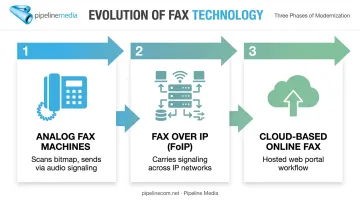
The technology has moved through three distinct phases:
- Analog fax machines — scan a document into a bitmap, convert it to audio signaling, and send it over the standard phone network (PSTN)
- Fax over IP (FoIP) — carries fax signaling across IP networks using gateways, letting fax coexist with modern phone systems
- Cloud-based online fax services — a hosted workflow where you upload a file through a web portal, email, or app, and the provider handles transmission and delivery digitally
These aren't interchangeable terms: FoIP is a transport method, while cloud fax is an access and delivery layer built on top of it. That layered evolution explains why fax, in some form, still shows up in workflows long after most communication went digital.
Why Fax Refuses to Disappear
Healthcare is the clearest example of why fax has staying power. Care summaries and referrals still get sent by "mail or fax" at many practices, largely because fax integrates with existing compliance and record-keeping habits without requiring a system overhaul. CAQH's index groups fax with other manual transactions, including phone calls and mail, underscoring how embedded it remains in regulated workflows where audit trails and signed documentation matter more than transmission speed.
The Role of T.38 and Transmission Speed
When a fax fails to go through, the culprit is often a transmission protocol mismatch. T.38 is the ITU-T standard that governs real-time fax over IP networks. Cisco's documentation shows standard T.38 supporting rates up to 14,400 bit/s, with T.38 Version 3 extending to Super Group 3 speeds of 33.6 kbit/s.
A quick clarification: these speeds are measured in bit/s, not baud. Baud refers to symbol rate, and it isn't automatically the same number. If a sending and receiving endpoint can't agree on a compatible rate, the transmission stalls or drops, one of the most common, and most fixable, fax failures.
What Is a "Phone Fax," Exactly?
A phone fax simply means sending a fax over a traditional telephone line connection, the classic analog method where your machine dials a number and transmits directly over the PSTN. It's distinct from online faxing, which routes your document through the internet instead of a dedicated phone line.
Types of Faxing: Traditional, Online, and Fax Broadcast
Three approaches dominate today's fax landscape, each suited to different needs.
Traditional Fax Machines
A physical fax machine connects to a landline and needs paper, ink or toner, and a dedicated phone line to function. Verizon's published business line pricing shows a typical traditional voice line at $65/month, with additional lines around $30/month — and that's before factoring in toner, paper, and machine upkeep.
Consumables add up too. Brother's FAX-2840, a common business unit, ships with starter toner rated for roughly 700 pages — meaning replacement costs are a recurring line item, not a one-time expense.
Online and Mobile Fax Services
Cloud fax services and mobile apps let you send and receive faxes through email, a dedicated app, or a web portal — no physical machine required. Established reviewers like PCMag and TechRadar regularly evaluate providers such as SRFax, Fax.Plus, iFax, RingCentral Fax, and Faxage for their business and healthcare-oriented features.
The appeal is straightforward:
- No paper, ink, or dedicated phone line
- Fax from any device with an internet connection
- Lower ongoing overhead than maintaining hardware
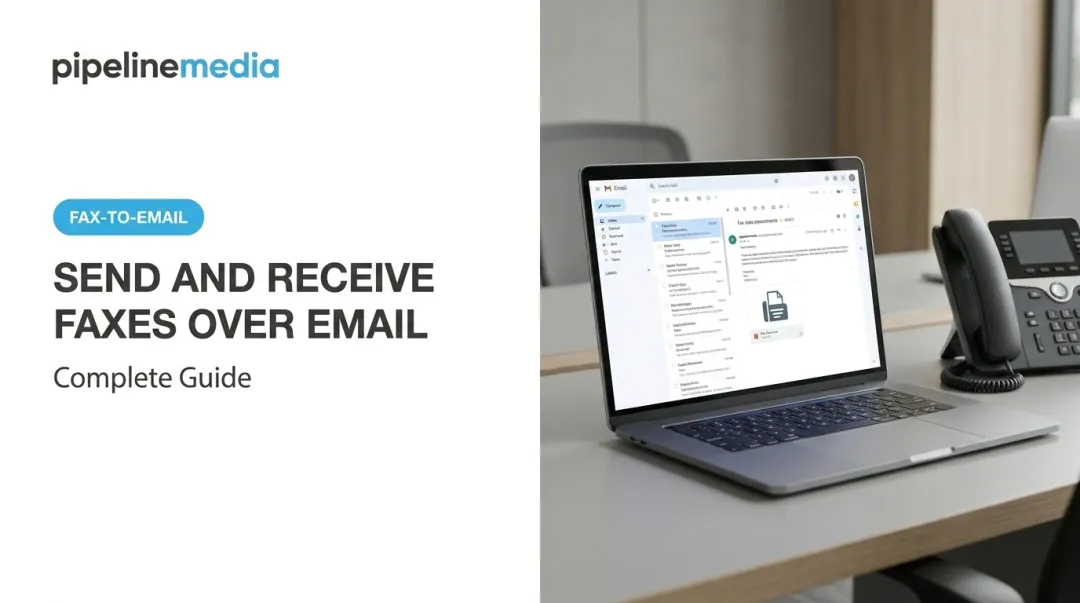
Pipeline Media's Fax-To-Email service reflects this model directly. The Standard Plan runs $10 USD/month for 100 incoming and 100 outgoing pages, while the Pro Plan is $20/month for 250 pages each way. Both come with no setup fee, work across US and Canadian city numbers, and can be cancelled anytime — no contract lock-in.
Fax Broadcasting for Business Communications
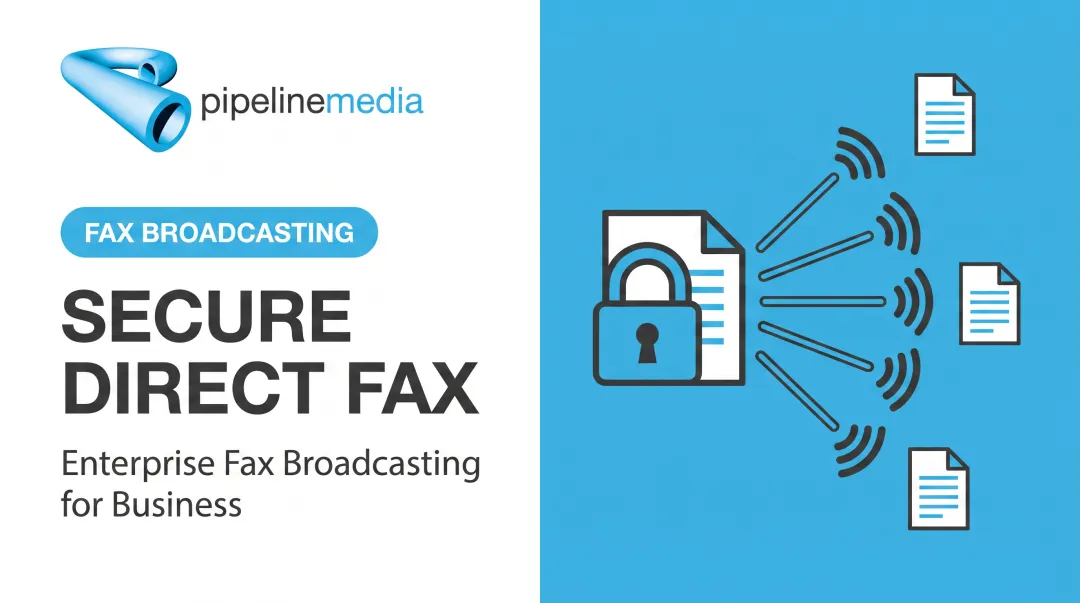
Fax broadcasting sends the same document to a large recipient list simultaneously. It's built for scale, not one-off transmissions.
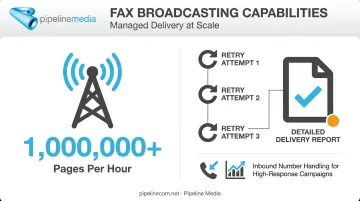
Pipeline Media's Fax Broadcast service handles this at a capacity of over 1 million pages per hour, which means large recipient lists receive documents almost simultaneously rather than trickling in over hours. The service also manages inbound fax handling through a dedicated inbound number, which is particularly useful for campaigns generating high response volume, like completed surveys or subscription renewals.
What separates a managed broadcast service from a DIY setup is what happens when numbers fail. Pipeline retries every problem number three times, free of charge, then delivers a detailed report showing exactly who received the document, who didn't, and why. No physical fax machine required on either end.
Comparing the three methods:
| Method | Cost Profile | Scalability | Best Fit |
|---|---|---|---|
| Traditional machine | Ongoing line, toner, paper costs | Low — one document at a time | Occasional, low-volume sending |
| Online/cloud fax | Low monthly subscription | Moderate — individual or small team use | Distributed teams needing flexibility |
| Fax broadcasting | Managed service pricing | High — thousands of recipients per run | Bulk announcements, compliance notices, large-scale outreach |
How to Send and Receive a Fax From Your Phone or Computer
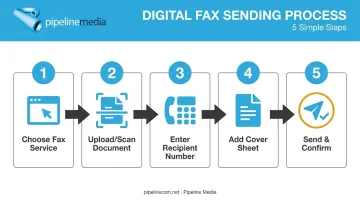
Sending a fax digitally follows a simple sequence:
- Choose a fax service or app that matches your volume needs
- Upload or scan your document — most platforms accept drag-and-drop uploads
- Enter the recipient's fax number, double-checking country and area codes for international sends
- Add a cover sheet with sender and recipient details
- Send and monitor for a delivery confirmation
Receiving works similarly in reverse. Your provider assigns a dedicated fax number tied to an email inbox or app, such as Pipeline Media's Fax-To-Email service. Incoming faxes then arrive as email attachments or in-app notifications, so no printer is required unless you specifically want a hard copy.
File format matters for reliable delivery. Most services support:
- PDF — the safest choice, since it preserves layout consistently across fax gateways
- Word documents — widely supported but occasionally reformatted during conversion
- Common image files (JPG, PNG) — fine for simple documents, less reliable for dense text
Sticking with PDF reduces the odds of a garbled transmission on the receiving end.
Fax Security, Compliance, and Best Practices
Fax has a reputation for being more secure than email, and there's a technical reason why. A traditional fax connection is point-to-point over the PSTN — it doesn't sit in a searchable inbox the way an email can, and it isn't as easily intercepted in transit as many assume email is.
But here's the nuance regulators actually care about: neither fax nor email is automatically compliant with anything. HHS guidance permits faxing PHI for treatment purposes, provided reasonable safeguards are in place — not because fax has some magic compliance shield, but because the safeguards make it acceptable. The same HHS guidance permits emailing e-PHI over open networks when it's adequately protected.
Security is a process, not a property of the medium. That applies equally to fax and email.
Why Regulated Industries Still Lean on Fax
Financial services, legal, healthcare, and government organizations continue to require fax because it satisfies specific compliance and legal-recognition needsthat many digital-first channels haven't fully replicated. Signature validity and audit trails are the two areas where fax still holds a legal edge.
Fax Best Practices Checklist
- Always include a cover sheet with complete sender and recipient details
- Double-check the fax number before sending, especially for international destinations
- Confirm delivery status rather than assuming success
- Never send unencrypted sensitive data over an unsecured line
- Test new fax setups with a short document before launching a large or time-sensitive campaign
Choosing a Provider With Real Accountability
Confirming delivery status only works if your provider actually tells you what happened. Not all providers handle failure the same way, and this is where the checklist above meets real-world accountability. Pipeline Media retries failed fax numbers three times at no extra cost and provides detailed delivery reports after every broadcast, showing exactly who received the fax and the specific reason behind any failure. For industries where documentation matters as much as delivery, that reporting layer often becomes the deciding factor in choosing a provider.
Common Fax Problems and How to Fix Them
Most fax failures fall into predictable categories, and most are fixable without a support call.
Outbound issues:
- Unsupported file types — convert exotic formats to PDF or DOC before sending; these two are accepted almost everywhere
- Oversized attachments — many services cap combined file size around 50 MB; compress or split large jobs
- Mixed page orientation — keep all pages consistently portrait or landscape before sending
- Incorrect international dialing — missing access codes or country codes are a leading cause of failed international faxes
Inbound issues:
- Numbers not configured to receive — verify the receiving line or service is actually set up for inbound fax, not just outbound
- Busy signals — common during high-volume response periods; a dedicated toll-free inbound number avoids this
- Rate/protocol mismatches — if sender and receiver can't negotiate a compatible transmission speed, the fax stalls
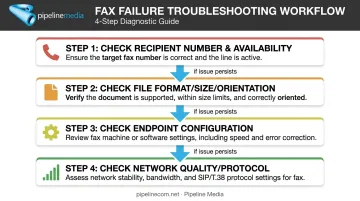
When a fax fails, work through the cause in this order:
- Check the recipient number and availability — confirm the number is correct and actively receiving faxes
- Check the file — verify format, size, and page orientation
- Check endpoint configuration — confirm both sending and receiving lines are set up correctly
- Check network quality — rule out rate or protocol mismatches last
Sending a short test fax before a large campaign catches most of these issues before they affect the full send. Managed broadcast services typically build this testing step in, along with automatic retries for numbers that fail on the first attempt.
Frequently Asked Questions
What is a phone fax?
A phone fax refers to sending a fax over a traditional telephone line connection, using the classic analog method. It's distinct from online faxing, which transmits your document over the internet instead.
Can I fax from my phone for free?
Some apps offer limited free faxes or short trials, but consistent, reliable business faxing typically requires a paid plan, since free tiers rarely include the delivery guarantees regulated industries need. Paid fax-to-email plans, often starting around $10/month, provide the reliability and page volume most businesses need.
Is faxing still relevant in 2024?
Yes. Fax remains standard in healthcare, legal, and government sectors because of compliance requirements and legal recognition of faxed signatures and documents that many digital channels still lack.
Is online faxing secure?
Online fax providers that use encryption and secure transmission protocols can be more secure than standard email. That said, security depends on the provider's specific safeguards, not just the channel.
What is fax broadcasting used for?
Fax broadcasting sends one document to many recipients simultaneously, commonly used for business announcements, alerts, or large-scale outreach. It's built for volume rather than individual transmissions.
What file formats can I send in a fax?
Most fax services support PDF, Word documents, and common image formats like JPG or PNG. PDF is generally recommended since it preserves formatting most reliably across different systems.