Here's the honest answer: no one can promise 100% inbox placement. Not your email service provider, not a marketing agency, not even Gmail itself. But specific practices — and the right partner — can get you remarkably close.
This guide breaks down what deliverability actually means, the practices that move the needle, and what to do when a message goes missing.
Key Takeaways
- No ESP or agency can legally guarantee 100% delivery — recipient inbox providers control the final decision
- Delivery rate (server acceptance) and deliverability (inbox placement) are different metrics with different stakes
- Sender reputation, list hygiene, authentication, and engagement are your biggest controllable levers
- Outsourcing to a full-service provider removes the technical burden of authentication, monitoring, and list management
Email Delivery vs. Deliverability — And Why "Guarantee" Is the Wrong Question
These two terms get used interchangeably, but they measure completely different things.
Delivery rate tracks whether the receiving mail server accepted your message. Deliverability (also called inbox placement) tracks whether that message actually landed in the primary inbox — not spam, not a promotions tab, not nowhere.
A message can be "delivered" 100% of the time and still land in spam. This is why a provider's "100% delivery guaranteed" claim can be misleading marketing language rather than a meaningful promise.
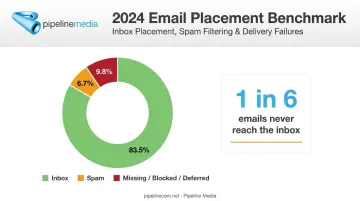
The scale of the problem is bigger than most people assume. Validity's global benchmark measured 83.5% inbox placement, 6.7% spam placement, and 9.8% missing mail in 2024 — meaning 16.5% of legitimate marketing email never reached the inbox at all. That's roughly one in six messages, even from senders following the rules.
Here's the breakdown:
| Placement | 2024 Rate |
|---|---|
| Inbox | 83.5% |
| Spam | 6.7% |
| Missing (blocked/deferred) | 9.8% |
Permission-based sending helps, but it doesn't insulate you from this reality. The senders who fare best combine clean lists with active compliance management — unsubscribe handling, authentication, and consistent monitoring — which is exactly where a managed email broadcasting service like Pipeline Media's earns its keep.
Why No ESP or Agency Can Promise 100% Delivery
Several factors sit entirely outside any provider's control:
- Recipient spam filter settings — individual users can mark senders as spam regardless of your reputation
- ISP-side outages or policy changes — Gmail, Outlook, and Yahoo update filtering algorithms constantly
- Mailbox health — full inboxes, invalid addresses, or inactive accounts block delivery no matter what you send
- Machine learning filters — modern spam detection adapts based on aggregate user behavior, not just your sending practices
Major mailbox providers say this outright. Google states it "can't guarantee messages sent by email providers will pass Gmail's spam filters," while Microsoft says submitting sender information "does not guarantee" inbox delivery to Outlook.com users. Yahoo goes further, noting that even a strong reputation review "still doesn't guarantee inbox delivery."
If Google, Microsoft, and Yahoo won't guarantee inbox placement on their own platforms, no third-party ESP or agency can override that.
Treat any "100% guaranteed deliverability" claim as a red flag, not a selling point. It's a sign the provider either doesn't understand how mailbox filtering works or is comfortable overpromising to close a deal.
What a reputable agency can do is stack the odds in your favor: clean list management, compliance with unsubscribe regulations, and pre-send testing. That's the standard Pipeline Media's email broadcasting team works to on every campaign.
Best Practices to Maximize Your Email Deliverability
You can't control the filters. You can control everything that feeds into them.
Build Permission-Based Lists
Use double opt-in so every recipient actually chose to hear from you. This single habit directly reduces spam complaints, which is one of the heaviest signals mailbox providers weigh.
Keep Your List Clean
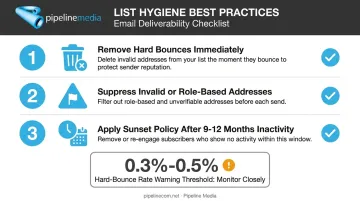
Sloppy data is the fastest way to torch a sender reputation. Validity flags hard-bounce rates above 0.3%-0.5% as a warning sign of poor list hygiene. To stay ahead of it:
- Remove hard bounces immediately, not at the end of a campaign
- Suppress invalid or role-based addresses (info@, admin@)
- Apply a sunset policy for subscribers who've gone quiet for 9-12 months
Authenticate Every Sending Domain
SPF, DKIM, and DMARC tell mailbox providers you're a legitimate sender, not an impersonator. This isn't optional anymore. Since February 2024, Gmail requires SPF or DKIM for all senders, and SPF, DKIM, and DMARC for anyone sending 5,000+ messages daily to personal Gmail accounts. Yahoo enforces nearly identical rules.
Write Content That Doesn't Trip Filters
- Avoid spam-trigger words and excessive punctuation or all-caps subject lines
- Include a real, monitored reply-to address
- Format emails in both HTML and plain text
- Add a working one-click unsubscribe link (now required by Gmail and Yahoo)
Send on a Consistent Cadence
Sudden volume spikes look suspicious to ISPs. Gmail specifically warns against doubling your previous send volume overnight, since it can trigger rate limiting and reputation drops.
Consistent sending only works if you know how subscribers are actually responding to it.
Monitor Engagement Before You Prune
Track opens, clicks, and complaints closely. Run a re-engagement campaign before removing cold subscribers entirely: sometimes a well-timed "we miss you" email revives a dormant contact instead of losing them for good.
Agencies managing bulk sends on a client's behalf, including services like Pipeline Media's Email Broadcasting, build these checks (authentication, list hygiene, unsubscribe compliance) directly into every campaign, so the burden of tracking each factor doesn't fall on one in-house team.
How to Ensure Your Emails Actually Reach the Inbox
"Ensuring" delivery isn't one fix. It's stacking the odds through ongoing technical and content discipline.
Warm Up New IPs and Domains Gradually
Never launch a new sending domain at full volume. Start small with your most engaged contacts, then scale up over several weeks. This gives mailbox providers time to build trust in your sending pattern instead of flagging you as a sudden, unknown source.
Check Your Sender Reputation Regularly
Once your domain is warmed up, ongoing monitoring keeps it that way. Free tools catch problems before they become full-blown blacklist issues:
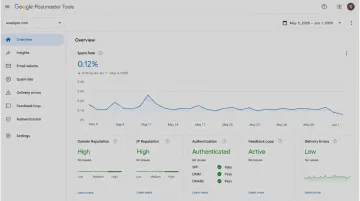
- Google Postmaster Tools: spam rate, domain reputation, authentication status
- Sender Score by Validity: reputation scoring and blocklist lookups
- MXToolbox: checks your IP against dozens of DNS blocklists
Segment and Personalize
Recipients engage more with relevant content. A healthcare client emailing appointment reminders to patients sees far higher open rates than a generic blast to an entire contact list.
Higher engagement reinforces good sender reputation over time, creating a feedback loop that compounds in your favor.
Consider a Managed Partner
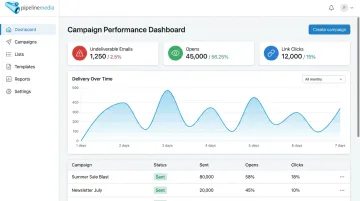
Most businesses don't have a dedicated deliverability specialist on staff, and that's fine, it's not their core job. This is where a full-service provider earns its keep. Pipeline Media's email broadcasting service handles the entire send: clients provide their list, message, and graphics, and the team manages setup, testing, and execution, with jobs typically running in 60-90 minutes even at volumes of millions of emails per hour. Every campaign includes tracking reports on undeliverable emails, opens, and link engagement, giving clients visibility without requiring them to become deliverability experts themselves.
What to Do If an Email Doesn't Arrive
Missing mail happens even with good practices. Here's how to diagnose it:
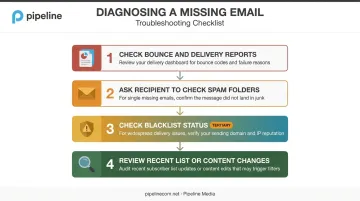
- Check bounce and delivery reports first: determine whether it's a hard bounce (permanent failure), a soft bounce (temporary issue like a full inbox), or a message that landed in spam
- For a single missing email, ask the recipient to check spam, junk, or promotions folders and whitelist your sending address
- For widespread delivery failures, investigate whether your domain or IP landed on a blacklist — tools like Spamhaus and Barracuda offer lookup and delisting processes
- Review recent changes to your list or content that might have triggered filters, and run future campaigns through a spam-checker before sending at scale
Running through these steps manually takes time your team may not have. Pipeline Media's tracking reports flag undeliverable emails automatically, and a real person responds to service requests within minutes, not days spent waiting on a support ticket.
How a Full-Service Partner Like Pipeline Media Improves Your Odds
Deliverability is a moving target. Mailbox providers change their rules, authentication requirements tighten, and list hygiene needs constant attention. Managing all of that in-house is a full-time job most businesses don't have room for.
Pipeline Media's email broadcasting service takes that workload off clients' plates:
- List and compliance management: staying current with email regulations and managing the unsubscribe system directly
- Quality control: jobs are tested and retested before launch to catch errors before they affect delivery
This kind of hands-on management is easier for a team with deep experience. Pipeline Media has operated since 2003, building expertise across regulated industries, including Financial Services, Healthcare, and Government, where reliable, compliant communication isn't negotiable. That track record matters when you're sending sensitive information at scale and need a partner who understands the stakes.
Frequently Asked Questions
How to ensure email delivery?
Focus on clean, permission-based lists, proper authentication (SPF, DKIM, DMARC), consistent sending patterns, and engaging content. Monitor sender reputation regularly rather than treating it as a one-time setup.
What to do if an email doesn't arrive?
Check bounce reports first to identify the failure type. Ask the recipient to check spam folders and whitelist your address. If it's affecting many recipients, check for blacklist issues.
Can any company really guarantee 100% email deliverability?
No. Legitimate providers won't make this claim because recipient-side spam filters and ISP policies are outside anyone's control. Treat guarantees of 100% delivery as a warning sign.
What's the difference between email delivery and email deliverability?
Delivery measures whether the receiving server accepted your message. Deliverability measures whether it actually reached the inbox. A message can be delivered but still land in spam.
How often should I clean my email list to protect deliverability?
Remove hard bounces immediately after each send. Run re-engagement campaigns quarterly for subscribers who've been inactive for several months before removing them entirely.
Does using a full-service email provider improve deliverability compared to sending in-house?
Often, yes, since a managed provider brings established sending infrastructure and ongoing monitoring that in-house teams often lack. Pipeline Media's email broadcasting service, for example, handles authentication, tracking, and unsubscribe compliance so businesses avoid the common errors that hurt deliverability.