Introduction
Over 5.79 billion people now use social media worldwide. A large share of them research brands and products directly on these platforms before ever visiting a website.
That's a massive audience. Posting content and generating leads, though, are two very different things. Many businesses struggle with this exact gap: they post consistently, gain followers, and still see almost none of that activity turn into an actual sales conversation.
Common culprits include unclear targeting, generic offers, and lead forms that ask for too much before delivering any value in return.
This guide covers the specific steps to generate leads on social media, when the approach makes sense for your business, the factors that most influence results, mistakes worth avoiding, and alternatives if you'd rather have this handled for you.
Key Takeaways
- Platform fit matters more than posting volume: match your audience to where they actually spend time
- Native lead forms typically cut cost-per-lead well below external landing pages
- Fast follow-up determines whether a captured lead converts or goes cold
- Follower counts and likes rarely correlate with lead quality or revenue
- Limited marketing bandwidth is a common reason teams outsource social lead work to a management partner
How to Generate Leads Using Social Media
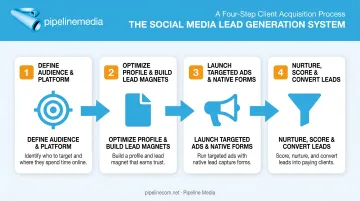
Generating leads on social media requires a connected system. Skip one step and the whole funnel leaks.
Step 1: Define Your Target Audience and Choose the Right Platform(s)
Before creating a single post, build buyer personas covering:
- Demographics: age, location, income, job title
- Pain points: the specific problems your product or service solves
- Buying behavior: research habits, decision timeline, budget authority
Then match each persona to the platform where they're already active:
| Platform | Best fit | Notable data point |
|---|---|---|
| B2B decision-makers | 89% of B2B marketers use it for lead generation, and 62% say it generates leads effectively | |
| Instagram/Facebook | Consumer, visual products | Consistently ranked among top-performing platforms for lead generation and engagement |
| TikTok | Younger, discovery-driven audiences | Roughly 2 in 5 users convert into leads after actively searching on the platform |
Before launch, set specific KPIs: target cost-per-lead, monthly lead volume, and conversion rate. Without these numbers, you can only tell whether a campaign feels busy, not whether it works.
Step 2: Optimize Profiles and Build Lead Magnets
Your profile is often the first thing a prospect checks after clicking an ad. A half-finished bio with no clear next step wastes that attention.
- Complete every bio field, add contact details, and link to a landing page, booking calendar, or lead form
- Use industry keywords in your description so prospects searching the platform can find you
- Build at least one gated asset (a checklist, short guide, webinar, or discount code) that solves one specific problem for your ideal buyer
- Keep branding, tone, and messaging consistent across every platform you use
A generic "10 tips" PDF rarely moves anyone. A calculator, template, or free audit tied to a real pain point does.
Step 3: Launch Targeted Ads and Use Native Lead Capture Tools
Organic reach only goes so far. Paid ads with layered targeting (job title, interests, behaviors, and website retargeting) put your offer in front of people who are already close to a decision.
Where the click lands matters just as much as who clicks. Native lead forms, such as LinkedIn Lead Gen Forms or Meta Lead Ads, pre-fill contact details and keep the whole process on-platform.
Advertisers running both instant-form and website-form campaigns together saw 60% lower cost-per-lead and 125% higher lead volume than those relying on website forms alone.
Run several ad variations simultaneously instead of betting on one "best guess" creative. Monitor performance early, then shift budget toward whichever combination of image, copy, and offer is actually converting.
Step 4: Nurture, Score, and Convert Captured Leads
Capturing a lead is only half the job. What happens over the next few days decides whether that contact becomes a customer or forgets you exist.
- Sync contacts immediately into a CRM or email platform so nurture sequences start automatically
- Score leads by engagement level and fit with your ideal customer profile before passing them to sales
- Track conversion data over time and route those insights back into your targeting and content decisions
Skip this step, and your cost-per-lead numbers will look fine on a spreadsheet while your actual pipeline stays empty.
When and Why Social Media Lead Generation Works Best
Social media lead generation isn't ideal for every business. Results hinge on audience size, sales cycle length, and the time and budget you can commit.
It works especially well for:
- B2B companies with longer sales cycles, where content builds familiarity across touchpoints before a demo or sales call
- B2C brands with visual or impulse-friendly products, where one strong image or video can drive a same-session decision
- Service firms that nurture warm prospects with educational posts, case studies, and clear offers
It becomes less efficient for:
- Hyper-local businesses with a small addressable audience (a neighborhood plumber doesn't need national ad reach)
- Heavily regulated industries that need extensive compliance review before campaigns, such as financial firms under FINRA rules
- Teams that can't respond quickly when new leads come in
Before starting, lock in three fundamentals:
- A defined ideal customer profile
- A system for tracking and following up on leads
- A realistic budget and time commitment for content and ads
Key Factors That Affect Your Social Media Lead Generation Results
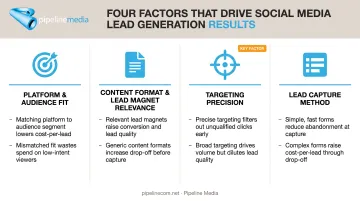
Outcomes come down to a handful of controllable variables.
Platform and audience fit. Leads convert well only when the platform's user base matches your buyer profile. A B2B software company running lead ads to a mostly teenage audience burns budget fast. Mismatched platforms inflate cost-per-lead and lower lead quality, even with strong creative.
Content format and lead magnet relevance. Generic offers get ignored. "Sign up for our newsletter" rarely convinces anyone to hand over contact details. Specific, problem-solving assets drive stronger opt-in rates because they fix one real problem immediately:
- Pricing calculators
- Compliance checklists
- Free audits
Targeting precision. Layered targeting by role, behavior, and past website visits filters out low-intent traffic before it sees your ad. Going too narrow can backfire. Broadening detailed targeting or using lookalike audiences often improves auction dynamics and lowers costs. Done right, precision cuts wasted spend and lifts lead-to-customer conversion.
Lead capture method. Friction kills conversions. Extra clicks, slow-loading pages, and forms with ten required fields cause prospects to abandon halfway through. Native, pre-filled lead forms consistently outperform external landing pages, and they are one of the easiest levers you control.
Common Mistakes to Avoid When Generating Leads on Social Media
Even a solid strategy fails when execution slips. Four mistakes show up again and again:
- Broadcasting instead of engaging: Promo-only posts with no replies to comments or DMs signal a one-way channel that suppresses reach and erodes trust.
- Skipping native forms: Sending traffic to a slow or generic landing page instead of built-in lead-capture tools causes drop-off right when a prospect is ready to convert.
- Chasing vanity metrics: Likes and follower counts feel good but don't pay the bills. Track cost-per-lead, lead quality, and downstream conversion instead.
- Following up too slowly: According to a 2025 Forbes analysis of MIT research, contacting a lead within five minutes makes a connection five times more likely, yet many teams let leads sit for days.
Alternatives to Running Social Media Lead Generation In-House
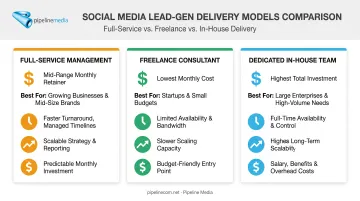
Not every business has the time, tools, or in-house expertise to run this process week after week. Depending on budget and internal capacity, a few alternative models make sense.
Full-Service Social Media Management
When it's better: Fits businesses without dedicated marketing staff that want a consistent, professional brand presence without managing it themselves day to day.
Pipeline Media, for example, runs a Social Media Presence package at $500/month across Instagram, Facebook, X, and LinkedIn. The package typically covers:
- Custom content creation and scheduled posting
- On-brand captions
- Comment and inbox monitoring
It focuses on brand credibility and consistency rather than dedicated lead-capture campaigns. If lead volume is the priority, discuss paid ad management and conversion-focused tactics on a free consultation call before signing on.
Key trade-offs: A predictable monthly cost in exchange for hands-off execution and freed-up internal time. Confirm the exact scope of any lead-generation work upfront.
Freelance Social Media Consultant
When it's better: Suits smaller budgets that need part-time, flexible support rather than a full program.
Key trade-offs: Lower cost, but less accountability, limited scalability as needs grow, and availability that can be inconsistent during busy stretches.
Dedicated In-House Marketing Team
When it's better: Fits larger organizations with the budget to build specialized internal expertise and their own toolset.
Key trade-offs: Higher fixed costs (the average social media manager salary alone runs around $54,600 a year, per Forbes Advisor), plus a longer ramp-up period before campaigns hit their stride.
Whichever route you choose, consistency, fast follow-up, and clear tracking are what separate a working lead-gen program from one that just looks busy.
Frequently Asked Questions
What is social media lead generation?
Social media lead generation is the process of attracting, engaging, and converting social users into contactable prospects. It relies on content, paid ads, and platform lead-capture tools like native forms.
What is the 5-3-2 rule on Instagram?
The 5-3-2 rule is a content-mix guideline: for every 10 posts, 5 share curated or value-add content from others, 3 are original brand content, and 2 are personal, behind-the-scenes posts.
How much should you pay for lead generation?
Costs vary by platform and industry. Facebook lead campaigns average roughly $28 per lead, with industry ranges spanning from about $3 to over $75. Targeting, offer type, and competition all move that number.
Which social media platform is best for lead generation?
LinkedIn tends to lead for B2B, given its high adoption among B2B marketers. Facebook, Instagram, and TikTok generally perform better for consumer-facing, visual, or impulse-driven offers.
How can I generate leads on social media for free?
Optimize your profiles, engage directly in comments and DMs, share genuinely useful content, and use free native lead tools — no ad budget required, just consistent effort.
How long does it take to see results?
Organic efforts usually need 4–12 weeks to build real momentum. Paid campaigns can produce leads much sooner, but still need ongoing optimization to keep quality high.