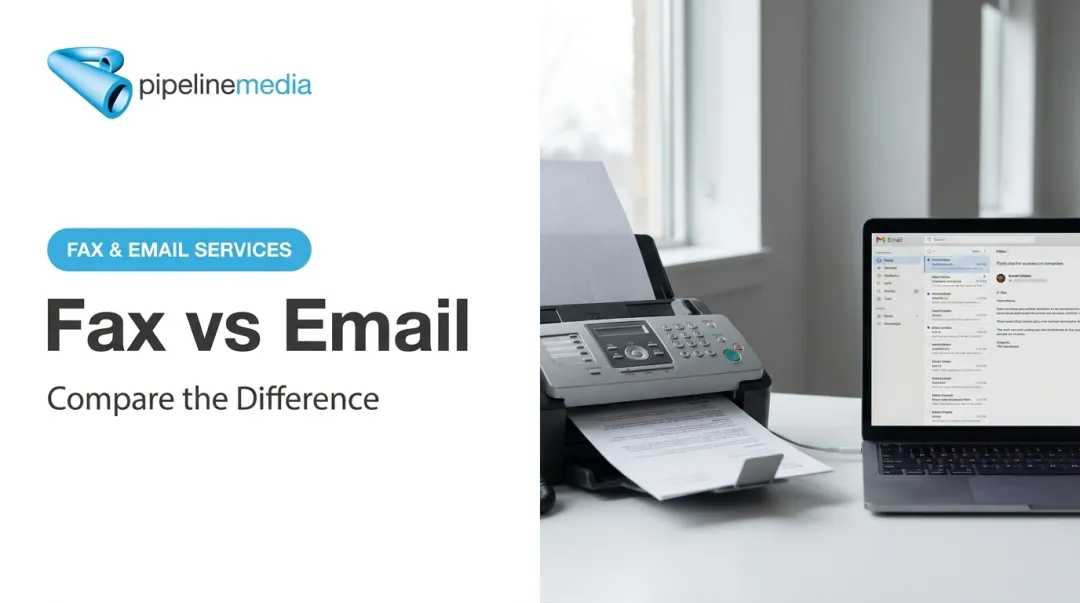
But "fax" doesn't mean one thing anymore. Businesses today choose between the analog machine bolted to the wall and cloud-based digital faxing that runs from a laptop or phone.
That choice affects more than convenience. It touches your monthly costs, document security, compliance exposure, and how fast your team gets paperwork where it needs to go. Get it wrong, and you're either overpaying for outdated hardware or exposing sensitive documents to compliance risk.
This guide breaks down both options so you can pick the right one for your business.
Key Takeaways
- Traditional fax needs physical hardware and a phone line; digital faxing works over the internet from any device
- Digital faxing typically costs less and adds encryption, audit trails, and delivery tracking
- Low-volume offices with existing equipment often stick with traditional fax for now
- 89% of medical organizations still rely on fax machines for daily operations
- Managed fax broadcasting services let businesses scale volume without owning any equipment
Traditional Fax vs Digital Faxing: Quick Comparison
Before diving deep, here's the side-by-side breakdown most businesses need first.
| Factor | Traditional Fax | Digital Faxing |
|---|---|---|
| Cost | Hardware, phone line, paper, toner, maintenance | Low monthly fee or per-page rate, no hardware |
| Technology | Physical machine + analog phone line | Any internet-connected device |
| Speed | One transmission at a time, busy signals common | Multiple simultaneous transmissions |
| Security | No encryption, documents exposed on the tray | Encrypted transmission, audit trails |
| Accessibility | Tied to one location | Send/receive from anywhere online |
Cost Breakdown
A traditional analog fax line runs roughly $60 per month, or about $720 per year — and that's before paper, toner, and repair costs. Digital services typically undercut that significantly, with Fax-To-Email plans, for instance, can start around $10/month for a set page allowance.
Security & Compliance Snapshot
This is where the two methods diverge sharply:
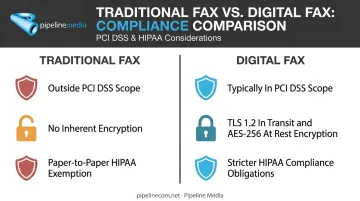
- PCI DSS scope: Standard phone line (PSTN) transmissions generally fall outside PCI DSS scope, while VoIP and digital fax transmissions are typically in scope
- Encryption: Analog fax has no inherent encryption; digital fax commonly uses TLS 1.2 in transit and AES-256 at rest
- HIPAA classification: Paper-to-paper faxing may not trigger covered-entity obligations the same way digital faxing does, changing how your compliance team needs to handle it
What is Traditional Fax?
Traditional fax sends scanned documents over a telephone line using the Public Switched Telephone Network (PSTN) and the T.30 transmission standard. A physical machine converts your paper document into an analog signal, dials a receiving number, and transmits page by page.
Regulated industries stick with it for a simple reason: established legal acceptance. A faxed document produces a tangible, timestamped physical copy that courts and regulators have treated as admissible for decades. Federal Rule of Evidence 1003 supports duplicates being treated similarly to originals, provided authenticity isn't in question, though the rule doesn't specifically name fax as a category.
Use Cases of Traditional Fax
Traditional fax hasn't disappeared from certain workflows:
- Doctor's offices transmitting prescriptions, referrals, and patient records
- Law firms sending signed contracts and court filings
- Government departments processing forms requiring physical signatures
Usage data confirms this staying power. 75% of medical communication still happens via fax, according to TechTarget's healthcare technology reporting, and 89% of medical organizations report using fax machines in daily operations. Legacy habits, established workflows with pharmacies, and compliance familiarity all keep the machines running.
What is Digital Faxing?
Digital faxing — also called online fax, eFax, or Fax over IP — sends and receives documents electronically over the internet. No landline. No physical machine sitting in a corner collecting dust. It typically uses the T.38 standard for real-time packetized transmission over IP networks.
Core benefits:
- Eliminates hardware and maintenance costs entirely
- Lets teams fax from any device — laptop, tablet, phone
- Adds encryption and delivery tracking that reduces compliance exposure
- Removes the single-line bottleneck of busy signals
Digital faxing shows up in a few different forms: web portal faxing, email-to-fax setups, mobile apps, and outsourced fax broadcasting for businesses sending high volumes. Pipeline Media covers most of these formats directly, with two service tiers built for different volume needs.
How Pipeline Media Handles This
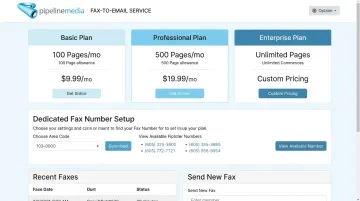
Pipeline Media's Fax-To-Email service lets businesses send and receive faxes from any computer, phone, or tablet — no fax machine required. It's structured as a straightforward subscription:
- Standard Plan: $10 USD/month, 100 incoming and 100 outgoing pages, one dedicated fax number
- Pro Plan: $20 USD/month, 250 incoming and 250 outgoing pages, one dedicated fax number
Both plans skip the setup fee, and clients can cancel anytime. Exceed your page limit and you're billed per extra page rather than getting shut off: $0.10 per page on Standard, $0.08 on Pro.
For businesses sending in bulk, Pipeline's Fax Broadcast service handles over 1 million pages per hour, with detailed delivery reports flagging exactly which recipients received the fax, why any failed, and automatic free retries on problem numbers — up to three attempts per number, no extra charge.
Use Cases of Digital Faxing
Digital faxing fits naturally into:
- Remote and hybrid teams who need to send faxes without a shared office machine
- Multi-location businesses centralizing fax management under one system
- High-volume senders — insurance renewals, marketing announcements, bulk regulatory notices
- Financial services and healthcare organizations managing distributed staff across regions
One Pipeline Media client, Andy R. from Detroit, described eliminating fax machines across five offices entirely: "Now everyone has their own personal fax number which allows our reps to send/receive faxes on the road." That's the mobility argument in practice, not theory.
On the efficiency side, vendor data from OpenText's work with the University of Kansas Health System showed a 90% reduction in IT maintenance workload after migrating to cloud fax. Other reported case studies point to roughly 30% cost savings from eliminating PSTN lines altogether.
Traditional Fax vs Digital Faxing: Which Is Better?
There's no universal winner here. The right answer depends on three things: your fax volume, how mobile your team needs to be, and your industry's compliance requirements.
Choose traditional fax if:
- Your office sends low volumes and already owns the hardware
- You need occasional physical copies purely for compliance record-keeping
- Your workflow is tied to one physical location with no plans to change
Choose digital faxing if:
- Your team works remotely or across multiple offices
- You're sending high volumes and need speed without busy signals
- You need stronger security features — encryption, audit trails, delivery confirmation
- You want to cut long-term hardware and paper costs
Example Scenario: Switching to Digital Faxing
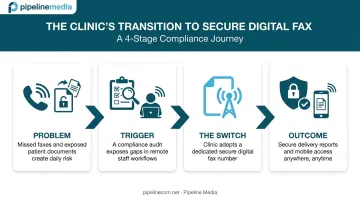
These trade-offs play out clearly in practice. Picture a mid-sized healthcare clinic network running patient referrals and prescription confirmations through a single analog fax line at each of its three locations.
The problem: Busy signals during peak referral hours led to repeated redialing. Printed faxes also sat unattended on the machine tray, a compliance flag during an internal audit that questioned unattended PHI exposure.
The trigger: A compliance review recommended reducing physical document exposure. At the same time, the clinic network was adding two remote administrative staff who couldn't access the office fax machine at all.
The switch: A managed fax-to-email setup gave each location a dedicated digital fax number. Remote staff could send and receive from home, and delivery reports replaced guesswork about whether a referral actually went through.
The outcome: No more busy-signal bottlenecks during peak hours, no printed documents left exposed, and remote staff handling referrals without missing a single fax.
Pipeline Media handles this type of transition regularly, providing detailed delivery reporting, automatic free retries on failed numbers, and fast setup support for clients making the switch.
Conclusion
Neither method is objectively "better" in every scenario. Traditional fax still earns its place in low-volume offices with existing hardware and compliance routines built around physical copies. Digital faxing wins for businesses prioritizing cost savings, mobility, and stronger security controls.
What matters is connecting the decision to real business outcomes:
- Lower monthly operating costs
- Faster document turnaround
- Less compliance risk from unattended paperwork
Outsourcing fax management — through a fax-to-email subscription or full-service broadcast provider — lets you capture digital faxing's advantages without managing the technology in-house.
If you're weighing this switch, Pipeline Media offers a free phone consultation across North American time zones to walk through what fits your volume and compliance needs.
Frequently Asked Questions
What is the difference between traditional fax and eFax?
Traditional fax uses a physical machine and phone line to send paper documents. eFax, or digital fax, sends and receives documents electronically over the internet with no hardware required.
How does traditional fax work?
A fax machine scans a paper document, converts it into an analog signal, and transmits it over a phone line to a receiving machine, which reproduces it as a printed copy.
Is digital faxing as secure as traditional faxing?
Digital faxing can be more secure thanks to encryption, audit trails, and compliance certifications. Traditional fax risks leaving printed documents exposed on an unattended machine.
Can I switch from traditional fax to digital faxing without changing my fax number?
Many digital fax providers support porting an existing number, though this varies by provider. Confirm number porting directly with your provider before switching.
Which industries still rely on traditional fax?
Healthcare, legal, insurance, and government sectors still use fax heavily, largely due to compliance habits and legally recognized documentation standards.
How much does digital faxing cost compared to traditional fax?
Traditional fax involves hardware, paper, toner, and phone line fees that add up over time. Digital faxing typically runs on low monthly subscriptions, such as Pipeline Media's Fax-To-Email plans starting at $10 USD/month, with no hardware investment.