The good news: you don't need a phone line to fax anymore. Traditional fax machines were built around analog telephone infrastructure, but internet-based alternatives have made landlines completely optional.
This guide breaks down why fax traditionally needs a phone line, which internet fax solutions eliminate that requirement, and how to pick the right option for your business.
Key Takeaways
- Traditional fax machines need an active analog phone line to send and receive documents
- Online fax services let you send and receive faxes using only an internet connection, no phone line or machine required
- Cutting your landline doesn't mean losing secure, compliance-ready document sharing
- Full-service providers like fax-to-email platforms handle bulk faxing so you never manage hardware or software
Do You Need a Phone Line to Fax? Understanding Traditional Faxing
Traditional fax machines convert your documents into audio tone signals, then transmit those signals over the Public Switched Telephone Network (PSTN). This process, standardized under ITU-T's T.30 specification, requires a dedicated analog phone line to function.
That high-pitched screeching sound you remember from old fax machines? That's literally the data transmission happening in real time.
So, do you need a special phone line for a fax machine? Yes. A physical fax machine needs an active analog line, and most manufacturers recommend a dedicated line separate from voice service.
Brother specifically advises using "a separate line with no custom features," since signals from services like call waiting can interrupt fax transmissions mid-send. HP notes similar conflicts can occur when automatic fax reception clashes with voicemail on shared lines.
Why Businesses Are Moving Away from Landlines
The numbers tell the story. According to FCC data, retail switched-access lines in the U.S. dropped from 73.37 million in 2014 to just 16.4 million by the end of 2024, a decline of roughly 77.7% in a single decade. Business and government lines alone fell nearly 75% during that same window.
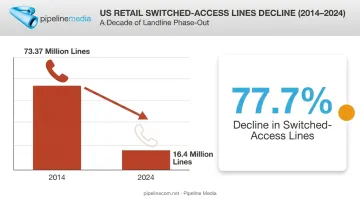
This marks an active phase-out, not a slow fade:
- Telecom carriers are discontinuing POTS lines in favor of VoIP and internet-based services
- Copper infrastructure is aging and expensive to maintain, prompting providers to retire it entirely in certain regions
- Regulatory bodies have approved service withdrawals in specific markets, cutting off new landline orders
Yet fax itself hasn't disappeared. Healthcare, finance, legal, and government sectors still lean on it heavily. Research from HealthIT.gov found that roughly 35% of U.S. office-based physicians in 2019 relied exclusively on fax, mail, or e-fax to share patient information with outside providers.
That creates a real tension: fax remains essential, but the phone lines it depended on are vanishing. The solution lies in decoupling fax from the landline entirely.
How to Fax Without a Phone Line: Internet Fax Solutions
Internet fax, sometimes called "e-fax," uses cloud servers to send and receive faxes over an internet connection instead of a phone line. Two ITU-T standards make this possible: T.37 for store-and-forward transmission and T.38 for real-time fax delivery over IP networks.
In practice, this means no analog line, no dial tone, no busy signals. Just your document and an internet connection.
Option 1: Online Fax Services (Send via Web, Email, or App)
This is the most straightforward path for most businesses. You upload a document—PDF, Word file, or image—through a web portal, mobile app, or as an email attachment. Enter the recipient's fax number, hit send, and the service transmits it as a genuine fax on the receiving end.
Most providers also assign you a dedicated fax number, so incoming faxes land directly in an email inbox or online dashboard. No paper, no machine, no missed transmissions because the line was busy.
Option 2: VoIP Fax Adapters (Keep Existing Fax Machine)
If you've already got a fax machine and don't want to replace it, a VoIP adapter—often called a Fax ATA (Analog Telephone Adapter)—converts your machine's analog signal into internet data. Cisco's ATA 190 series, for example, supports both T.38 fax relay and G.711 fax pass-through, letting you keep existing hardware while dropping the landline entirely.
The tradeoff worth knowing about:
- Packet loss above 2% can cause routine failures on some networks
- 3-5% packet loss tends to produce consistent transmission failures
- Network jitter, clock timing mismatches, and codec negotiation issues can all disrupt fax-over-IP calls
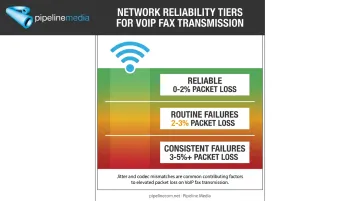
VoIP fax adapters work, but they're more sensitive to network quality than fully cloud-based online fax services. That sensitivity becomes a bigger problem at scale, and for businesses sending faxes to large distribution lists rather than one-off documents, managing your own software or hardware setup becomes impractical fast. This is where a full-service fax broadcast provider changes the equation entirely.
Option 3: Full-Service Fax Broadcasting for Businesses
Pipeline Media, for instance, requires zero phone lines, fax machines, or technical infrastructure on the client's end. You send your recipient list and document, and the team handles the rest:
- Sets up and manages the entire campaign, from formatting to transmission
- Delivers detailed reports on delivery status for every recipient
- Retries problem fax numbers up to 3 times at no extra charge
- Handles inbound fax responses on the client's behalf
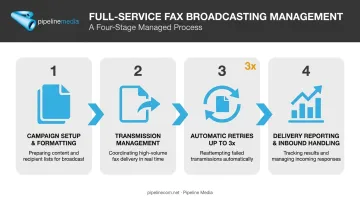
This full-service model is designed to remove hours of repetitive campaign work from a client's monthly workload.
Pipeline also offers a Fax-To-Email service starting at just $10/month with no setup fee, letting businesses send and receive faxes from any device without ever touching a physical machine.
Benefits of Faxing Without a Phone Line
Cutting the landline solves more than a compliance problem. It delivers tangible advantages across cost, mobility, reliability, security, and even environmental impact.
Internet fax delivers benefits in several key areas:
- Cost savings: No landline installation fees, monthly line charges, or long-distance surcharges. Everything runs over internet you're likely already paying for.
- Mobility and flexibility: Send and receive faxes from a laptop, tablet, or smartphone from anywhere with a connection, without being tethered to an office fax machine.
- Improved reliability: Cloud fax sidesteps busy signals, paper jams, and analog line interference. Documents transmit as data packets, not audio tones vulnerable to interruption.
- Environmental benefits: Less paper, less ink, and less physical waste compared to running a traditional fax machine daily.
Security and compliance support. The HHS confirms that HIPAA's Privacy Rule permits sharing protected health information by fax, provided reasonable safeguards are in place. Reputable online fax providers build in:
- Encryption during transmission
- Access controls and user authentication
- Audit trails and delivery records
How Much Does It Cost: Phone Line Fax vs. Internet Fax
Maintaining a dedicated analog fax line isn't cheap once you account for installation, monthly access fees, and potential premises work. Carrier pricing varies significantly by state and exchange, but the cost categories typically include:
| Cost Component | Traditional Analog Fax Line | Online Fax Service |
|---|---|---|
| Setup/installation | Installation fees + service-order charges | $0 (no setup fee) |
| Monthly cost | Recurring line access fee + surcharges | As low as $10/month |
| Hardware | Fax machine required | None required |
| Maintenance | Repairs, jack work, line issues | Included in subscription |
According to TechRadar's 2025 review of online fax services, basic plans start around $6.99/month for 200 pages, with mid-tier plans running $13.99-$27.99/month depending on volume needs.
Pipeline Media's Fax-To-Email pricing fits squarely into this affordable range:
- Standard Plan: $10 USD/month for 100 incoming and 100 outgoing pages, with overages at $0.10/page
- Pro Plan: $20 USD/month for 250 incoming and 250 outgoing pages, with lower overages at $0.08/page
One client, Martine C. from Sacramento, CA, reported that switching fax traffic to Pipeline saved her business "hundreds of dollars per week, with no interruption in service."
Beyond the subscription savings, eliminating a landline also removes maintenance and repair costs tied to aging copper infrastructure. These expenses only grow as carriers retire POTS service in more regions.
Choosing the Right Internet Fax Solution for Your Business
The right fit depends on a handful of practical factors. Before committing, weigh these:
- Expected fax volume - Occasional faxing suits a self-serve app; high-volume needs point toward a managed service
- Dedicated fax number requirements - A permanent number tied to your business identity may be required for client-facing communications.
- Security and compliance needs - Healthcare, finance, and legal sectors need providers with strong data safeguards
- Existing hardware - Some businesses want to preserve a physical fax machine, while others prefer going fully digital.
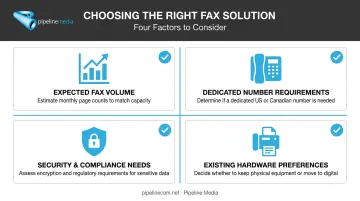
Self-serve apps work well for low-volume, occasional faxing. But businesses sending to large distribution lists benefit more from a full-service provider that handles list management, delivery retries, and reporting automatically.
Pipeline Media illustrates what that full-service model looks like in practice. The company has managed business fax communications since 2003 and now offers fax broadcasting capable of sending over 1 million pages per hour. When a number fails on the first attempt, Pipeline automatically retries it three times, free of charge, and follows every campaign with a detailed report showing successful deliveries, failed numbers, and the specific reason each failure occurred. For businesses that want faxing handled without in-house management, that level of follow-through matters.
Frequently Asked Questions
Do you need a special phone line for a fax machine?
Yes. Traditional fax machines need an active analog phone line, and many businesses use a dedicated line separate from voice service to avoid conflicts. Online fax services remove this requirement entirely.
How much is a phone line for fax?
Costs vary by carrier and region, but dedicated analog lines typically involve installation fees plus recurring monthly charges. Online fax alternatives often cost far less, starting around $10 USD/month with no setup fee.
Can I fax from my cell phone without a landline?
Yes. Internet fax apps and services let you send and receive faxes directly from a smartphone using only a data or Wi-Fi connection. No landline or fax machine is required.
Is faxing over the internet secure and compliant?
Reputable online fax providers use encryption and offer features that support HIPAA and other compliance standards. Always confirm specific compliance certifications with your provider before handling regulated data.
Do I still need a fax machine if I switch to internet faxing?
No physical fax machine is required—documents can be uploaded and sent digitally through a web portal or app. If you prefer to keep existing hardware, a VoIP adapter lets you connect it to the internet instead.
What's the difference between VoIP fax and online fax services?
VoIP fax keeps your existing physical machine connected via an adapter that converts analog signals to internet data. Online fax services are entirely digital, requiring no hardware at all.