But outsourcing isn't a plug-and-play fix. Hand your accounts to the wrong freelancer, or skip a brand voice guide, and results swing wildly. Some businesses see real engagement growth. Others get generic posts nobody notices. The model you choose, how clearly you define goals, and how you manage the relationship matter more than the price tag on the contract.
This guide covers exactly how to outsource social media management in 2026: what to prepare before you start, the five-step process for finding and onboarding the right partner, the factors that determine success, and the mistakes that quietly sink partnerships before they get off the ground.
TL;DR
- Outsourcing options range from freelancers and VAs to full-service agencies handling content and engagement
- The right fit depends on budget, goals, and how much creative control you want in-house
- Success requires a documented brand voice guide, a clear approval workflow, and secure account access
- Track engagement rate, click-through rate, and conversions, not follower count or impressions
- Most failed partnerships trace back to vague briefs, no voice guide, or micromanaging every post
How to Outsource Social Media Management in 2026
Outsourcing works best as a deliberate process, not a scramble to hire the first name that pops up in a Google search. Here's the sequence that actually holds up.
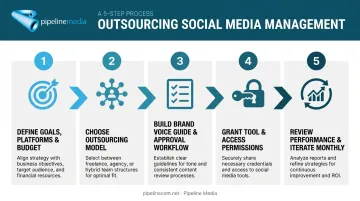
Step 1: Define Your Goals, Platforms, and Budget
Before contacting a single freelancer or agency, get clear on three things: why you're outsourcing, where your audience really lives, and what you're willing to spend.
Start with your primary objective, brand awareness, website traffic, lead generation, or direct sales. Each goal calls for a different content strategy and skillset. A team built for eye-catching brand content isn't necessarily built for lead-gen copywriting and DM follow-up.
Next, audit your platforms. Maintaining a strong presence on five networks when your customers only use two wastes budget. Confirm where your audience spends time in practice, not where you assume they do.
Finally, set a realistic budget and posting cadence before reaching out. Market pricing varies:
- Social media virtual assistants: roughly $10-$20/hour
- Freelance social media managers: $14-$35/hour, according to Upwork's 2026 marketplace data
- Full-service strategy and execution: $3,000-$7,000/project
Knowing these ranges upfront keeps you from overpaying, or from accepting a lowball quote that can't actually deliver.
Step 2: Choose Your Outsourcing Model
Once goals and budget are set, decide who does the work. There are three common routes, plus a fourth worth considering if you want one partner across multiple channels.
| Model | Best for | Trade-off |
|---|---|---|
| Freelancer | Single point of contact, lower cost | Limited backup if they're sick or overbooked |
| Agency | Scalable teams, broader expertise | Higher cost; junior staff sometimes handle execution |
| Virtual assistant | Cost-effective, brand-immersed | Needs more hands-on training upfront |
| Full-service agency | One accountable partner across channels | Fewer platform-specific specialists |
Full-service communications agencies like Pipeline Media bundle social media management with email broadcasting and PPC campaigns, so you're not juggling three vendors, three invoices, and three account managers.
Pipeline's Social Media Presence package starts at $500/month and covers full management of Instagram, Facebook, X, and LinkedIn, giving you one accountable partner instead of a patchwork of specialists.
Whichever route you pick, start small. A short trial, a 30-day window or a single project, confirms style fit and communication quality before you sign anything longer.
Step 3: Build a Brand Voice Guide and Content Approval Workflow
Outsourced teams can only sound like you if you tell them what that sounds like. Document your tone, the vocabulary you use (and avoid), sensitive topics to steer clear of, and your visual style, colors, fonts, image treatment.
Consistent brand presentation ties directly to revenue performance. Research cited by Marq's brand consistency report links steady presentation with a 10%-20% revenue lift, though that's a self-reported association, not a guarantee.
Pair the voice guide with a phased approval process:
- Weeks 1-4: Review every post before it goes live
- After trust is established: Spot-check roughly 30% of posts instead of everything
- Ongoing: Use a shared document or project tool for draft review and comments
This keeps quality control tight early on without becoming a permanent bottleneck.
Step 4: Grant Access to Tools, Assets, and Tracking
Handing off social media doesn't mean handing over your master password. Share credentials through a password manager, and provide a brand assets folder, logos, product photography, and your best-performing past posts as reference material.
For platform access specifically, Meta (Facebook/Instagram) offers task-based access instead of full account control, while X's Delegate feature lets a provider post and manage your account without ever seeing your password.
Connect scheduling and analytics tools with editor-level, not admin-level, permissions. Your provider can create, publish, and pull reports, but can't touch billing or lock you out of your own account. Agree on which metrics get reported, and how often, before work begins. Ambiguity here is where most "success" disagreements start.
Step 5: Review Performance and Iterate Monthly
Set monthly check-ins comparing results against the goals from Step 1. A good outsourced team brings trend ideas and content format suggestions to the table instead of waiting for instructions.
Buffer's analysis of more than 100,000 users found consistent posters earned about 5x more engagement per post than sporadic ones, according to Buffer's consistent posting study. That's the kind of data point worth tracking monthly instead of guessing.
Adjust scope, budget, or platform focus based on what the numbers say, not gut feeling. Give any new partnership at least 90 days before making major strategy changes. Social growth compounds. It doesn't spike overnight.
Is Outsourcing Right for You?
Outsourcing isn't universally right for every business stage. It depends on your time constraints, budget, and how much control you're willing to hand off.
Signs You're Ready to Outsource
- Spending hours every week on content and scheduling pulls you away from core business tasks
- Posting stays inconsistent despite genuine effort, damaging brand credibility
- Your business has outgrown what a DIY social presence can realistically support
What You Need Before You Start
- Brand assets, a designated point of contact, and ideally two weeks of past posting data ready to share
- A realistic budget range and internal bandwidth for approvals, even if it's minimal
- Realistic timeline expectations: allow 30 to 45 days for a consistent posting rhythm
Key Factors That Affect Outsourcing Results
Outcomes depend far more on how the relationship is managed than on which provider's name is on the contract. Four factors separate partnerships that pay off from ones that fizzle.
Posting Frequency & Consistency
Irregular posting undermines algorithm favor and audience trust. As noted above, consistency ties directly to engagement. In practice, a realistic cadence, three times a week sustained for months, usually beats daily posting that burns out after three weeks.
Brand Voice Alignment
Without a documented voice guide, outsourced content drifts into generic phrasing that could belong to any brand. That's not just an aesthetic issue. Brand consistency research ties steady presentation to a measurable revenue lift, as covered earlier. If your provider's posts don't sound like you, prospects notice, even if they can't say exactly why.
Metrics You Choose to Track
Vanity metrics (follower count, impressions) feel good but rarely reflect business impact. A profile can gain thousands of followers and still generate zero leads. Track engagement rate, click-through rate, and conversions instead. These numbers tie directly to whether social media is growing your business, not just your ego.
Communication Cadence & Feedback Loops
Infrequent check-ins let small tone or strategy issues compound into bigger problems. A voice that drifts slightly in month one can be wildly off by month four if nobody flags it. Monthly reviews, paired with quick feedback turnaround on drafts, correlate with stronger long-term performance than a "set it and forget it" approach.
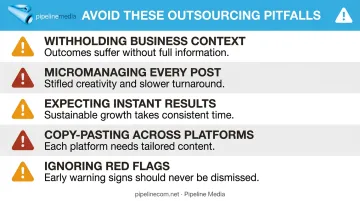
Common Mistakes When Outsourcing Social Media Management
Most failed outsourcing partnerships trace back to a handful of avoidable errors.
- Withholding business context: Not sharing product launches, PR issues, or promotions leaves your provider posting blind at the worst possible moment.
- Micromanaging every post: If you built a voice guide and approval workflow, trust it. Reviewing every comma defeats the point of outsourcing.
- Expecting instant results: Viral growth within weeks isn't realistic. Treat outsourced social media as a months-long investment.
- Copy-pasting across platforms: Identical tone and format on LinkedIn and Instagram ignores that each platform's audience expects something different.
- Ignoring red flags: Guaranteed follower counts, vague reporting, or resistance to sharing analytics are reasons to walk away, not push through.
Catch these early and the partnership has a real shot at compounding value instead of stalling out by month two.
Conclusion
Outsourcing social media management in 2026 works best when goals, brand voice, and the right model are locked in before you sign anything. Most failed partnerships don't fail because of the provider's skill. They fail because of unclear briefs, missing approval workflows, or a mismatch between provider type and business size.
Whether you land on a freelancer, an agency, or a full-service partner like Pipeline Media, the right structure turns social media from a time drain into a consistent, on-brand presence. Pipeline's Social Media Presence package is built around that principle: one point of contact, clear deliverables, and no guesswork about what you're paying for.
Frequently Asked Questions
How much does it cost to outsource social media?
Pricing typically ranges from a few hundred dollars a month for basic content plans to several thousand for full-service strategy, community management, and reporting. Scope, platform count, and provider type all affect the price.
What is the 5-5-5 rule on social media?
It's a simple 15-minute daily habit: five minutes creating content, five minutes engaging with other accounts, and five minutes responding to comments or messages. It keeps you active without turning social media into a full-time job.
What is the 5-3-2 rule on Instagram?
For every ten posts, five are curated or industry content, three are original brand posts, and two are personal or behind-the-scenes moments. The mix keeps your feed varied instead of feeling like a constant sales pitch.
How do I know if it's the right time to outsource my social media?
The clearest signals are spending hours weekly on content instead of core business tasks, posting inconsistently despite real effort, and outgrowing what a DIY presence can support.
What's the difference between hiring a freelancer versus an agency for social media?
Freelancers offer affordability and direct communication but limited backup if they're unavailable. Agencies provide scalable teams and consistent coverage, usually at a higher price point.
Can small businesses afford to outsource social media management?
Yes. Entry-level plans start in the low hundreds per month, like Pipeline Media's Social Media Presence package at $500/month, making outsourcing accessible without hiring a full-time employee.