Social media fills the gap between renewals. It puts your agency in front of prospects who are researching coverage options or asking friends for recommendations right now, before they ever call you.
Many agents avoid social media because they think it requires viral content or a massive following. It doesn't. What builds trust is consistency: showing up regularly with useful information until prospects recognize your name when a renewal or a new policy need comes up.
This guide covers platform selection, proven content frameworks like 70/20/10 and 5-5-5, and a step-by-step strategy you can start using today.
Key Takeaways
- Pick 1-2 platforms that match your book of business rather than every network
- Keep promotional content under 30% of your feed using the 70/20/10 or 5-5-5 framework
- Post consistently (3-5 times weekly on most platforms) rather than in unpredictable bursts
- Track engagement rate, click-throughs, and follower growth monthly
- Outsource content creation to focus on writing policies instead of managing feeds
Choosing the Right Social Media Platforms for Your Insurance Agency
You don't need to be everywhere. Trying to maintain five platforms usually means doing all of them poorly. Success comes from picking the one or two channels where your specific audience already spends time, then showing up there reliably.
The right choice depends on your book of business. A personal-lines agency serving local families has different platform needs than a commercial agent chasing general liability accounts.
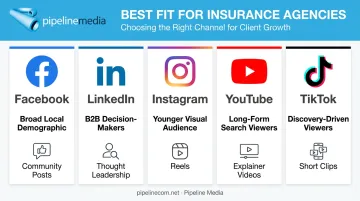
Facebook works best for local community engagement, client updates, and reviews. Pew Research found that 68% of U.S. adults use Facebook, and it's one of only two platforms used by a majority of every age group they measured.
That breadth makes it the default choice for agencies writing home, auto, and life policies for a broad local demographic.
LinkedIn earns its place for commercial-lines agents. Sprout Social reports that 4 in 5 LinkedIn members influence business decisions at their companies. If you write general liability, professional liability, or workers' comp policies, this is where the decision-makers already are.
Thought-leadership posts, industry commentary, and direct outreach perform well here in a way they simply don't on consumer-facing platforms.
Instagram suits visual storytelling and a more relatable side of your agency. Think 30-second reels explaining renters insurance for a college-town audience, or quick clips busting common coverage myths.
It's less about follower count and more about shareability. Content designed to be forwarded to a friend often outperforms polished, corporate-feeling posts.
YouTube and TikTok
These two serve different attention spans but the same educational purpose. YouTube holds longer explainer videos that show up in search results for years. TikTok (and Instagram Reels) works for short, discovery-driven clips that introduce one idea and point viewers toward deeper content elsewhere.
Consistently posting across chosen platforms takes real time, and many agents struggle to find it. Full-service providers like Pipeline Media manage that day-to-day presence across Facebook, Instagram, and LinkedIn, so agents stay active without extra workload.
Content Rules Insurance Agents Should Follow (70/20/10 vs. 5-5-5)
Once you've picked a platform, the next question is what to actually post. Two frameworks give agents a repeatable structure.
The 70/20/10 rule breaks your content into:
- 70% educational or value-driven posts - coverage explainers, claims tips, seasonal reminders
- 20% curated industry content - sharing relevant news or third-party articles
- 10% direct promotion - your services, quote requests, or agency announcements
The 5-5-5 rule works differently, dividing content into three groups of five posts per cycle:
- 5 original educational or informative posts
- 5 curated posts from other sources
- 5 engagement or response-focused posts
Neither framework is a scientifically tested formula. Both are planning heuristics designed to keep one thing in check: over-promotion. When promotional content dominates a feed, followers disengage quickly and trust starts to erode.
Content types that perform well within these ratios
A handful of formats consistently earn engagement without feeling salesy:
- Short-form video explainers - 30-60 seconds on a single coverage question
- Infographics and quote graphics - easy to skim, easy to share
- Client testimonials and success stories - social proof beats self-promotion every time
- Behind-the-scenes "meet the team" content - humanizes the agency
- Live Q&A sessions - answer real coverage questions in real time
Tie your value content to the calendar. A few reliable prompts:
- Renewal reminders in the weeks before policies expire
- Storm-prep tips ahead of hurricane or wildfire season
- Updates on local insurance regulation changes
Each gives you something useful to say without asking for anything in return.
Building a Winning Social Media Strategy Step-by-Step
A content framework only works if it sits inside a broader plan. Here's how to build one:
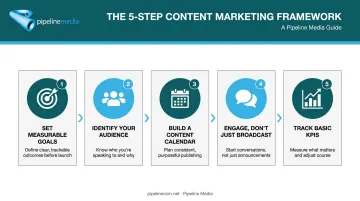
Set one or two measurable goals first. Are you driving quote requests, growing referral visibility, or generating phone calls? Every post should serve that goal.
Identify your audience. Review your existing client base for age, location, and coverage types. Don't have enough data? Check what a competitor's followers look like for a rough benchmark.
Build a simple content calendar. Map out topics, platforms, and posting frequency monthly or quarterly. This removes the daily scramble to think of something to post.
Engage, don't just broadcast. Respond to comments and messages promptly. Comment on local businesses' and nonprofits' posts. Go live occasionally to put a face to the agency.
Track basic KPIs. Use each platform's free native analytics to monitor engagement rate, click-throughs, and follower growth, then adjust your posting schedule based on what the numbers show.
Consistency matters more than volume here. Industry benchmarks suggest a floor of 3-5 posts per week on Instagram as a sustainable baseline. Three well-planned posts a week beat seven rushed ones.
Common Social Media Mistakes Insurance Agents Should Avoid
Even agents who understand the frameworks above still trip over the same handful of mistakes.
Inconsistent posting schedules. Posting daily for two weeks, then going silent for a month, undermines the trust you're trying to build. A content calendar (see the section above) fixes this, and outsourcing the task to a team like Pipeline Media's social media management service removes the guesswork entirely.
Copy-pasting content across every platform. A 45-minute webinar recording belongs on YouTube. Chopping it into a 15-second TikTok clip without editing for the format wastes both channels. Tailor the length, tone, and format to where it's posted.
Ignoring comments and direct messages. A prospect asking a question in your comments is watching how you respond, or if you respond at all. Slow replies read as poor customer service before someone even becomes a client. Set a response-time expectation for your team and stick to it.
When (and Why) to Outsource Your Agency's Social Media Marketing
There's a point where DIY social media stops making sense. The signs are usually obvious:
- Posting has become sporadic because nobody has time to sit down and create content
- Engagement has plateaued despite consistent effort
- You're spending hours each week on captions and scheduling instead of clients
This is where agencies typically bring in outside help. Pipeline Media, a Toronto-based business communications agency operating across North America since 2003, offers a Social Media Presence package at $500 USD/month that fully manages Instagram, Facebook, X, and LinkedIn on an agency's behalf.
The package covers custom content creation, scheduled posting, on-brand captions, and comment and inbox monitoring, so profiles stay active and polished without daily attention from agency staff.
For agencies wanting social media to actively generate inquiries rather than just maintain a presence, pairing the Social Media Presence package with Pipeline's pay-per-click advertising service adds paid reach and click tracking on top of the organic content already in place.
Social media rarely works best in isolation. Pairing it with email broadcasting for renewal reminders and policy updates gives clients two consistent touchpoints instead of one.
Pipeline's full-service model handles both once a client shares their goals and brand materials, so an agent's team doesn't have to manage either channel day-to-day. You can review the specifics or book a free consultation to see which package fits your agency's size and goals.

Frequently Asked Questions
How can I use social media to market my insurance agency?
Pick one or two platforms based on where your clients already spend time, post consistently with value-driven content, and engage directly with your local community and existing clients online.
What social media content rules should insurance agencies follow (70/20/10 or 5-5-5)?
The 70/20/10 rule allocates 70% educational content, 20% curated content, and 10% promotion. The 5-5-5 rule splits content into five original, five curated, and five engagement posts. Both prioritize education over direct selling.
How often should insurance agents post on social media?
Aim for a sustainable, repeatable schedule, roughly 3-5 posts per week on platforms like Instagram, rather than posting daily for a while and then disappearing. Consistency matters more than raw volume.
Which social media platform is best for insurance agents?
There's no single best platform. Facebook works well for broad, local personal-lines outreach. LinkedIn reaches commercial-lines decision-makers more directly, while Instagram and TikTok tend to connect with younger, local audiences.
Can I run social media ads for my insurance agency?
Yes. Facebook and LinkedIn both support demographic and geographic targeting, and you can retarget people who already visited your website for better conversion rates on quote requests.
Is social media marketing worth it for small insurance agencies?
Yes, even without a dedicated marketing team. Outsourcing to a service like Pipeline Media's social media management, which starts around $500/month, keeps posting consistent without adding to your workload. That visibility between renewals builds the familiarity that turns into referral-driven trust when someone needs coverage.