Yet plenty of ecommerce brands post consistently and still see almost no sales come through. The problem usually isn't effort. It's the lack of a platform-specific strategy and a content plan built for conversion, not just visibility.
This guide breaks down the best platforms for ecommerce, proven strategies that drive revenue, content-mix rules that keep feeds from feeling like ads, and the metrics that actually matter.
Key Takeaways
- US social commerce will top $100 billion by 2026, making it a core revenue channel, not a side project
- Platform choice should match your product type and audience, not follow whatever's trendy
- Pairing organic content with paid boosts on proven winners outperforms all-organic or all-paid strategies
- User-generated content influences purchase decisions far more than branded posts
- Revenue-linked metrics, not follower counts, show whether social media is working
What Is Social Media for Ecommerce?
Social media for ecommerce means using platforms to promote products and engage shoppers, ultimately driving traffic or direct purchases. It's broader than "social commerce," which specifically refers to selling within the app itself rather than sending shoppers elsewhere.
Platforms have shifted from discovery tools into functioning storefronts:
- Shoppable posts let users tap a product tag and see pricing instantly
- In-app checkout (where available) lets shoppers buy without leaving the app
- Live shopping combines video, urgency, and one-click purchasing in real time
That shift is why social commerce sales are projected to exceed $100 billion in the US by 2026. Brands that treat their social profiles as marketing-only, rather than as a sales channel, are leaving a substantial slice of revenue on the table.
Best Social Media Platforms for Ecommerce Success
There's no universal "best" platform. The right choice depends on your audience's demographics, whether your product sells on visuals or explanation, and how your customers typically shop.
Instagram remains a strong fit for visually-driven brands: fashion, beauty, home goods, lifestyle products. Shopping tags on posts, Stories, and Reels let users browse and buy without friction, and Instagram Shop adds a dedicated storefront tab.
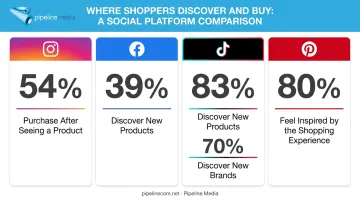
The purchase behavior backs this up. In a Meta-commissioned Ipsos study, 54% of respondents said they bought a product either immediately or later after seeing it on Instagram. Nearly 9 in 10 took some action after viewing product information there.
Facebook's strength is reach across a broader demographic, plus tools for re-engaging shoppers who almost bought. Facebook Shops gives merchants a customizable storefront, while dynamic retargeting ads remind visitors about products they viewed but didn't purchase.
According to Sprout Social's research, 39% of consumers use Facebook to discover new products. Groups are also worth building for community and repeat-customer loyalty, especially for brands with an engaged following that wants a place to talk.
TikTok
TikTok drives impulse purchases among Gen Z and Millennial shoppers through short-form video and creator partnerships. TikTok Shop lets users buy directly from videos, livestreams, or a brand's shop tab.
The discovery data is striking: TikTok and GlobalData found that 83% of TikTok Shop shoppers discovered a new product on the platform, and 70% discovered a new brand. Among shoppers who engaged with TikTok Shop, 76% purchased from a livestream in 2024.
Pinterest works best for inspiration-driven categories: home decor, fashion, DIY, weddings. Rich Pins pull in real-time pricing and availability, and shoppable boards let users curate wish lists that double as purchase intent signals.
Pinterest's own data shows 80% of weekly Pinners feel inspired by the platform's shopping experience. In fact, 96% of top searches are unbranded, meaning shoppers arrive without a specific brand in mind, which creates an opportunity for discovery.
Proven Social Media Marketing Strategies for Ecommerce
Platform choice is only half the equation. These strategies turn presence into actual sales.
Combine organic and paid social. Publish content organically first. Track which posts perform best organically, then put ad spend behind those winners. This approach avoids wasting budget on unproven creative and maximizes ROI on content that's already resonating.
Reduce checkout friction. Complicated checkout is a documented cart-abandonment driver. Baymard Institute's research found that roughly 17% of US online shoppers abandoned an order specifically because checkout felt too long or complicated. Shoppable posts and native storefronts shorten that path from scroll to sale.
Use influencer and creator partnerships strategically. Macro-influencers offer reach; micro-influencers often deliver better trust and engagement. HypeAuditor data found Instagram micro-influencers (10K-50K followers) averaged 1.38% engagement versus 1.08% for macro-influencers, though the pattern flips on TikTok and YouTube, where larger creators sometimes outperform.
Build hype around launches. Teaser content, countdown stickers, and early-access drops create urgency before a product even goes live.
Lean into authentic storytelling. Behind-the-scenes content, founder stories, and user-generated content consistently outperform polished brand messaging. In a Stackla survey of over 2,000 consumers, 79% said user-generated content highly influenced their purchase decisions, compared to just 12% for branded content and 9% for influencer content.
Social Media Content-Mix Rules Every Ecommerce Brand Should Know
Posting only product photos gets ignored fast by both algorithms and humans. Content-mix rules help balance promotional, engaging, and personal content so a feed feels worth following.
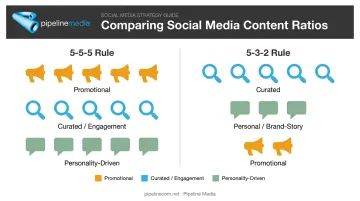
The 5-5-5 Rule
Out of every 15 posts:
- 5 promote your own brand or products directly
- 5 engage with or reshare content from others (customers, partners, industry voices)
- 5 show personality: behind-the-scenes, team moments, day-in-the-life content
A weekly example: Monday product feature, Tuesday customer repost, Wednesday team photo, and so on through the cycle.
The 5-3-2 Rule
Out of every 10 posts:
- 5 are curated or third-party content relevant to your niche
- 3 are personal or brand-story posts
- 2 are direct promotional posts
This ratio skews less product-heavy than 5-5-5, useful for brands still building trust with a newer audience.
Neither rule is a formal industry standard; they're planning heuristics, not scientific benchmarks. Treat them as a starting framework, then adjust based on what your performance data shows.
If product posts are converting well, skew more product-forward, while still keeping enough personality and community content that the feed doesn't feel like a catalog.
Key Metrics to Measure Your Ecommerce Social Media Success
Vanity metrics feel good but don't pay bills. Here's what actually signals whether social media is driving revenue:
| Metric | What It Signals |
|---|---|
| Click-through rate (CTR) | How compelling your content is at driving traffic |
| Add-to-cart rate | Whether traffic is interested enough to consider buying |
| Cost per acquisition (CPA) | How efficiently ad spend converts to customers |
| Engagement rate | How much your audience actually interacts with content |
For context, Shopify cites 2%-4% as a healthy add-to-cart rate range, with top performers reaching 8%-10%. Rival IQ's 2025 benchmark data put retail engagement rates at just 0.04% on Facebook, 0.06% on Instagram, and 0.29% on TikTok. Don't panic if raw engagement numbers look small.
Prioritize revenue-linked metrics over follower counts or likes:
- Social-attributed sales (tracked through UTM parameters or platform pixels)
- Repeat purchase rate from social-driven customers
- Actual conversion rate, not just clicks
Platform-native tools like Meta Business Suite and TikTok Analytics are solid starting points, and third-party dashboards can consolidate cross-platform data once you're managing multiple channels.
Why Partner with a Full-Service Agency for Social Media Management
Running content calendars, ads, and engagement consistently across four or more platforms is genuinely time-intensive, especially for small and mid-sized businesses without a dedicated marketing team. Something usually slips: posting schedules go quiet, comments go unanswered, or paid budget gets spent without a clear strategy.
This is where outsourcing makes practical sense.
Pipeline Media offers a Social Media Presence package ($500/month) that manages Instagram, Facebook, X, and LinkedIn for ecommerce brands needing consistent, professional visibility without daily hands-on effort. The package covers:
- Custom content creation and on-brand captions for every platform
- Comment and inbox monitoring to keep conversations moving
- Profile optimization to keep brand presentation consistent
This scope can expand as posting needs grow, without requiring a new contract.
Beyond social, Pipeline Media brings over 20 years of full-service communications experience dating back to 2003, plus a real person who responds to client requests within minutes.

For ecommerce brands stretched thin managing everything internally, pairing social media management with email broadcasting or PPC advertising creates a more unified cross-channel approach, freeing up real time to focus on the business itself.
Frequently Asked Questions
What is the best social media marketing strategy for ecommerce?
There's no single best strategy. Effective approaches combine organic storytelling, paid promotion of top-performing content, influencer partnerships, and consistent use of user-generated content.
Which social media platform is best for ecommerce?
It depends on your audience and product type. Instagram and Facebook work broadly well for visual products, while TikTok suits younger, trend-driven audiences chasing impulse buys.
What are common social media content-mix rules for ecommerce?
The 5-5-5 rule splits 15 posts into promotional, curated, and personal content, while the 5-3-2 rule uses a similar split across 10 posts. Both help ecommerce brands avoid overly salesy feeds while still driving sales.
How often should an ecommerce brand post on social media?
Consistency matters more than raw volume. Let audience activity data and platform norms guide frequency rather than posting for the sake of hitting a number.
How much does social media management cost for a small ecommerce business?
Basic outsourced management typically starts around a few hundred dollars per month for presence-focused services, while more comprehensive packages with added lead-generation components can run $1,000 or more per month.
Can social media replace my ecommerce website?
Not yet. Research from SimplicityDX found 71% of social shoppers still preferred checking out on a brand's website over the social platform itself. Social media should complement your website, not replace it.