Here's the problem: not every fax solution qualifies as HIPAA compliant just because it moves documents electronically. Pick the wrong provider, and you've opened your practice up to breach notifications, financial penalties, and a very uncomfortable conversation with patients.
This guide breaks down what actually makes a fax solution HIPAA compliant, settles the traditional-versus-online fax debate, and gives you a practical checklist for vetting providers.
Key Takeaways
- Safeguards, not the method, determine compliance: a signed BAA, encryption, and audit trails matter most
- Misdirected faxes containing PHI can trigger the Breach Notification Rule, requiring HHS and patient notification within 60 days
- A Business Associate Agreement (BAA) is non-negotiable for any fax vendor handling PHI
- HIPAA penalties can reach $2,190,294 annually for uncorrected willful neglect
- A secured online fax service often beats a machine sitting exposed in an open hallway
What Is a HIPAA Compliant Fax Solution?
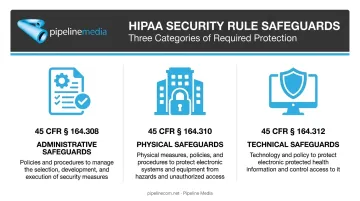
A HIPAA compliant fax solution is one that satisfies the Security Rule's three safeguard categories whenever it transmits or stores protected health information:
| Safeguard Type | Regulation | What It Covers |
|---|---|---|
| Administrative | 45 CFR 164.308 | Policies and procedures for managing security measures |
| Physical | 45 CFR 164.310 | Protecting facilities, equipment, and access points |
| Technical | 45 CFR 164.312 | Technology controls governing ePHI access |
Meeting these three categories isn't optional. HHS defines them as the baseline for protecting confidentiality, integrity, and availability of electronic PHI.
The Business Associate Agreement Is Non-Negotiable
Any fax provider that creates, receives, maintains, or transmits PHI on your behalf counts as a business associate under HIPAA. That triggers a legal requirement: a signed Business Associate Agreement before a single fax containing patient data goes through their system.
A compliant BAA must address:
- Permitted and required uses of PHI
- Breach and disclosure reporting obligations
- Subcontractor flow-down requirements
- PHI return or destruction upon contract termination
- HHS access to relevant compliance records
No BAA means no PHI through that service, without exception.
Encryption: Where the Rules Are Changing
Encryption requirements deserve a closer look. Current HIPAA rules treat encryption as "addressable," not mandatory, under 45 CFR 164.312(a)(2)(iv) and (e)(2)(ii). That doesn't mean providers can skip it. They still must assess whether encryption is reasonable and document any alternative if they choose not to implement it.
HHS breach safe-harbor guidance points to NIST standards for both states of data:
- Data at rest: NIST SP 800-111
- Data in transit: NIST SP 800-52, SP 800-77, and SP 800-113
This standard is expected to change soon. HHS published a proposed rule in the Federal Register on January 6, 2025, that would make encryption of ePHI mandatory at rest and in transit, with only narrow exceptions. This is still a proposal, not final law, but it signals where enforcement is heading.
Audit Trails and Access Controls
Every fax touching PHI needs a documented audit trail. Required Security Rule documentation must be retained for 6 years from creation or last effective date, whichever comes later, per 45 CFR 164.316(b)(2)(i).
Role-based access matters too. Not every staff member needs to see every incoming fax. A compliant system limits visibility based on job function, so front-desk staff aren't viewing lab results meant for a physician.
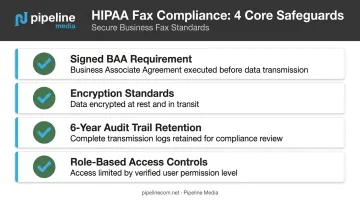
Together, these administrative, physical, and technical requirements form the checklist worth applying to any fax provider handling patient data, whether that's an in-house fax server or a managed fax-to-email service.
Are Faxes Considered HIPAA Compliant? Traditional vs. Online Fax
Short answer: faxing isn't inherently compliant or non-compliant. Compliance lives in the safeguards, not the transmission method. HHS confirms providers can share PHI by fax, email, or phone for treatment purposes without patient authorization, as long as reasonable safeguards are in place.
Where Traditional Paper Fax Falls Short
Physical fax machines create real exposure points:
- Misdialed numbers send PHI to the wrong recipient entirely
- Unattended machines in shared office areas let anyone glance at incoming pages
- Faxes sitting in output trays stay visible to unauthorized staff, cleaning crews, or visitors until someone retrieves them
- No audit trail exists for who picked up a document or when
One real OCR case example: a physician's office accidentally faxed a patient's HIV status to the patient's employer instead of a new provider. The fallout included a written warning for the employee, a revised confidentiality statement on the fax cover sheet, and staff retraining, according to HHS's case examples archive.
That kind of mistake isn't rare, and it carries real consequences. Here's when the Breach Notification Rule kicks in.
What Triggers Breach Notification
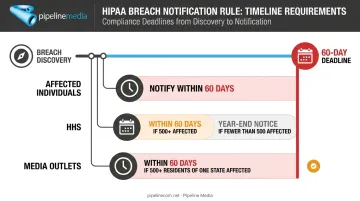
A misdirected fax containing PHI likely counts as a reportable breach. Under the rule, covered entities must notify:
- Affected individuals — no later than 60 days after discovery
- HHS — within 60 days if 500+ people are affected, or by year-end if fewer
- Media outlets — within 60 days if a breach affects more than 500 residents of one state
Miss these windows, and you've added a compliance violation on top of the original mistake.
Why Online Fax Can Actually Be Safer
Cloud-based fax services route documents directly to a secure digital inbox instead of a physical tray — Pipeline Media's Fax-To-Email service, for example, delivers incoming pages straight to a designated inbox rather than a shared machine. When built correctly, with encryption, audit logging, and a signed BAA, online fax can exceed what a paper machine ever offered. There's no tray for a stranger to walk past.
One caveat: standard email is not HIPAA compliant on its own. Fax-to-email and email-to-fax services need to run through a BAA-covered, encrypted gateway. Otherwise, you're just trading one compliance gap for another.
How to Send a HIPAA Compliant Fax Without a Fax Machine
The shift away from physical machines is well underway. Staff can now send faxes from a browser, a mobile app, or a secure email inbox through an online fax provider, no bulky hardware required.
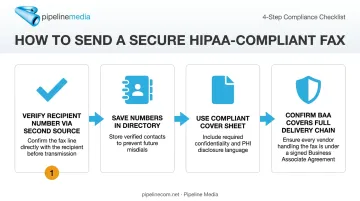
Steps to Send Securely
- Verify the recipient's fax number through a second source before sending anything containing PHI, exactly as HHS recommends for reducing misdirected faxes
- Save frequently used numbers in a preprogrammed directory to eliminate manual dialing errors
- Use a compliant cover sheet that includes sender and recipient details, a confidentiality statement, and a "notify sender if received in error" instruction, while keeping PHI out of any subject line
- Confirm BAA coverage extends to every link in the chain, including any email gateway component, before transmitting anything sensitive
Services built for this workflow let staff fax from any device without a physical fax machine on-site. Pipeline Media's Fax-To-Email service works this way, letting teams send and receive documents remotely instead of tying everyone to a single machine in one office.
That said, convenience and compliance aren't automatically the same thing. Before sending any PHI through a fax-to-email service, confirm in writing that the provider's BAA covers the full delivery path, not just the fax transmission itself but any email component too. If a provider can't answer that clearly, that's your answer.
Choosing the Right HIPAA Compliant Fax Provider
Not all providers are built the same, and healthcare organizations can't afford to guess. Ask these questions before signing anything:
- Does the provider offer a signed BAA at no extra cost? If it's an add-on fee or unavailable, walk away
- What encryption standard protects data in transit and at rest?
- Are audit logs retained for at least 6 years, matching HIPAA's documentation requirement?
- Does the BAA cover subcontractors and every component of the delivery chain?
Match the Provider to Your Organization's Size
A solo practice and a 12-location hospital network have different needs:
- Solo or small practices typically need a simple, affordable, BAA-backed plan without unnecessary complexity
- Multi-location networks need centralized access controls, multi-user reporting, and consolidated audit visibility across sites
AHIMA's due-diligence guidance recommends going further than a sales pitch. Request compliance questionnaires, a security risk analysis completed within the past 12 months, and documented encryption policies before signing, according to the Journal of AHIMA's guidance on business associate due diligence.
Full-Service Support Matters for Regulated Industries
Meeting this level of due diligence gets harder when you're also piecing together fax infrastructure, servers, encryption, and staff training in-house. That's why healthcare, financial services, and government organizations increasingly lean on established partners instead of building from scratch.
Pipeline Media has served Healthcare, Financial Services, and Government clients for over two decades through full-service fax broadcasting and Fax-To-Email subscription plans. If your organization needs specific documentation, such as a signed BAA or encryption protocol details, request it directly from the provider before sending any PHI through their platform.
Risks of Non-Compliant Faxing
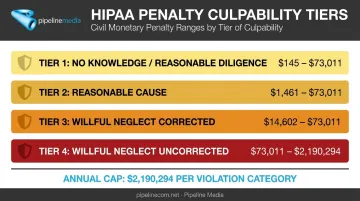
The financial exposure here is not theoretical. Under the 2026 inflation-adjusted penalty schedule, violations break down by culpability tier:
| Tier | Minimum Per Violation | Maximum Per Violation | Annual Cap |
|---|---|---|---|
| No knowledge, reasonable diligence | $145 USD | $73,011 | $2,190,294 |
| Reasonable cause | $1,461 | $73,011 | $2,190,294 |
| Willful neglect, corrected | $14,602 | $73,011 | $2,190,294 |
| Willful neglect, uncorrected | $73,011 | $2,190,294 | $2,190,294 |
These figures come from the Federal Register's 2026 civil penalty inflation adjustment. As of OCR's most recent review, 152 cases have resulted in settlements or penalties totaling nearly $145 million USD.
The Real Culprit Isn't Technology
OCR's 2024 breach data tells a clear story. Among breaches affecting fewer than 500 people, 94% stemmed from unauthorized access or disclosure, and 60% involved paper records specifically, per HHS's annual breach report to Congress.
Misdirected faxes fall squarely into that category. A single wrong number can:
- Trigger mandatory breach notification within 60 days
- Damage patient trust that took years to build
- Invite an OCR investigation into your broader compliance posture
The fix isn't just better technology. It's pairing a compliant platform with consistent staff training on number verification, cover sheet protocols, and recognizing what counts as a reportable incident. Delivery confirmation reports and automatic retry logic on failed transmissions add another layer of protection, catching misdirected sends before they become breach notifications.
Frequently Asked Questions
Are faxes considered HIPAA compliant?
Faxing isn't automatically compliant or non-compliant. Compliance depends on whether safeguards like a signed BAA, encryption, and access controls are properly in place, not on the transmission method itself.
How do I send a HIPAA compliant fax without a fax machine?
Use a BAA-backed online fax service accessible through a browser, app, or secure email gateway. Always verify the recipient's number through a second source and attach a compliant confidentiality cover sheet.
Is a Business Associate Agreement required for HIPAA fax compliance?
Yes. Any fax vendor that handles PHI must sign a BAA before transmission begins. Using a provider without one is a violation, regardless of what encryption they use.
Is fax-to-email HIPAA compliant?
Standard email alone is not HIPAA compliant. Fax-to-email can be compliant only if the entire delivery chain, including the email gateway, is covered by a BAA and properly encrypted.
What happens if a HIPAA-protected fax is sent to the wrong number?
This typically triggers the Breach Notification Rule, requiring notification to affected patients and HHS within 60 days. Number verification safeguards exist to prevent this scenario.
How long must HIPAA fax records be retained?
Required Security Rule documentation, including fax transmission and audit logs, must be retained for 6 years from the date of creation or last effective date, whichever is later.