A missed disclosure. An unsubscribe link that doesn't work. A promotional claim that oversteps FINRA guidelines. Any of these can turn a routine campaign into a compliance headache.
That's why "best practices" for financial services email marketing aren't optional extras. They're the baseline. This guide covers the compliance rules you can't skip, segmentation strategies that actually work, the campaign types worth running, and the metrics that tell you if it's all paying off.
Key Takeaways
- Email consistently outperforms paid search on cost efficiency for financial marketing budgets
- Compliance sits at the intersection of general email law and finance-specific regulation, and both apply simultaneously to every campaign
- Segmentation by account behavior, not just demographics, drives measurably higher engagement
- Welcome emails generate the highest opens and clicks of any campaign type
- Authentication protocols (SPF, DKIM, DMARC) are essential given how often financial brands are impersonated in phishing attempts
Why Email Marketing Is a Smart Channel for Financial Services
Money conversations rarely happen in a single ad click. Loan approvals, retirement planning, and investment decisions unfold over months. Email lets financial brands stay present through all of it.
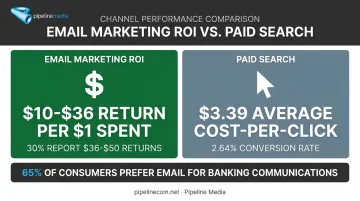
The economics back this up. In Litmus's 2025 survey of nearly 500 marketing professionals, 35% reported earning $10 to $36 back for every $1 spent on email, and another 30% reported returns between $36 and $50. Compare that to paid search. LocaliQ's 2026 benchmarks put the average finance and insurance cost-per-click at $3.39, with a 2.64% conversion rate. The metrics aren't identical, but the pattern holds: email delivers ongoing value at a fraction of the acquisition cost of paid clicks.
Consumer behavior reinforces the case for prioritizing this channel:
- 65% of US consumers say they prefer email for banking communications, according to Broadridge research reported by The Financial Brand
- Millennials, often assumed to be email-averse, actually engage with email at rates comparable to other generations
- Long decision cycles (mortgages, retirement accounts, investment portfolios) mean one touchpoint isn't enough — email provides the repeated contact these journeys require
A single ad click gets someone to a landing page once. A well-run email sequence keeps a prospective client informed, and warmed up, for the months it might take them to actually apply for that mortgage or open that investment account. Running that sequence well, though, means sending at scale without sacrificing deliverability or compliance — the kind of managed email broadcasting that keeps opens, clicks, and unsubscribes tracked from the first send to the last.
Compliance and Legal Requirements You Cannot Ignore
Financial services email sits at a legal crossroads. General email law applies. Finance-specific regulation applies on top of it. You don't get to choose one.
General Email Laws Apply Everywhere You Send
Depending on where your recipients live, you're dealing with different consent standards:
| Regulation | Consent Standard | Unsubscribe Requirement |
|---|---|---|
| CAN-SPAM (US) | Opt-out generally sufficient | Honor requests within 10 business days |
| CASL (Canada) | Express or implied consent required | Honor requests within 10 business days |
| GDPR/ePrivacy (EU) | Prior consent generally required | Simple opt-out in every message |
| CCPA/CPRA (California) | Governs data sale/sharing, not email consent | N/A — CAN-SPAM handles unsubscribe rules |
A common mistake: assuming that because someone opened an account, they've consented to promotional email. Account signup typically covers transactional messages (statements, security alerts, service notices). It does not automatically cover marketing emails. Financial marketers need a separate, documented opt-in for promotional content.
Every Email Needs These Elements, By Law
- A visible, functioning unsubscribe link
- Accurate sender information (no disguised "From" addresses)
- Your business's physical mailing address
- Clear identification that the message is an advertisement, where applicable
Finance Adds Its Own Layer
On top of general email law, financial institutions answer to:
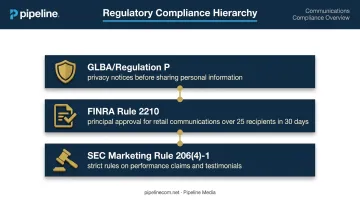
- GLBA/Regulation P — requires privacy notices before sharing nonpublic personal information with third parties
- FINRA Rule 2210 — email to more than 25 retail investors in 30 days counts as a "retail communication" requiring principal approval before use; content must be fair, balanced, and free of exaggerated or misleading claims
- SEC Marketing Rule (206(4)-1) — governs adviser communications, including email, with strict conditions on performance claims and testimonials
Risk disclosures for investment products need to be clear and prominent. There isn't a universal rule requiring disclaimers to match body-copy font size exactly, but the SEC has flagged unreadable disclosure text as potentially misleading in its own right. When in doubt, make disclosures easy to read, not buried in six-point grey text.
The Stakes Are Real
In 2021, FINRA settled with Robinhood Financial LLC over a range of violations, including a December 2018 email sent to more than 8.2 million accounts that made false claims about SIPC coverage and interest rates. Other emails omitted material facts about "free stock" promotions and misstated options risk. The total settlement reached $57 million in fines plus $12,598,445.16 in restitution, though that figure covers broader supervisory failures beyond email alone. Still, it's a clear signal: regulators read your marketing emails and take promotional language seriously.
Keep Your Records
Given the scrutiny cases like Robinhood attract, documentation matters as much as the content itself. Maintaining an audit trail (proof of consent, timestamps of sends, unsubscribe logs) is essential if a regulator ever comes asking.
Pipeline Media's email broadcasting service builds unsubscribe management directly into every campaign, tracking opt-out requests so financial services clients don't have to build that infrastructure themselves.
Segmentation and Personalization Best Practices
Segment Your Audience Beyond Basic Demographics
Age and location are a start, not a strategy. Real segmentation in financial services should account for:
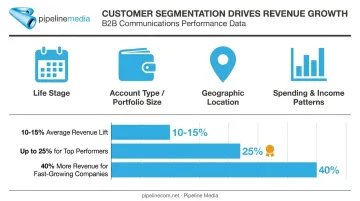
- Life stage — a 28-year-old opening a first savings account needs different messaging than a 58-year-old planning retirement withdrawals
- Account type and portfolio size — a $5,000 checking account holder and a $500,000 investment client shouldn't get identical messaging
- Geographic location — relevant not just for relevance, but because regulations vary by province, state, and country
- Spending and income patterns — informs which products actually make sense to promote
Here's a concrete example. A "first-time homebuyer" segment should receive educational content about down payments, pre-approval, and closing costs. An "existing homeowner refinancing" segment, pulled from the same campaign template, should instead see current rate comparisons and equity-based messaging. Same shell, different message, because the financial situations don't overlap.
Personalize With Purpose, Not Just Names
Inserting "Hi [First Name]" isn't personalization anymore. It's table stakes. Real personalization in financial services means:
- Surfacing a pre-calculated loan rate based on the client's actual credit profile
- Recommending an investment product that matches their existing portfolio composition
- Timing an email around a life event, like a CD maturing or a mortgage renewal date
This isn't just a nice-to-have. McKinsey found that companies applying strong personalization typically see a 10% to 15% revenue lift, with results ranging as high as 25% for top performers. Faster-growing companies pull 40% more revenue from personalization efforts than their slower-growing peers.
A smaller, sharply targeted list will consistently outperform one giant newsletter. Relevance drives opens far more reliably than raw list size. Pipeline Media's email broadcasting service handles this at scale, managing merge-field personalization on behalf of financial clients so large sends still carry account-specific details and an individual feel.
High-Performing Email Campaign Types for Financial Brands
Not every email serves the same purpose. Financial institutions should be running a mix:
- Welcome/onboarding series — introduces new clients to their account, sets expectations, and drives early engagement
- Transactional/service emails — statements, security alerts, payment confirmations
- Educational content — budgeting guidance, investment basics, retirement planning tips
- Promotional/cross-sell offers — relevant product recommendations, framed around client benefit
- Product/policy update announcements — rate changes, new features, regulatory notices
Welcome Emails Deserve Extra Attention
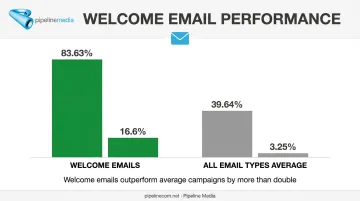
GetResponse's 2024 benchmark study, based on more than 4.4 billion messages, found welcome emails average an 83.63% open rate and 16.6% click-through rate, compared to 39.64% and 3.25% across all email types combined — more than double the engagement of any other type.
The first 90 days after signup is the window where new clients are most receptive. Use it to educate them on account features, set up autopay, or introduce a financial planning tool — before you ever ask for anything.
Educational Content Builds Trust First
That welcome-period education sets the tone, but the strategy should extend well beyond onboarding. Budgeting tips, first-time investor guides, retirement calculators — these build authority without asking for a sale. When you eventually do make an ask, clients are more receptive because you've already delivered value.
Don't Overdo the Asks
Promotional and cross-sell emails should be limited in frequency and always framed around the client's benefit, not the product's features. Send too many, and unsubscribe rates climb fast. The fix: cap promotional sends, and make sure each one clearly answers "what's in it for the client," not just "here's what we're selling." Managed email programs that build in compliance and unsubscribe tracking make this discipline easier to maintain at scale.
Email Design and Security Standards for Financial Institutions
Design That Reinforces Trust
Consistent branding — logos, colours, and footer details — across every email matters more in finance than in almost any other industry. Clients trust institutions that look organized. A sloppy or inconsistent email undermines that instantly.
Mobile responsiveness is not optional. Most recipients check email primarily on their phones. A broken layout on mobile signals carelessness at exactly the moment you're trying to build confidence.
Visual polish builds trust at a glance, but that trust only holds if the email actually reaches the inbox safely. That's where authentication comes in.
Authentication Protects Your Sender Reputation
Financial brands are prime targets for phishing and spoofing. Three technical protocols reduce that risk:
| Protocol | What It Does |
|---|---|
| SPF | Verifies which mail servers are authorized to send on your domain's behalf |
| DKIM | Cryptographically signs outgoing mail so receivers can confirm it wasn't altered |
| DMARC | Ties SPF and DKIM together, telling receiving servers what to do with unauthenticated mail |
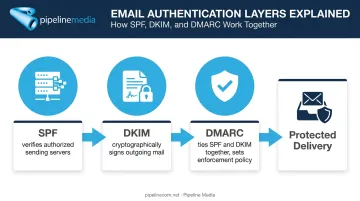
None of these stop every phishing attempt, but they significantly reduce the odds of your domain being spoofed and your emails landing in spam. Technical setup only goes so far, though. Pipeline Media backs it up with hands-on quality control, testing and retesting every email job before deployment so formatting and delivery issues get caught before they reach a client's inbox.
Tracking the Right Metrics and Managing Campaigns Efficiently
You can't improve what you don't measure. The core metrics every financial marketer should watch:
- Open rate — signals subject line and sender reputation strength
- Click-through rate — shows whether content actually resonates
- Bounce rate — flags list quality issues (hard bounces mean dead addresses)
- Unsubscribe rate — an early warning sign of fatigue or irrelevance
- Conversion rate — the ultimate measure of whether emails drive action
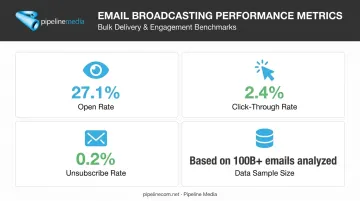
For context, Campaign Monitor's 2022 industry benchmark report put financial services average open rates around 27.1%, with a 2.4% click-through rate and a 0.2% unsubscribe rate, based on more than 100 billion emails analyzed in 2021.
Run Sunset Campaigns Before They Hurt You
That 0.2% unsubscribe benchmark only holds if you manage disengaged contacts proactively. If someone hasn't opened your last 3 to 5 emails, don't just keep sending. Run a re-engagement campaign first, then remove non-responders. Continuing to email unengaged contacts drags down your sender reputation and hurts deliverability for everyone else on the list.
When Internal Bandwidth Runs Short
Smaller banks, credit unions, and advisory firms often don't have a dedicated team to manage list hygiene, run A/B tests, and produce consistent reporting on top of everything else on their plate. This is where a full-service partner adds real value.
Pipeline Media manages email broadcasts end-to-end, handling unsubscribe compliance and providing detailed tracking on deliverability, opens, and link engagement. Internal teams stay focused on strategy while the execution runs in the background.
Campaigns go live within 60 to 90 minutes of submission, with sending capacity of millions of emails per hour. That speed matters for financial institutions that can't afford to sacrifice compliance guardrails for turnaround time.
Frequently Asked Questions
What are the key benefits of email marketing in the financial services sector?
Email delivers strong ROI compared to paid channels, keeps your brand present throughout long financial decision journeys, and builds trust through consistent, relevant communication with clients and prospects.
How can financial institutions stay compliant with CASL, CAN-SPAM, and GDPR in email marketing?
Obtain clear opt-in consent for promotional emails, always include a visible and functioning unsubscribe option, and maintain records of consent and sent campaigns in case of a regulatory audit.
What email marketing best practices work best for financial services companies?
Focus on behavior-based segmentation, personalization tied to actual account data, compliance-first design with visible disclosures, and limiting promotional asks per email to avoid fatigue.
How often should financial brands send marketing emails?
Frequency should follow engagement data and campaign type. Educational and transactional emails can go out more often; promotional emails should be sent more sparingly to avoid unsubscribes.
What email authentication measures should financial institutions use?
SPF, DKIM, and DMARC work together to verify sender identity and protect against domain spoofing. These are critical safeguards in financial services, where phishing attempts frequently impersonate trusted institutions.
Is it better to manage email campaigns in-house or outsource them?
Outsourcing suits teams without dedicated marketing staff, since a full-service provider handles compliance, unsubscribe management, and performance tracking. Agencies like Pipeline Media manage these campaigns end-to-end, freeing internal teams to focus on core operations.