Choosing the wrong channel isn't just inconvenient. Sending a signed contract over an unsecured email chain, or trying to fax a marketing campaign to 50,000 prospects, can cost you time, money, and in regulated industries, compliance standing.
Here's what the numbers show: approximately 70% of hospitals still used mail or fax to exchange patient health information as of 2021, according to a TechTarget report on DirectTrust. Meanwhile, the world sends an estimated 361.6 billion emails every single day, per Statista's 2024 email traffic data. Both channels are thriving. The question isn't which one wins, it's which one fits your specific message.
Key Takeaways
- Fax remains the standard for signed, regulated documents in healthcare, legal, and government sectors
- Email delivers unmatched speed for marketing, internal updates, and high-volume correspondence
- Modern cloud fax services eliminate hardware costs while preserving fax's compliance strengths
- Most businesses need both channels, and managing them through one provider simplifies billing and support
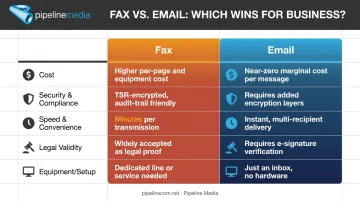
Fax vs Email: Quick Comparison
Here's how the two channels stack up across the factors that matter most to businesses.
Cost
Fax: Traditional fax requires hardware, phone lines, paper, and toner. Those costs add up fast. Cloud-based alternatives cut this dramatically. Pipeline Media's Fax-to-Email service starts at $10 USD/month for the Standard plan (100 pages in/out) or $20 USD/month for the Pro plan (250 pages in/out), with no setup fees.
Email: Generally cheaper for everyday messaging through hosted platforms like Gmail or Outlook. Bulk campaigns are different — managing lists, deliverability, and compliance takes real infrastructure, which is why many businesses outsource broadcasting rather than build it in-house.
Security & Compliance
Fax: Point-to-point transmission via phone lines is widely considered less exposed to internet-based attacks. But fax isn't flawless — HHS documented a case where a practice faxed a patient's HIV status to the wrong recipient entirely.
Email: Higher exposure to phishing and account compromise. Verizon's 2024 Data Breach Investigations Report found the human element present in 68% of breaches, with phishing simulations showing a median click time of just 21 seconds.
Speed & Convenience
Fax: Pipeline's Fax Broadcast service sends over 1 million pages per hour, with most jobs completing in under an hour.
Email: Pipeline's Email Broadcast handles millions of emails per hour, typically live within 60–90 minutes of submission.
Legal Validity
Fax: Several jurisdictions, including California, formally recognize signed fax documents under specific procedural rules.
Email: Protected under the federal E-SIGN Act, which states electronic signatures and records can't be denied legal effect solely for being electronic — though court and agency-specific rules still apply.
Equipment/Setup Requirements
Legal recognition aside, the two channels differ sharply in what it actually takes to get started.
| Channel | What You Need |
|---|---|
| Traditional fax | Fax machine, phone line, paper, toner |
| Cloud fax (Pipeline Fax-to-Email) | Internet connection only — no hardware, no software install, no setup fee |
| Business email | Domain, hosted mail service, authentication setup |
What Is Fax?
Fax transmits document images through phone lines or, increasingly, through online fax servers that skip the physical hardware entirely. It survives in 2025 because regulated industries need something email struggles to guarantee: a verifiable, point-to-point delivery trail for signed documents.
Its core advantages include:
- Reduced interception risk through point-to-point transmission (versus email's exposure to inbox compromise)
- Delivery confirmation that shows exactly when and where a document landed
- Broad acceptance for signed, regulated paperwork across legal and government workflows
Traditional Fax Machines vs. Cloud Fax Services
The old model meant a physical machine, a dedicated phone line, paper, and toner. Every one of those is a potential failure point — and a recurring cost.
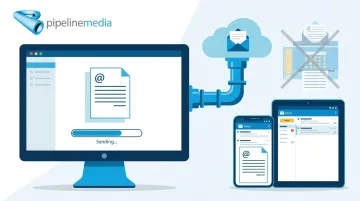
Cloud fax services remove that dependency. Pipeline Media's Fax-to-Email service, for instance, lets users send and receive faxes from any computer or device for a flat monthly fee. One client testimonial captures it well: "Pipeline's Fax-to-Email service allowed us to get rid of our old fax machines in 5 offices." No machine to break down. No paper to run out of.
Use Cases of Fax
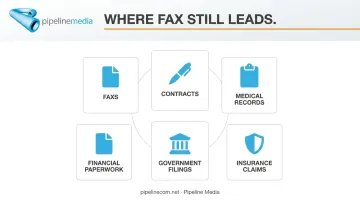
Fax fits naturally into workflows involving signatures, regulatory filings, and sensitive records:
- Contracts requiring signed originals or specific procedural recognition
- Medical records and referrals between healthcare providers
- Insurance claims with supporting documentation
- Government filings, including forms like the IRS SS-4, which explicitly permits fax submission
- Financial paperwork requiring verified, traceable delivery
Healthcare remains fax's strongest use case. The 70% hospital usage figure for mail and fax reflects ongoing workflow habits that are hard to displace, even as electronic health record systems expand. CAQH's 2023 Index Report also found that 71% of medical attachments remained fully manual, a category that includes fax alongside phone and mail.
Pipeline Media supports clients in Financial Services, Government, and Healthcare, where fax's compliance-friendly reputation continues to justify its place in the workflow.
What Is Email?
Email moves messages and files across the internet, instantly and at almost no marginal cost. It's the default channel for high-volume, fast-turnaround communication, from customer service to internal memos to marketing blasts.
Core benefits include:
- Instant delivery across any distance
- Low per-message cost, even at massive scale
- Support for varied file attachments (PDFs, images, spreadsheets)
- Simple mass distribution to thousands of recipients simultaneously
Standard Email vs. Broadcast Platforms
Those benefits hold up for one-to-one correspondence, but a standard inbox breaks down fast at scale. Sending limits, no tracking, and no personalization make it a poor fit for bulk outreach.
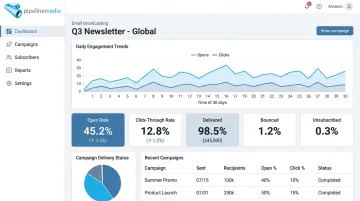
Broadcast platforms solve that gap. Pipeline Media's Email Broadcasting service, for example, sends millions of emails per hour with built-in tracking, merge-based personalization, and unsubscribe compliance management baked in. Most campaigns finish within 60–90 minutes, with delivery data ready for review right after launch.
Use Cases of Email
Email dominates wherever speed and scale matter more than formal signatures:
- Marketing campaigns targeting large customer lists
- Internal communication across teams and departments
- Customer service correspondence and support tickets
- Non-sensitive document sharing, like brochures or newsletters
These use cases explain why retail, technology, publishing, and marketing-heavy organizations lean on email as their primary channel. The scale backs this up: Mailchimp's benchmark data puts the average marketing email open rate at 35.63% across tracked campaigns, with government messaging performing even better at 40.55%. With 361.6 billion emails sent daily worldwide, no other channel matches that volume.
For businesses running high-volume campaigns without in-house infrastructure, managed email broadcasting services like Pipeline Media's handle the delivery, tracking, and compliance work behind these use cases, from marketing blasts to customer service correspondence.
Fax vs Email: Which Is Better for Your Business?
There's no universal winner here. The right answer depends on:
- Document sensitivity: whether the document is signed, regulated, or legally significant.
- Industry compliance requirements, since some sectors still expect fax for certain filings.
- Recipient expectations — Will the other party even accept email for this document type?
- Budget, factoring in your volume and the true cost per channel.
- Turnaround time — Do you need instant delivery or verified receipt?
Choose fax when:
- The document requires a signature or regulatory acceptance
- Delivery confirmation matters more than speed
- You're operating in healthcare, legal, financial, or government sectors
Choose email when:
- You need to reach a large audience quickly
- Cost-efficiency and speed outweigh formal verification needs
- The content is marketing, internal updates, or general correspondence
These lists aren't mutually exclusive, though. Many businesses need both channels depending on the document, which is why you don't have to pick one and stick with it forever. Pipeline Media manages Fax Broadcast and Email Broadcast campaigns side by side, letting you route each message through the channel it actually needs without juggling two vendor relationships. Its Fax-to-Email service adds a hybrid option on top: fax capability without ever touching a physical machine.
Real-World Example: Running Both Channels Effectively
Picture a mid-sized company still running a physical fax machine in the back office, alongside a marketing team manually blasting emails from a shared inbox. Deadlines slip. Delivery tracking is inconsistent at best. Nobody knows if that fax actually went through until someone calls to check.
That's a common breaking point — and it's usually when businesses switch to a full-service broadcast provider.
What changes with a managed provider:
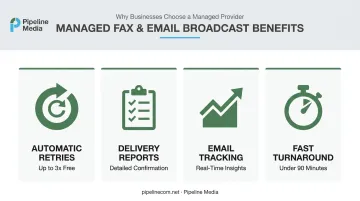
- Failed fax numbers get retried automatically up to 3 times, at no extra cost
- Detailed reports show exactly who received a fax and why others failed
- Email campaigns come with open-rate tracking, link-click data, and undeliverable lists
- Jobs run fast: fax broadcasts complete in under an hour; email jobs go live in 60–90 minutes
The financial impact is real. Martine C. of Sacramento reported that switching her fax traffic to Pipeline Media saved her organization "hundreds of dollars per week," with jobs running faster and cheaper than before.
Robert H. of Miami said outsourcing his monthly fax broadcasts removed "hours of monotonous work" from his plate every month.
Neither fax nor email needs to disappear — they just need the right infrastructure behind them. Automatic retries, delivery reports, and fast turnaround times are what keep both channels from becoming a bottleneck.
If you're currently managing fax and email separately — or manually — Pipeline Media can show you exactly what a managed campaign looks like on a free consultation call.
Conclusion
Neither fax nor email is the "better" technology in some absolute sense. The right choice comes down to what you're sending, who's regulating it, and what the recipient expects to receive. A signed medical record and a marketing newsletter simply don't belong in the same channel.
Businesses that treat fax and email as complementary tools, rather than competing ones, tend to see the biggest wins. Lower compliance risk, less administrative overhead, and communication that lands reliably, no matter which channel carries it. Pipeline Media's fax broadcasting, fax-to-email, and email broadcasting services let you run both channels from one partner, so the right message always reaches the right inbox or fax line.
Frequently Asked Questions
Are email and fax the same thing?
No, they're fundamentally different technologies. Email sends text and attachments over the internet, while fax transmits document images via phone lines or dedicated fax servers. "Fax-to-email" services bridge the two by letting you send and receive faxes through an email-like interface.
Is it better to email or fax?
It depends on the use case. Email wins for speed and mass communication, while fax remains preferable for legally binding or regulated documents that require compliance and signature verification.
Is faxing more secure than email?
Fax is generally considered more secure due to its point-to-point transmission model, compared to email's greater exposure to phishing and inbox compromise. Online fax services add further encryption safeguards on top of that baseline.
Can I send a fax without a fax machine?
Yes. Online fax and fax broadcasting services, like Pipeline Media's Fax-to-Email, let you send and receive faxes from any computer or device without physical hardware.
Is fax still used in business today?
Yes, fax remains widely used in healthcare, legal, financial, and government sectors due to its legal recognition and compliance acceptance. Approximately 70% of hospitals still used mail or fax for health information exchange as of 2021.
Which is more cost-effective, fax or email?
Email is generally cheaper for everyday communication. However, cloud fax services have significantly reduced traditional fax costs, with plans like Pipeline Media's starting at $10 USD/month, making bulk fax campaigns competitive for regulated document delivery.