

It doesn't matter if your office is in Toronto, Texas, or Tokyo. If you're emailing people in the EU, the regulation applies to you.
The stakes are real. Fines can reach into the millions. But the flip side matters too: compliant email programs tend to see better engagement, because subscribers who genuinely opted in actually want to hear from you. This guide walks through the legal bases, the core GDPR requirements, and the practical steps that keep your campaigns on the right side of the law.
What Is GDPR Email Marketing Compliance?
GDPR (the General Data Protection Regulation) is the EU's data protection law. It treats an email address as personal data the moment it can be linked to an identifiable person, which means your subscriber list counts as a regulated dataset, not simply a marketing asset.
That classification extends to more than the address itself:
- Names attached to an inbox
- Open and click tracking tied to a person
- Engagement history and preference data
This broad definition matters because GDPR's reach doesn't stop at EU borders. Under Article 3(2), any organization (regardless of headquarters location) must comply if it markets to or monitors people located in the Union. A Canadian agency emailing prospects in Germany is just as accountable as a company based in Berlin.
Is Sending Marketing Emails Without Permission Illegal?
Generally, yes. The ePrivacy Directive's Article 13(1) requires prior consent for direct marketing by email. Combine that with GDPR's lawful basis requirement, and sending unsolicited marketing emails without a valid legal justification is a violation that can trigger regulatory fines and enforcement action.
Key Takeaways
- GDPR requires a valid legal basis — usually consent or legitimate interest — before you email EU residents
- Consent must be freely given, specific, informed, and unambiguous — pre-checked boxes don't count
- The "soft opt-in" lets you email existing customers about similar products without fresh consent
- Fines can reach €20 million or 4% of global annual revenue, whichever is higher
Legal Bases for Sending Marketing Emails Under GDPR
GDPR lists six lawful bases for processing personal data, but email marketers realistically lean on two: consent and legitimate interest.
Consent as the Primary Basis
Valid consent under GDPR must meet four conditions:
- Freely given — no penalty for refusing
- Specific — tied to a particular purpose, not bundled with unrelated permissions
- Informed — the person knows exactly what they're agreeing to
- Unambiguous — expressed through clear, affirmative action
Pre-ticked checkboxes fail this test. So does silence or inactivity. According to the ICO's guidance on valid consent, default settings never count as consent — the person has to actively opt in.
Withdrawal has to be just as easy as signing up. If someone can subscribe with one click, they need a one-click way out too.
Legitimate Interest for Existing Relationships
Legitimate interest works better for existing customers than cold outreach. To rely on it, organizations should document a three-part test:
- Purpose test — identify the legitimate interest being pursued
- Necessity test — confirm the processing is actually needed to achieve it
- Balancing test — weigh that interest against the individual's rights and reasonable expectations
Even when legitimate interest applies, people retain the right to object at any time. Legitimate interest also only covers processing contact data — ePrivacy rules still govern whether you're allowed to send the email at all.
The Soft Opt-In Exception
The ePrivacy Directive carves out one practical exception. If you obtained someone's email address during a sale, you can market your own similar products or services without new consent — as long as you offered a clear opt-out at collection and include one in every message. This allowance stays narrow: it covers follow-up marketing on similar products, not general prospecting lists.
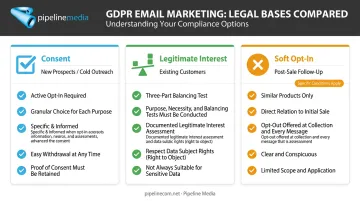
Here's how the three bases compare in practice:
| Legal Basis | Best For | Key Requirement |
|---|---|---|
| Consent | New prospects, cold outreach | Active opt-in, easy withdrawal |
| Legitimate Interest | Existing customer relationships | Documented three-part test |
| Soft Opt-In | Post-sale follow-up marketing | Clear opt-out at collection and in every message |
Getting this right matters beyond the legal risk. Pipeline Media's email broadcasting service builds unsubscribe and compliance management into every campaign, so opt-outs are honored automatically regardless of which basis a client relies on.
The 7 GDPR Requirements Every Email Marketer Must Know
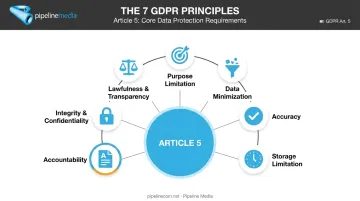
Article 5 of GDPR lays out seven principles that shape nearly every operational decision an email marketer makes.
| Principle | What It Means for Email Marketing |
|---|---|
| Lawfulness, fairness & transparency | Have a valid legal basis and be upfront about data use |
| Purpose limitation | Data collected for one purpose can't quietly become marketing fuel |
| Data minimization | Collect only what the campaign actually needs |
| Accuracy | Keep records current; let people fix errors easily |
| Storage limitation | Don't hoard contact data past its useful life |
| Integrity & confidentiality | Apply real security safeguards |
| Accountability | Prove compliance with documentation, not just claims |
Purpose Limitation and Data Minimization
If a customer gave their email to receive a receipt, that's not automatic permission to add them to a newsletter. Purpose limitation means disclosing marketing use upfront — or getting separate consent for it.
Data minimization keeps this simple: collect the email address and maybe a first name. Skip the extra fields unless you have a genuine use for them.
Storage Limitation and Accuracy
Minimizing what you collect only helps if you also manage what you keep. Sitting on years of dead contacts doesn't just clutter your database. It's a compliance liability. Regular list cleanups — removing inactive subscribers and correcting outdated records — satisfy both principles at once.
Security and Accountability
Clean, accurate records mean little if they aren't protected. Security failures remain a real threat vector. In Verizon's 2025 Data Breach Investigations Report, phishing accounted for roughly 15% of known initial-access vectors in breaches analyzed. Email lists are a target, not just a marketing tool.
Accountability means keeping the paper trail: consent records, data processing agreements, retention schedules. Regulators don't take your word for compliance; they expect evidence. Agencies managing email broadcasts on a client's behalf typically maintain these records as part of the service, including unsubscribe and compliance tracking.
Best Practices for GDPR-Compliant Email Campaigns
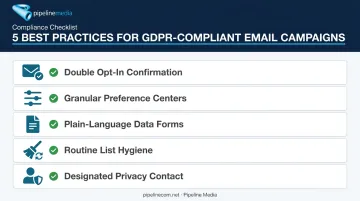
Turning these principles into daily practice requires a few concrete habits.
- Use double opt-in confirmations. A follow-up confirmation email gives you documented proof of consent and filters out invalid or mistyped addresses.
- Build granular preference centers. Let subscribers choose content types and frequency instead of forcing an all-or-nothing subscription.
- Write plain-language data forms. State exactly what you're collecting, why, and how long you'll keep it. Skip the legal jargon.
- Run routine list hygiene. Remove inactive contacts and process suppression requests automatically, not as an afterthought.
- Assign a designated privacy contact. Someone internally (or at your marketing partner) needs to own consent documentation and keep it current.
Where Managed Providers Fit In
Manually tracking consent records, unsubscribe workflows, and list hygiene gets harder the bigger your list grows. At scale, it's easy for a suppression request to fall through the cracks, and that single oversight can trigger a compliance failure.
Full-service providers address this directly. Pipeline Media, for example, builds compliance management into its email broadcasting campaigns, including handling the unsubscribe system on clients' behalf. Instead of a client's team manually processing opt-outs across spreadsheets, that administrative and legal burden shifts to the provider running the campaign.
Pipeline also maintains a designated privacy contact, Mark Hunter, who oversees data handling matters for the organization. It's a practical example of the "internal privacy contact" habit worth building into any email program, whether managed in-house or through a partner.
Common Violations, Data Subject Rights & Penalties
Most GDPR email enforcement traces back to a short list of recurring mistakes:
- Buying or renting email lists with no verifiable consent
- Using pre-checked opt-in boxes at signup
- Ignoring or delaying unsubscribe requests
- Publishing vague privacy notices that don't explain actual data use
The UK's ICO fined HelloFresh £140,000 after it sent 79 million marketing emails without properly informed consent. The consent wording didn't clearly cover email marketing, according to the ICO's official enforcement notice.
Cases like this show why unsubscribe handling and consent tracking can't be an afterthought bolted onto a campaign. Full-service email broadcasting providers such as Pipeline Media build compliance and unsubscribe management directly into the sending process, which is one reason businesses outsource this piece rather than manage it manually.
Data Subject Rights Marketers Must Support
- Access — people can request what data you hold on them
- Rectification — correcting inaccurate records
- Erasure — the "right to be forgotten," subject to certain exceptions
- Objection — the right to stop direct marketing at any time, no justification required
Requests generally need a response within one month, extendable by up to two additional months for complex cases. Have a process ready before the request arrives, not after.
Beyond the EU: CASL and CAN-SPAM
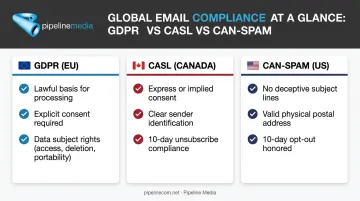
GDPR isn't the only regime that matters for North American senders. Businesses running cross-border campaigns should also track these parallel rules:
| Regime | Core Requirement |
|---|---|
| Canada's CASL | Express or implied consent, sender identification, working unsubscribe within 10 business days |
| US CAN-SPAM | No deceptive subject lines, valid postal address, opt-outs honored within 10 business days |
Frequently Asked Questions
Is it illegal to send marketing emails without permission?
Generally, yes. Under GDPR and the ePrivacy Directive, marketing emails need a lawful basis, consent or an exception like soft opt-in. Without one, you're exposed to fines and regulatory action.
What is GDPR in email marketing?
GDPR is the EU law governing how businesses collect, store, and use personal data — including email addresses — for marketing. It requires a lawful basis, transparency, and respect for subscriber rights.
What are the 7 GDPR requirements?
Lawfulness/fairness/transparency, purpose limitation, data minimization, accuracy, storage limitation, integrity/confidentiality, and accountability. These come from Article 5 of the regulation.
Does GDPR apply to businesses outside the EU?
Yes. Any organization processing personal data of people located in the EU must comply, regardless of where the company itself is headquartered.
Can I email existing customers without new consent under GDPR?
Yes, under the soft opt-in exception. You can market your own similar products to existing customers without fresh consent, provided you offer a clear opt-out in every message.
What happens if a business doesn't comply with GDPR email marketing rules?
Fines can reach €20 million or 4% of global annual revenue, whichever is higher. Beyond the financial hit, non-compliance damages subscriber trust and brand reputation.