Introduction
Running a business today means running a marketing department, too, even if you never planned on it. Between writing email campaigns, keeping social feeds active, and tweaking ad accounts daily, marketing quickly turns into a full-time job on top of everything else.
Many business owners end up stitching together a freelancer here, a boutique agency there, and a part-time hire somewhere in between. The result? Inconsistent messaging, missed deadlines, and nobody who can answer for the whole picture.
A full-service digital marketing agency solves this by putting one team in charge of strategy and execution across every channel. This guide breaks down what these agencies actually do, the benefits of hiring one, and how to pick the right partner, including what to look for in a communications-focused provider.
Key Takeaways
- Full-service agencies consolidate PPC, social media, email, and broadcast communications under one accountable team.
- Businesses hire them primarily to save internal hours and cut vendor-management overhead.
- Not every "full-service" agency offers identical services, so verify depth before signing.
- Paid channels show results in weeks; organic strategies take months to compound.
What Is a Full-Service Digital Marketing Agency?
A full-service digital marketing agency manages multiple marketing functions, strategy, creative, media buying, execution, and reporting, under one roof. Instead of hiring a freelance copywriter, a separate PPC specialist, and a social media contractor, you work with one team that coordinates all of it.
This differs sharply from a niche agency that focuses on a single channel, like an SEO-only shop or a PPC specialist. Niche agencies can go deep on one skill set, but they leave you responsible for stitching everything together yourself.
A single point of contact matters more than most businesses realize. When one team owns every channel, you get:
- Consistent messaging across email, social, and paid ads
- One set of timelines instead of five conflicting schedules
- A single party accountable for results, not a chain of finger-pointing
Here's the catch: "full-service" doesn't mean every agency offers an identical menu. Some lean communications-focused (email, fax, PPC). Others specialize in creative and branding. Still others build out enterprise tech stacks. The label describes a model, not a fixed list of services.
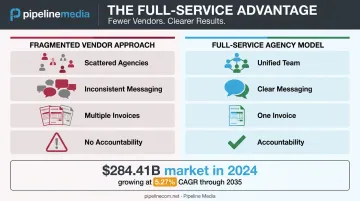
Demand for this model is climbing. The global marketing-agencies market was valued at $284.41 billion in 2024, with a projected 5.27% compound annual growth rate through 2035, according to Market Research Future.
That growth reflects a broader shift: businesses want one accountable partner instead of a patchwork of vendors. Consolidating vendors cuts the hours spent managing multiple relationships and reduces the miscommunication that creeps in between disconnected providers.
Core Services a Full-Service Digital Marketing Agency Typically Offers
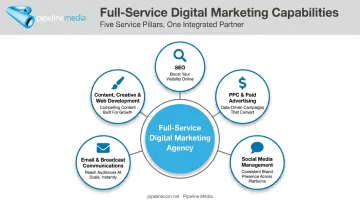
Not every full-service agency provides every channel below. Think of this as the standard menu, then check which items your prospective partner actually serves.
Search Engine Optimization (SEO)
SEO services typically cover keyword research, on-page optimization (titles, headings, internal links), and content strategy built to earn organic visibility over time. Unlike paid channels, SEO compounds slowly.
Search Engine Land reports that meaningful SEO results generally take several months to as long as a year to materialize, depending on competition, site history, and technical health. There's no shortcut here, just steady, methodical work.
Pay-Per-Click (PPC) & Paid Advertising
PPC management covers campaign setup, keyword bidding, ad copy, and continuous optimization across platforms like Google and social ad networks. A good PPC partner is also constantly refining Quality Scores to bring your cost-per-click down over time.
Reputable providers often skip long-term contracts and setup fees entirely. That lowers the barrier for smaller businesses testing paid channels for the first time.
What a client-friendly PPC model usually looks like:
- No sign-up fees to get started
- No long-term contract lock-in
- Client-controlled daily or weekly budgets
- Charges tied only to actual clicks, not impressions
Social Media Management
This service typically includes content calendars, organic posting, community engagement, and, increasingly, paid social campaigns aimed at generating leads rather than just likes.
Pricing usually scales with scope. A baseline "presence" package might cover consistent posting and profile management across a handful of platforms.
Higher tiers often add paid ad creation and conversion-focused content, layering growth tactics on top of that foundation once it's solid.
Email Marketing & Broadcast Communications
Email services cover list segmentation, campaign design, and performance tracking (opens, clicks), along with compliance work like unsubscribe management. That compliance piece isn't optional. Under the CAN-SPAM Act in the US, businesses must honor opt-out requests within 10 business days, and neither the sender nor the company can contract away that responsibility.
Some full-service providers extend this into other broadcast formats, like fax-to-email, for industries still leaning on fax communication. Healthcare, legal, and government sectors, for instance, often still use fax because it offers secure transmission and reliable delivery confirmation that email can't always guarantee.
Content, Creative & Web Development
Many full-service agencies round out their offering with website design, graphic design, and content creation that supports the other channels. This isn't universal, though. Some agencies deliberately stay focused on communications and paid channels rather than spreading into web development.
Benefits of Partnering with a Full-Service Digital Marketing Agency
Consolidating channels under one team pays off in ways that go beyond convenience.
Message consistency improves. When one team writes your email copy, manages your social captions, and builds your ad creative, your brand voice stays coherent across every touchpoint. Coordinating five separate vendors on brand guidelines is a losing battle.
Time and cost savings compound. Outsourcing execution frees your internal team to focus on running the business instead of chasing campaign status updates. This isn't hypothetical:
- Pipeline Media clients have reported saving hours of monotonous coordination work each month
- One client specifically noted savings of hundreds of dollars per week after consolidating fax traffic to a single provider
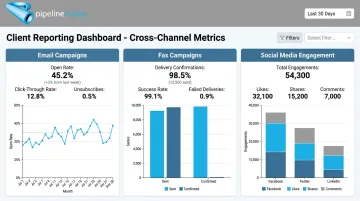
- Detailed tracking reports cover email opens, link clicks, and fax delivery status automatically, so no one has to chase down status updates manually
Vendor fatigue is real, too. A 2018 WFA study found that agency-roster arrangements were under review at 74% of multinational brands, largely due to dissatisfaction with fragmented, hard-to-manage vendor relationships. Fewer vendors means less time in status meetings, fewer invoices to reconcile, and less chance of anything falling through the cracks.
How to Choose the Right Full-Service Digital Marketing Agency
Picking a partner shouldn't be a leap of faith. Follow this sequence:
- Define your goals and budget first. Vague hopes like "grow our brand" don't give you anything to measure against. Set specific benchmarks (lead volume, cost-per-click, email open rate) before you start evaluating agencies.
- Verify service depth in the channels that matter most to you. "Full-service" doesn't guarantee equal strength everywhere. If PPC is your priority, don't just confirm they offer it; ask specific questions:
- How are campaigns structured and segmented?
- What's the process for ongoing optimization?
- How is budget allocated across channels?
- Ask who actually manages your account. Find out whether you'll get a dedicated contact or get routed through a support queue, and how quickly they respond to requests. A same-day response is reasonable to expect; anything slower should raise a flag.
Signs Your Business Needs a Full-Service Marketing Partner
Some warning signs are easy to miss until they've cost you real opportunities.
- Task overload: Campaigns get delayed, emails go out late, or social posts stop altogether during busy weeks.
- Disjointed messaging: Your email tone doesn't match your social voice, and nobody's tracking whether that inconsistency is hurting conversions.
- No performance tracking: You're spending money on ads or campaigns without a clear read on what's actually working.
This isn't a niche problem. A 2025 Constant Contact survey of 2,500 small-business decision-makers found that 42% had less than one hour per day to dedicate to marketing. That same study found confidence in marketing effectiveness dropped year over year, from 27% to just 18%.
If you're juggling several freelancers or single-channel vendors, you've likely already felt the communication gaps a unified partner eliminates. And if you're expanding into a new channel, such as adding social to an existing PPC program, a full-service partner can scale immediately. You won't need to repeat vendor onboarding for every new channel you add.
Why Businesses Choose Pipeline Media as Their Full-Service Communications Partner
Pipeline Media has operated as a full-service business communications agency out of Toronto since 2003. The company started with fax broadcasting, sending over a million pages per hour, and grew into a full suite covering fax-to-email, email broadcasting, social media management, and PPC advertising.
A few things set the model apart:
- Real-person response within minutes. When you contact Pipeline to start a campaign, an actual person replies quickly and works to get it live as soon as possible, not an automated ticket system.
- No-contract PPC. Clients control their own daily or weekly budget, pay only for actual clicks, and aren't locked into long-term agreements or setup fees.
- Detailed tracking across channels. Email reports cover opens, undeliverables, and link engagement. Fax reports confirm delivery status and explain any failures, with problem numbers retried three times at no charge.
- Professionally managed social media presence. The Social Media Presence tier ($500/month USD) covers consistent, professionally managed posting across Instagram, Facebook, X, and LinkedIn.
Businesses across healthcare, financial services, government, and manufacturing rely on this model because it removes the guesswork of managing multiple vendors. A free consultation shows exactly how these services map to your specific channels.
Frequently Asked Questions
What does a full-service marketing agency offer?
A full-service agency bundles strategy, creative, and execution across channels like PPC advertising, social media, and email marketing under one team. This integrated approach reduces the need to manage multiple vendors.
What is the difference between a full-service agency and a specialized agency?
Specialized agencies focus deeply on a single channel, like SEO or PPC. Full-service agencies coordinate multiple channels together, delivering consistent messaging and unified reporting across all of them.
How much does it cost to hire a full-service digital marketing agency?
Pricing varies widely by scope, from a few hundred dollars monthly for a single channel like social media to several thousand for multi-channel programs. Clutch reports typical digital-marketing engagements ranging from $5,000 to $50,000 per month across the broader industry.
How do I know if my business needs a full-service marketing agency?
Businesses juggling multiple vendors, lacking in-house marketing bandwidth, or struggling with inconsistent messaging are strong candidates. If nobody internally is tracking campaign performance, that's another clear signal.
What should I look for when choosing a full-service digital marketing agency?
Look for clear goals and defined budgets upfront, verified depth in the channels you care about most, transparent reporting, and responsive, accountable communication. Ask specifically who manages your account day to day.
How long does it take to see results from a full-service marketing agency?
Paid channels like PPC and email can deliver measurable results—such as clicks and conversions—within weeks. In contrast, building an organic social media presence often takes several months to gain traction and show audience growth.