Many companies launch a campaign, set a budget, and walk away. The result? Wasted clicks on irrelevant searches, sinking Quality Scores, and landing pages that bleed conversions instead of capturing them.
This is where PPC campaign management comes in. It's the difference between throwing money at ads and building a system that actually pays for itself.
In this guide, we'll break down what PPC campaign management involves, the core components that make campaigns work, the real benefits of professional oversight, and how to decide whether to manage things in-house or bring in a specialist.
Key Takeaways
- PPC management is ongoing — research, execution, and optimization never stop
- Five pillars drive results: keywords, ad creative, bids, landing pages, and tracking
- Skilled management lowers cost-per-click while boosting conversion rates
- Choosing DIY vs. an agency comes down to your time, expertise, and need for speed
What Is PPC Campaign Management?
PPC, or pay-per-click, is an advertising model where you only pay when someone clicks your ad. Campaign management is the ongoing work behind that model : planning, launching, monitoring, and continuously adjusting ads so they actually hit your business goals, instead of just running in the background.
How the PPC Auction Works
Many business owners assume the highest bidder always wins the top ad spot. That's not how it works.
Google's Ad Rank formula combines your bid with Quality Score — a mix of expected click-through rate, ad relevance, and landing page experience. A well-optimized ad with a lower bid can beat a sloppy ad backed by a bigger budget.
Costs vary wildly by industry and competition. WordStream's 2025 benchmark study of over 16,000 U.S. search campaigns found an average CPC of $5.26, though that number swings dramatically depending on your niche.
Here's a distinction that trips up a lot of advertisers: your keyword is the phrase you bid on to trigger your ad, while the search term is the actual phrase a real person types into the search bar.
These aren't always the same. A business bidding on "accounting software" might show up for a search term like "free accounting software for nonprofits," a completely different intent. Reviewing your search terms report regularly keeps your budget pointed at the right audience.
PPC vs. SEO: Understanding the Difference
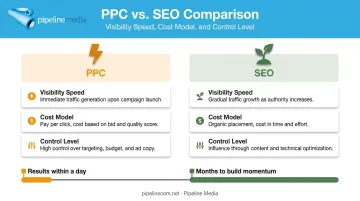
Paid search puts you in front of customers today. SEO gets you there eventually, but the wait can be long.
Ahrefs' 2025 study of newly published pages found that only 1.74% of new pages reached Google's top 10 within a year. PPC ads, by contrast, can go live within a day of approval.
That doesn't make SEO a bad investment. It makes PPC and SEO different tools for different jobs:
| Factor | PPC | SEO |
|---|---|---|
| Visibility | Immediate, live within a day | Builds gradually over months |
| Cost model | Pay only for clicks | No cost per visit, but requires ongoing investment |
| Control | Turn on or off anytime | Slower to adjust once rankings are set |
The strongest digital strategies rarely pick one over the other. PPC drives fast, measurable traffic while SEO compounds in the background, building equity that pays off for years.
Core Components of Effective PPC Campaign Management
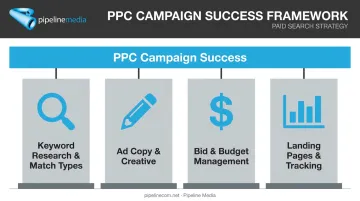
A PPC campaign runs on several moving parts, not a single lever. Pull one out, and performance stalls. Here are the four pillars that make campaigns actually work.
Keyword Research & Match Types
Effective keyword research starts with understanding exactly what your customers type into search bars. Tools like Google Keyword Planner reveal search volume, competition, and cost estimates for any term you're considering.
Match types control how tightly your keyword mirrors a user's search:
- Broad match: widest reach, can trigger on loosely related searches
- Phrase match: shows for searches containing your keyword's meaning
- Exact match: shows only for searches matching the keyword's intent
Negative keywords matter just as much: they block your ads from showing on irrelevant searches. WordStream's analysis of over 250,000 Google Ads audit reports found accounts using at least one negative keyword saw a 13% conversion rate, compared to just 4.6% for accounts with none. That's not a small gap.
Ad Copy & Creative Development
A winning ad has four parts working together: a headline that grabs attention, a description that reinforces the offer, a display URL that builds trust, and extensions that add extra value, like phone numbers or site links.
The copy has to match what the searcher is actually looking for. An ad promising "same-day emergency plumbing" needs to lead with urgency, not a generic tagline.
Continuous A/B testing isn't optional. Testing different headlines, CTAs, and value propositions against each other reveals which combinations actually drive clicks, and which ones waste your budget instead.
Bid & Budget Management
There are two broad approaches. Manual bidding gives you full control over what you pay per click, ideal for smaller or highly predictable campaigns. Automated bidding (like Target CPA or Target ROAS) uses machine learning to adjust bids in real time based on conversion likelihood.
Automated strategies need a runway to work. Google's own guidance notes that automated bidding can take up to three weeks, or one to two conversion cycles, to fully calibrate.
Budget pacing matters too. Smart management means shifting spend away from underperforming ad groups and toward the keywords and audiences actually converting, not letting the budget drain evenly across winners and losers alike.
Landing Pages & Performance Tracking
Your ad might be flawless, but if the landing page doesn't deliver on the promise, that click was wasted money. This is called message match: making sure the page a user lands on echoes the exact language and offer from the ad and keyword that got them there. Mismatched messaging spikes bounce rates and tanks conversions.
Once traffic is landing correctly, tracking tells you what's actually working:
| KPI | What It Tells You |
|---|---|
| CTR | How compelling your ad is to searchers |
| CPC | What you're paying per click |
| Conversion Rate | How well your landing page converts visitors |
| CPA | Cost to acquire one customer or lead |
| ROAS | Revenue generated per dollar of ad spend |
Benefits of Professional PPC Campaign Management
Running PPC takes constant attention: daily bid checks, weekly reporting, ongoing testing, and constant adjustments as markets shift. That's a real time cost for internal teams already stretched thin.
Professional management typically delivers:
- Freed-up internal time: your team stops babysitting bids and reports and gets back to core operations
- Lower cost-per-click over time: continuous optimization catches waste that "set-and-forget" campaigns miss entirely
- Access to premium research tools: competitor analysis and reporting platforms that would otherwise cost a business thousands of dollars a year to license independently
"Set-and-forget" campaigns are one of the most expensive mistakes a business can make. Ad platforms shift constantly: auction dynamics change, competitors adjust bids, and audience behavior evolves over time. Without someone watching, budgets drift toward keywords and placements that stopped performing months ago. Pipeline Media closes that gap by monitoring accounts continuously, with no sign-up fees or contracts.
DIY PPC vs. Partnering with a PPC Management Agency
Managing PPC yourself is entirely possible. It's also a steeper climb than most people expect.
In-house challenges typically include:
- The learning curve — mastering Quality Score and auction dynamics, plus keeping pace with platform algorithm changes, takes months, not days
- Time investment — daily monitoring and weekly reporting eat into hours meant for running the actual business, on top of the ongoing testing every campaign demands
- Trial-and-error costs — mistakes get paid for in real ad spend, not hypothetical losses
A dedicated agency brings platform expertise built from managing accounts across industries. That translates into regular performance reporting and continuous optimization, all without the client needing to check in daily.
Pipeline Media's PPC advertising service is one example of this hands-off model in action. The Toronto-based agency has managed business communications and digital campaigns for corporate clients across North America since 2003, and its PPC program runs on a few simple principles:
- No sign-up fees or contracts — clients set their own daily or weekly budget and can adjust or cancel anytime
- Configuration and optimization handled in full — from placing ads where customers are already searching to continuously refining Keyword Quality Scores and reducing cost-per-click
- Remarketing built in — keeping a brand in front of visitors after they leave the site
- Real human support — a person responds within minutes of a campaign request, rather than routing clients through automated ticketing systems
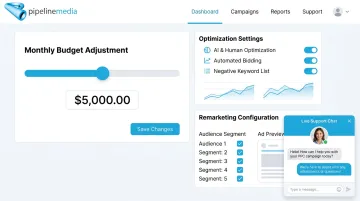
For a business already running fax or email campaigns through the same provider, adding PPC without hiring a new specialist or learning a new platform is often the deciding factor.
Popular PPC Platforms & Tools
Google Ads remains the dominant platform for search and display advertising, reaching users at the exact moment they're actively looking for a product or service. It's usually the first stop for businesses starting PPC.
Beyond Google, several other platforms serve different purposes:
- Facebook and Instagram: interest- and behavior-based targeting, useful for reaching people before they're actively searching
- LinkedIn: B2B targeting based on job title, industry, and company size
- Bing Ads (Microsoft Advertising): typically less competition and lower CPCs, a solid secondary channel for search traffic
Ongoing refinement also relies on research tools. Keyword planners reveal search volume and competition data, while competitor analysis tools show where rival ad dollars are going and which messaging is winning clicks in your space.
No single platform works for every business. The right mix depends on where your customers spend their time and what stage of the buying journey you're trying to reach.
Frequently Asked Questions
What is PPC campaign management?
PPC campaign management is the ongoing process of planning, launching, and optimizing pay-per-click ads to maximize ROI, rather than simply turning ads on and leaving them running.
How do you organize a PPC campaign?
Structure campaigns around themed ad groups, with keywords and ad copy tightly aligned within each group. Landing pages should match the specific offer and language used in the corresponding ads.
What does PPC stand for?
PPC stands for "pay-per-click," an advertising model where advertisers are charged each time someone clicks their ad rather than for impressions or views.
How much does PPC campaign management cost?
Costs vary based on ad spend, industry competition, and whether you manage campaigns in-house or through a provider. Compare pricing models like flat fees versus percentage-of-spend before committing.
Is PPC better than SEO for driving traffic?
PPC delivers faster, immediate visibility, while SEO builds long-term organic traffic over months. Most effective strategies combine both rather than choosing one exclusively.
How long does it take to see results from a PPC campaign?
Initial data typically appears within days of launch. Meaningful optimization and stable ROI usually take a few weeks of testing and refinement.