Introduction
The United States had 253 million social media user identities as of January 2025, roughly 73% of the population, according to DataReportal's Digital 2025 report. For businesses, that's not a vanity number. It's where customers now discover, vet, and decide who to buy from.
Yet most business owners know this already. What they struggle with is execution. Between running the business and everything else on the to-do list, consistent posting, engagement, and strategy often fall to the bottom of the pile.
This guide covers why a real social media presence matters, how to build one step by step, which platforms deserve your time, best practices that drive results, and when it makes sense to hand the work to a professional team.
Key Takeaways
- Social media now shapes purchase decisions before customers ever visit your website or store
- Consistency beats perfection: a steady, good-enough posting schedule outperforms sporadic brilliance
- Matching platforms to your audience matters more than being everywhere at once
- Response speed directly affects whether customers stay or buy from a competitor
- Professional management pays off once DIY posting starts costing more time than it saves
Why a Strong Social Media Presence Matters for Your Business
Social platforms have become the front door to most businesses, whether you sell B2B software or run a local service firm. Customers browse Instagram before checking your website. They scroll LinkedIn before taking a sales call. They search Facebook before booking an appointment.
Trust and responsiveness are now baseline expectations. According to Sprout Social's 2025 Index, 73% of social users expect a brand response within 24 hours, and 73% say they'll buy from a competitor if a brand ignores them on social media. Fast responses build loyalty. Slow ones lose sales.
Here's what a weak or inactive presence actually costs a business:
- Lost discovery opportunities — prospects find competitors instead, simply because they showed up first
- Eroded trust — an outdated or silent profile signals a business that might not answer the phone either
- Missed lead generation — every unanswered comment or DM is a warm prospect going cold
- Ceded ground to competitors — active accounts absorb the attention inactive ones lose
Presence isn't optional anymore. It's table stakes. The question is how to build one without it eating your whole week.
How to Increase Your Social Media Presence: Step-by-Step Strategies
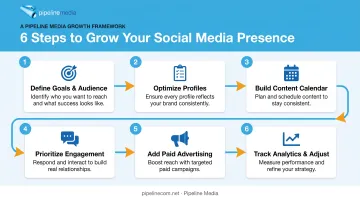
Growing a social presence comes down to posting the right things, consistently, to the right people. Here's the process that works:
Define clear goals and know your audience. Decide whether you're chasing brand awareness, leads, or customer service wins. Then map your audience's demographics and where they actually spend time online.
Optimize every profile. Use consistent logos, bios, contact details, and website links across Instagram, Facebook, LinkedIn, and X. A half-finished profile looks abandoned even if it isn't.
Build a content calendar. Planning ahead prevents the scramble-and-skip cycle. General posting benchmarks look something like this:
| Platform | Suggested Frequency |
|---|---|
| 1–2 posts per day | |
| Instagram feed | 3–5 posts per week |
| 1–2 posts per day | |
| X | 2–3 posts per day |
Treat these as starting points, then adjust based on what your own analytics tell you.
Prioritize two-way engagement. Reply to comments and DMs quickly, and use social listening tools to jump into relevant conversations happening about your industry.
Add targeted paid advertising. Boosting the right posts to the right audience extends organic reach far beyond what free posting alone achieves.
Track analytics and adjust. Watch reach, engagement rate, follower growth, and conversions weekly. Double down on what's working and cut what isn't.
Skip any one of these steps and the whole system gets shakier. Most businesses that "tried social media and it didn't work" actually skipped steps three and six.
Choosing the Right Social Media Platforms for Your Business
You don't need to be everywhere. You need to be where your customers actually are, doing the things you have the resources to do well.
Match platform choice to:
- Audience demographics
- Business goals
- Time and budget you can realistically commit
Facebook for Business
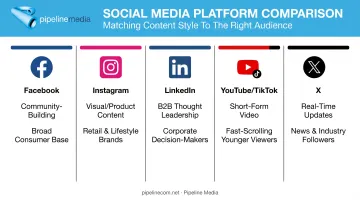
Facebook remains one of the most widely used platforms among American adults, with 71% of US adults saying they use it, according to Pew Research Center's 2025 survey. Its broad age range makes it strong for community-building, local search visibility, and customer service through Messenger and reviews.
Instagram for Business
Instagram's visual-first format suits product-based and lifestyle brands. It skews younger than Facebook and rewards businesses that invest in photography, Reels, and hashtag strategy for discoverability.
LinkedIn for Business
For B2B companies, LinkedIn is where decision-makers actually pay attention. It's built for thought leadership, professional networking, and reaching buyers who are already in a research mindset rather than a scrolling-for-entertainment one.
YouTube and Short-Form Video (TikTok)
Video content drives both engagement and search visibility in ways static posts can't match. Short-form video has become essential for reaching younger audiences who increasingly search platforms like TikTok the way older generations search Google.
X (Twitter) for Business
X has a smaller overall footprint than Facebook or Instagram, but it still earns its keep for real-time updates, customer service threads, and building relationships with media and press contacts.
Most full-service social media programs concentrate on Facebook, Instagram, LinkedIn, and X. Pipeline Media's Social Media Presence package is built around these same four channels because together they cover the widest mix of business use cases.
Social Media Best Practices for Consistent Growth
Growth rarely comes from one clever post. It comes from consistent habits applied over months. Practices that drive steady results:
- Tailor captions to each platform—LinkedIn and Instagram shouldn't sound the same. Identical cross-posts signal low effort.
- Use platform-specific discovery: hashtags on Instagram, keywords in LinkedIn headlines, searchable captions on TikTok.
- Repost customer photos and reviews. User-generated content builds more credibility than brand posts alone.
One well-tailored post per platform beats five identical ones spread thin.
Common Social Media Mistakes That Hurt Business Growth
Some mistakes are quiet killers. They don't cause a crisis overnight, but they slowly bleed customers and credibility.
- Letting an account go dormant. An inactive profile can be worse than no profile at all. It tells visitors the business might not be responsive anywhere, including the phone or email.
- Spreading across too many platforms. Trying to maintain five mediocre accounts usually performs worse than mastering the one or two where your audience actually lives.
- Ignoring analytics and negative feedback. A small complaint left unanswered publicly can snowball into a reputation problem. Regular monitoring catches issues while they're still manageable.
None of these mistakes are dramatic on their own. Together, they're often why a social media strategy stalls and stops producing results.
When to Bring in Professional Social Media Management
DIY social media works fine, until it doesn't. A few signs it's time to bring in outside help:
- Posting has become inconsistent or stopped altogether
- There's no clear content strategy, just occasional posts when someone remembers
- Engagement and follower growth are flat or declining
- Nobody on the team has the time or expertise to manage it properly
A professional social media service typically handles the entire workload end-to-end: content creation, scheduling, day-to-day engagement, and performance reporting, so the business gets the benefit without the daily grind.
Pipeline Media offers a Social Media Presence package (starting at $500/month) built for this exact situation. It includes:
- Full management of Instagram, Facebook, X, and LinkedIn
- Custom content creation, scheduled posting, and on-brand captions
- Comment and inbox monitoring
- Profile optimization

The goal is a consistent, credible presence without the daily management load. For businesses that want help scoping fit and next steps, Pipeline Media offers a free consultation to discuss goals and recommend a path forward.
Frequently Asked Questions
How do I increase social media presence for my business?
Post consistently and tailor content to your audience on each platform. Engage with comments and messages, then use analytics and paid ads to grow reach beyond organic followers.
How much should a small business budget for social media each month?
It depends on whether you're managing it yourself or outsourcing. Professional management packages, like Pipeline Media's, often start around $500/month for full-service presence management.
How often should a business post on social media?
Aim for 1–2 daily posts on Facebook and LinkedIn, 3–5 per week on Instagram, and 2–3 daily on X. Adjust based on your audience response and how much quality content you can sustain.
Which social media platform is best for a small business?
It depends on where your target audience spends time and whether your content strengths lean visual, professional, or video-based. Choose the platform that matches both—not the one with the largest overall user base.
How long does it take to see results from social media marketing?
Organic growth typically takes several months of consistent posting and engagement to build momentum. Paid campaigns can generate visibility and leads much faster, often within weeks.
Should I manage social media myself or hire a professional?
DIY gives you full control but demands consistent time and skill. Hiring a professional trades some control for expertise, consistency, and hours back in your week.