The data tells a different story. Faxing volumes in regulated industries remain surprisingly resilient, even as the physical machines disappear from shelves. This creates a real dilemma: should you invest in fax infrastructure, cut it entirely, or modernize how you use it?
This article separates the myth from the reality. Fax machines, the hardware, are on their way out. Faxing, the method, isn't going anywhere soon.
Key Takeaways
- Fax machines are declining, but faxing as a document transmission method keeps growing in specific industries
- Healthcare, legal, government, and finance rely on fax for compliance and audit trails that email can't replicate
- Cloud fax services eliminate the need for physical hardware while keeping fax's core benefits intact
- The global fax services market is projected to grow from $3.31B in 2024 to $4.48B by 2030 (Arizton via Research and Markets)
Fax Machines vs. Faxing: Why the 2026 Answer Is Nuanced
Here's where most confusion starts. People treat "fax machines" and "faxing" as the same thing. They aren't.
- Fax machines are the physical hardware sitting on a desk, requiring toner, paper, and a dedicated phone line
- Faxing is the underlying method: secure, point-to-point document transmission with a verifiable delivery record
Conflating the two leads business leaders to assume that because nobody buys standalone fax machines anymore, the entire practice is dying. That's not accurate.
Why the Hardware Is Fading
Physical machines are being phased out for practical reasons, not sentimental ones:
- Manufacturers are discontinuing dedicated models and their replacement parts. Canon has retired its FAXPHONE L100, and Panasonic has flagged multiple consumer fax models and ink-film accessories as discontinued or at risk of disappearing by region
- Maintenance, toner, and dedicated phone-line costs keep climbing for a device most employees touch once a month
- Physical machines offer zero flexibility for remote or hybrid teams who aren't sitting next to the office fax anymore
Why the Method Survives
Despite the hardware exodus, faxing transmission volumes stay resilient. The core need — secure, verifiable document exchange — hasn't gone away. Forecasts for the broader fax services and online fax market vary by scope, but they consistently point up. Estimates range from roughly 5.17% to 12.9% CAGR through 2030, depending on whether the study covers cloud, on-premises, and hybrid fax broadly, or focuses narrowly on internet-based subscription platforms like fax-to-email services.
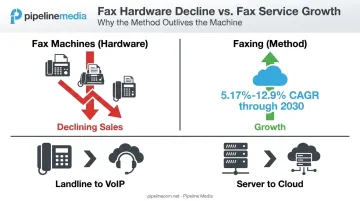
This "hardware dies, method survives" pattern isn't unique to fax. Landline phones gave way to VoIP. Physical servers gave way to cloud computing. The function persisted; only the delivery mechanism changed.
Why Fax Refuses to Die: The Industries Still Depending On It
Some sectors keep faxing not out of habit, but because their compliance frameworks and legal systems were built around it.
Healthcare and Compliance-Heavy Sectors
Hospitals, clinics, and insurers still fax patient referrals, lab results, and prescriptions daily. This isn't inertia. HIPAA's Privacy Rule explicitly permits providers to share protected health information by fax, provided reasonable safeguards are in place, such as verifying numbers and controlling who receives printed output (HHS guidance).
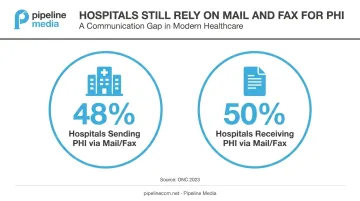
In 2023, 48% of U.S. non-federal acute-care hospitals sent, and 50% received, patient health information through the combined category of "mail or fax" (ONC data brief).
That figure blends mail and fax together, but it confirms these channels still hold a real place in clinical workflows, even as EHR adoption grows.
Legal, Government, and Financial Services
Law firms lean on fax confirmation pages because they create a timestamped, harder-to-tamper record of delivery. Courts back this up directly:
- Connecticut courts require filers to retain the transmission record as their official confirmation of receipt
- Kansas courts treat the sending machine's printed log as legal proof that a filing arrived on time
- California courts require attached transmission reports showing error-free completion for proof of service
Government agencies reinforce this pattern in uneven but telling ways. The IRS added fax submission for Form 8023 in 2026, allowing up to 100 pages per transmission, and continues accepting fax for forms like SS-4 and 2553. Meanwhile, the CFPB has stopped accepting fax for FOIA requests entirely. The takeaway: government fax demand isn't uniform. It's form-by-form and agency-by-agency.
That same unevenness shows up outside government offices, too. When internet service drops or broadband access is unreliable, fax often becomes the one channel still standing for time-sensitive documents.
What's Replacing Traditional Fax Machines? The Rise of Modern Faxing Solutions
Nothing has replaced faxing itself. What's changed is how faxes get sent. Cloud-based online fax platforms have replaced the physical hardware while keeping the compliance and reliability benefits intact.
Modern platforms typically offer:
- Device flexibility — send and receive from a computer, phone, or tablet, no machine required
- Encrypted transmission for security-conscious industries
- Delivery confirmations that double as audit trail evidence
- Integration with email and existing business systems, so faxes land in an inbox instead of a paper tray
Fax Broadcasting for High-Volume Sends
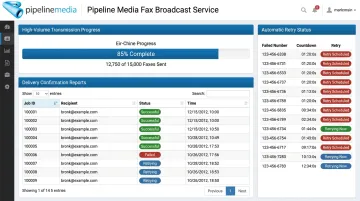
For businesses that need to send hundreds or thousands of documents at once, fax broadcasting removes the need for multiple machines or phone lines entirely. Pipeline Media's Fax Broadcast service handles this volume directly, pushing over 1 million pages per hour with jobs typically running within an hour of submission. Problem numbers get retried three times automatically at no extra cost, and clients receive detailed reports showing exactly who received their fax and why any failed.
Not every business needs that scale. For lower-volume, everyday use, Pipeline's Fax-to-Email service starts at $10 USD/month for the Standard tier (100 pages in and out) or $20 USD/month for the Pro tier (250 pages in and out), with numbers available across US and Canadian cities. No setup fee, cancel anytime.
One customer, Andy R. from Detroit, put it simply: switching to Fax-to-Email "allowed us to get rid of our old fax machines in 5 offices," giving reps personal fax numbers they could use on the road.
When evaluating any provider, look for:
- Fast turnaround (jobs completing in under an hour)
- A real person responding to support requests quickly, not a chatbot loop
- Transparent, itemized delivery reporting
Should Your Business Still Use Fax in 2026? A Quick Decision Framework
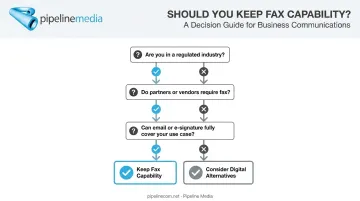
Ask yourself three questions before deciding.
- Are you in a regulated industry? Healthcare, legal, finance, or government organizations should assume fax capability stays necessary, even if volume is shrinking.
- Do your partners or vendors require it? If a hospital, court, or agency you work with only accepts fax for certain documents, you need a reliable way to send one.
- Can email, e-signature, or a secure portal fully cover your use case? If your industry has no regulatory tie to fax and your partners are flexible, it's worth testing whether digital alternatives close the gap.
Even businesses with declining fax volume shouldn't eliminate it completely. Occasional fax requests from clients, insurers, or agencies tend to pop up when least expected.
Keeping a lightweight, low-cost online fax option on standby costs far less than scrambling to find a solution the day a compliance officer asks for a faxed signature page. A fax-to-email subscription, for instance, can run as little as $10 a month with no setup fee and no long-term contract, letting you send and receive faxes from any device only when you actually need to.
How Pipeline Media Helps Businesses Modernize Communication Without Losing Reliability
Pipeline Media has operated as a full-service business communications agency out of Toronto since 2003. What started as fax broadcasting has grown into a broader suite covering fax, email, social media, and PPC, giving clients a single point of contact instead of juggling separate vendors for legacy and modern channels.
For businesses still dependent on fax, Pipeline's core offerings solve the two biggest pain points directly:
- Fax-to-Email lets teams send and receive faxes from any device, with no hardware, no dedicated phone line, and no busy signals
- Fax Broadcast handles high-volume sends with automatic retries on failed numbers at no added cost, plus delivery reports showing exactly what happened to every recipient
This matters most for clients in healthcare, finance, and government, where Pipeline has built relationships over two decades. Clients in these regulated industries consistently point to two outcomes: fewer dropped transmissions to doctors, pharmacies, and agencies across North America, and lower weekly costs compared to running fax traffic in-house.
That same reliability extends to how requests get handled. A real person typically responds within minutes, not days, which matters when a compliance deadline can't wait on a support ticket queue.
Frequently Asked Questions
What has replaced faxing?
No single technology has fully replaced faxing. Cloud-based online fax services, such as fax-to-email platforms, have replaced the physical machine, while email, e-signature tools, and secure file-sharing platforms have replaced fax for use cases that don't require its specific compliance or legal benefits.
Does anyone use faxes anymore?
Yes, particularly in healthcare, legal, government, and financial services. These sectors rely on fax's audit trails and compliance-friendly transmission records, which many workflows and court rules still specifically require.
Is fax being phased out?
Rising maintenance costs and discontinued parts are pushing physical fax machines out of use. Faxing itself, however, is shifting to online platforms rather than disappearing entirely.
Is faxing more secure than email?
Fax uses point-to-point transmission, which is often considered more tamper-resistant than email, though no major security body declares it categorically safer. Modern encrypted online fax services now match or exceed typical email security standards.
What industries still rely on fax machines the most?
Healthcare, legal, government, and finance top the list. All four share a need for compliance documentation and verifiable, timestamped proof of delivery that other channels struggle to match.
Will fax become completely obsolete in the future?
Physical machines will likely keep disappearing, but the faxing method is projected to persist for years given its compliance role. Online fax services are forecast to keep growing between 5.17% and 12.9% annually through 2030, depending on market scope.