 on Social Media](https://file-host.link/website/pipelinecom-zozmiq/assets/blog-images/1f313e44-4ea0-427b-a12b-45c84dc65cc4/1785328490148813_2dd198401745448288db12c5dd932c52/360.webp)
Introduction
Social media now reaches an estimated 5.79 billion user identities worldwide, with the average person spending more than 2.5 hours a day across social and video platforms, according to DataReportal's Digital 2026 Global Overview Report. That's a massive audience. But having an account on every platform isn't the same as having a presence.
Plenty of businesses post regularly and still get ignored. Others build recognizable, trusted brands with a fraction of the effort. The difference comes down to strategy, not luck.
Results vary widely based on platform choice, content quality, and consistency.
This guide walks through the exact steps to build a brand presence that works, covering what you need before you start and the factors that move the needle. It also covers common mistakes to avoid and when it makes sense to hand the work to a professional team.
Key Takeaways
- A documented brand voice and focused platform mix outperform simply "being active" online
- Response time and engagement quality boost algorithm visibility as much as posting frequency
- Most brands fail from inconsistent posting, spreading too thin, or over-automating without interaction
- Professional social media management pays off once time or expertise gaps limit results
How to Build a Brand Presence on Social Media
These steps build on one another. Skip the foundational work, like defining your brand voice or researching your audience, and everything after it becomes guesswork.
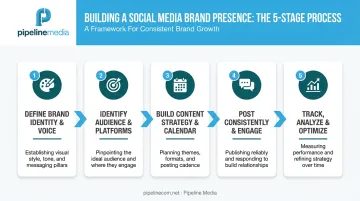
Step 1: Define Your Brand Identity and Voice
Before you write a single caption, decide who your brand sounds and looks like. This includes your tone (formal, playful, direct), your visual style (colors, fonts, imagery), and three to five core messaging pillars you'll return to again and again.
Document it. Create a simple guide covering:
- Approved tone and sample captions for common post types
- Do's and don'ts for language, humor, and sensitive topics
- Visual specs, including logo usage, color codes, and image style
- Brand story and mission in a few sentences anyone can reference
Without this, every team member or freelancer creating content will interpret your brand differently, and followers will notice the inconsistency.
Step 2: Identify Your Target Audience and Choose the Right Platforms
Not every platform deserves your attention. Build audience personas that cover demographics, interests, and pain points, then match those personas to platform strengths.
The data backs this up. In Content Marketing Institute's 2025 survey of B2B marketers, 85% said LinkedIn delivered the best organic value, compared to just 28% for Facebook and 21% for Instagram.
Meanwhile, Pew Research found Instagram usage hits 80% among U.S. adults ages 18-29, and roughly half of that same age group uses TikTok daily.
The takeaway: if you're selling to businesses, LinkedIn earns your attention first. If you're targeting younger consumers with visual products, Instagram and TikTok make more sense. Pick two or three platforms where your actual audience spends time. Trying to be everywhere spreads your effort too thin to master any single channel.
Step 3: Build a Content Strategy and Calendar
A content calendar keeps you from scrambling for ideas the night before a post is due. Map out themes, formats (video, user-generated content, educational posts), and key campaign dates at least a month ahead.
What should fill that calendar? Emplifi's 2025 survey of frequent social users found people follow brands for discounts (64%), entertainment (58%), and learning about new products (57%). The same research found 65% said authentic, unscripted content influenced their purchase decisions more than polished ads.
That doesn't mean hard-selling is off the table. It means balance:
- Lead with value: education, behind-the-scenes looks, and genuine entertainment
- Mix in product content without making every post a pitch
- Prioritize authentic, human-made content over overly produced clips
Step 4: Post Consistently and Engage With Your Audience
Set a posting frequency you can actually sustain, then stick to it. Hootsuite's 2025 benchmarks suggest 1-2 posts a day on Facebook and LinkedIn, and 3-5 posts a week on Instagram and TikTok, though actual customer averages ran lower across the board.
Consistency pays off. Buffer's analysis of 2.1 million Instagram posts found accounts posting 3-5 times weekly grew followers more than twice as fast as those posting once or twice, with roughly 12% more reach per post.
Posting is only half the job, though. Consumer research shows engagement matters just as much:
- Nearly three-quarters of consumers expect a brand response within 24 hours
- About a third expect a reply to a direct message within one hour
- 67% prefer talking to an actual human over a bot when solving a problem
Slow or absent responses damage trust even if your posting volume looks impressive on paper.
Step 5: Track, Analyze, and Optimize Performance
You can't improve what you don't measure. Track these core metrics monthly:
| Metric | What It Tells You |
|---|---|
| Reach | Unique accounts that saw your post |
| Engagement rate | Interactions divided by followers |
| Follower growth | Audience size change over time |
| Click-through rate | How many people acted on your content |
Rival IQ reports a median Instagram engagement rate around 0.36%, but benchmarks vary widely by platform and industry, so compare your own account against itself over time rather than chasing a universal number. Double down on content types that consistently perform, and cut what isn't resonating instead of clinging to it out of habit.
If tracking these metrics and adjusting strategy every month pulls you away from running the actual business, that's a common breaking point. Pipeline Media's Social Media Presence service manages consistent posting and brand credibility across Instagram, Facebook, X, and LinkedIn, so your team stays focused on core operations instead of the day-to-day feed.
What You Need Before You Start
Under-preparing is the single biggest predictor of a stalled or inconsistent presence. Before posting anything, gather:
- A documented brand voice guide and visual asset library so anyone creating content stays on-brand
- Audience research and personas, plus a quick look at what competitors are doing well (or poorly)
- Dedicated time each week for content creation, posting, and responding to messages
- A content tool stack for design, scheduling, and basic analytics
- A modest ad budget for boosting posts that already perform well organically
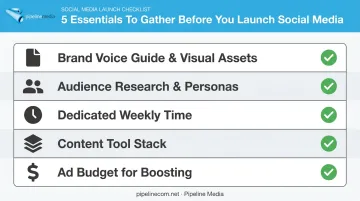
Skipping any of these means building on a shaky foundation. It's the reason many businesses post for a few weeks with enthusiasm, then quietly go dark. If time is the gap, Pipeline Media's Social Media Presence service can keep your posting consistent.
Key Factors That Affect Your Social Media Brand Presence
Outcomes hinge on a handful of controllable variables, not algorithm luck. These five factors determine whether your brand builds lasting visibility or fades into the noise.
| Factor | Why It Matters | Impact |
|---|---|---|
| Content Quality and Relevance | Quality determines whether people stop scrolling or scroll past. | Platform algorithms reward content that earns comments, shares, and saves, so weak content directly limits your reach. |
| Posting Consistency | Irregular posting signals inactivity to both algorithms and followers. | A steady cadence compounds visibility and trust over months, as Buffer's Instagram data demonstrates. |
| Platform-Audience Fit | The same post performs differently depending on platform norms and who's actually there. | Misaligned platform choice wastes production effort on content that never reaches your target audience. |
| Engagement and Response Time | Fast, genuine responses build trust and prove there's a real business behind the profile. | Slow or missing replies damage brand perception, even with high posting volume. |
| Balance of Organic and Paid Content | Organic reach keeps shrinking—Socialinsider reports a 12% drop on Instagram and a 34% decline on LinkedIn. | A calculated mix of boosted posts and organic content sustains visibility without over-relying on either. |
Strengthening one factor often reinforces the others, while neglecting any single one can undercut the rest.
Common Mistakes to Avoid
If growth has stalled, the cause usually traces back to one of these:
- Spreading effort across too many platforms instead of mastering two or three where the audience actually is
- Posting inconsistently or disappearing for weeks, which causes algorithms and followers to lose interest fast
- Over-relying on automation and generic scheduled content that feels out of touch with real-world events
- Ignoring comments, messages, or negative feedback instead of using them to build trust and catch issues before they spread
Fix even one of these, and improvement usually shows up within a couple of posting cycles.
When to Bring in Professional Help for Your Social Media Presence
DIY management works fine for early-stage brands with time to spare. It becomes inefficient once posting volume, multi-platform complexity, or lead-generation goals exceed what you can realistically handle in-house.
Signs it's time to outsource:
- Posting has become inconsistent because nobody has the bandwidth
- Nobody on the team understands how to read or act on analytics
- Social followers aren't converting into actual inquiries or leads
Pipeline Media, a Toronto-based agency with over 20 years of full-service communications experience, built its Social Media Presence package for exactly this transition.
The package ($500/month USD) covers full management of Instagram, Facebook, X, and LinkedIn, including custom content creation, on-brand captions, comment and inbox monitoring, and profile optimization. All four platforms are included at one flat rate.

Getting started costs nothing upfront. A free consultation is available across North American time zones from AST through PST/YST, with no obligation attached.
Frequently Asked Questions
What is brand presence on social media?
Brand presence refers to how visible and active your brand is across platforms through profiles, content, and interactions, not just the existence of an account.
How does social media affect brand presence?
It shapes perception directly through visibility, tone, responsiveness, and social proof like shares and comments. Consistent, quality activity builds trust; inconsistent or absent activity erodes it.
How long does it take to build a strong social media presence?
Timelines vary based on your industry and effort invested, with your starting point also playing a role. Many businesses following a consistent, targeted posting strategy start seeing measurable engagement growth within a few months.
Which social media platform is best for building brand presence?
It depends on your audience and content type. LinkedIn tends to work best for B2B brands, while Instagram and Facebook suit visual content aimed at consumer audiences.
Do I need to be on every social media platform to build a strong presence?
No. Focusing on two or three platforms where your target audience is genuinely active outperforms spreading effort thin across every network available.
How much should a small business budget for social media branding?
Budgets vary widely by scope and goals. Professional management packages, like Pipeline Media's Social Media Presence tier, often start around $500 USD a month for foundational, full-service presence-building.