In fact, mail and fax combined were still used by 69% of U.S. hospitals to send summary-of-care records as of the 2021 AHA IT survey, with 78% using them to receive records. Email and messaging apps haven't displaced fax in regulated industries the way many assume.
The problem? Most businesses use broadcast fax services without understanding what actually happens between clicking "send" and a document landing on hundreds of machines. That gap in understanding leads to poor provider choices and unrealistic expectations about speed, reliability, and cost.
This guide breaks down exactly how broadcast fax works, stage by stage.
Key Takeaways
- Broadcast fax sends one document to thousands of numbers simultaneously via automated, parallel transmission
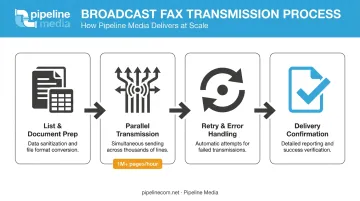
- The core cycle has four stages: list/document prep, parallel transmission, retry handling, and delivery confirmation
- Fax bypasses email spam filters entirely, which is why regulated industries still rely on it for time-sensitive notices
- Pipeline Media handles formatting, transmission, and retries — clients just submit a list and document
- Healthcare, finance, government, and B2B sectors use it for both compliance notices and marketing outreach
What Is Broadcast Fax?
Broadcast fax is the transmission of a single document to multiple fax numbers in one coordinated operation. Instead of dialing each recipient by hand, one document and one recipient list trigger dozens or hundreds of simultaneous transmissions.
The need is straightforward: businesses had to distribute time-sensitive or regulated documents (notices, account updates, offers) to large audiences without manually sending faxes one at a time. Manually faxing 500 recipients isn't just slow. It's operationally unworkable.
Broadcast fax isn't the same as:
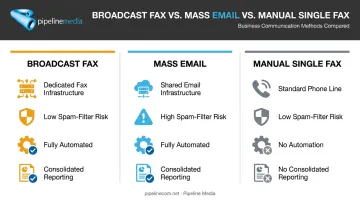
- A mass email blast (different addressing system, different infrastructure, no shared spam-filter risk)
- A single fax sent repeatedly by hand (no automation, no parallel dialing, no consolidated reporting)
Federal rules actually define this distinction formally. A facsimile broadcaster is any entity that transmits fax messages to fax machines on behalf of another company for a fee, a legal category separate from a standard sender. Agencies like Pipeline Media operate under this designation when running campaigns for corporate clients.
Why Broadcast Fax Persists
Fax still holds a few practical advantages that email hasn't replicated:
- It runs on point-to-point telephone sessions, not shared mail servers, so it isn't caught in spam or promotions folders
- Many regulated industries treat fax as legally recognized documentation
- It doesn't depend on the recipient's inbox filtering rules or IT policies
Two Functional Types
Broadcast fax generally splits into two categories:
- Transactional — compliance notices, account updates, regulatory disclosures
- Promotional/marketing — outreach campaigns, offers, announcements
The mechanics stay identical either way, but the content and compliance requirements shift. Marketing faxes carry stricter consent rules under the Telephone Consumer Protection Act, which the next section covers in detail.
How Does Broadcast Fax Work?
Broadcast fax runs through a defined sequence: preparation, transmission, error handling, and confirmation. Each stage determines whether the message actually reaches its recipient intact.
Initiation: Preparing the List and Document
Everything starts with two inputs: a document (PDF, Word file, or image) and a recipient list of fax numbers, typically imported as a CSV.
Initiation can work two ways:
- Manual — a one-time campaign submitted for immediate send
- Automated/scheduled — recurring notices triggered on a set schedule or by an internal system
Pipeline Media's process reflects the manual-first model most full-service providers use: clients email their list and document, and the team sets up the entire job. Most campaigns go live in under an hour, and the platform works with virtually all file formats, so clients aren't stuck reformatting documents before sending.
The common bottleneck here is list quality. Outdated or mistyped fax numbers don't cause problems immediately — they cause failed transmissions later, once the broadcast is already running.
Core Operation: Parallel Transmission
Once the list and document clear that checkpoint, the system moves into transmission — and this is where broadcast fax differs from a single fax. Instead of dialing recipients one at a time, the platform opens multiple simultaneous connections across carrier-grade telephone lines.
Each transmission still follows the same underlying fax protocol as a single fax call. The document gets converted into a compressed, monochrome image format compliant with ITU-T T.30 fax-session standards, then transmitted to each recipient's machine or virtual inbox through its own individual session. Broadcast scale comes from running many of these sessions in parallel, not from one shared signal reaching every number at once.
That parallelism is what determines speed. Speed here is measured in scale: Pipeline Media's platform can transmit over 1 million pages per hour, which is why most fax broadcast jobs complete in under an hour rather than running for a full day. For a 500-recipient list, that throughput means most numbers receive the document at roughly the same time instead of waiting in a long sequential queue.
Retry and Error Handling
Real-world transmission hits real-world problems: busy signals, no-answer lines, temporary carrier errors. A broadcast running across hundreds of numbers will always encounter some of these.
The system's job is to manage that automatically while the broadcast is still running:
- Failed numbers get flagged the moment they occur
- They're queued for a set number of retry attempts
- Unresolved numbers get marked as permanent failures once the retry limit is reached
At Pipeline Media, every problem number gets three retry attempts, at no extra cost. That matters operationally — without automated retries, a portion of any large list would simply never receive the document on the first pass. A busy line at 2:14 PM shouldn't mean a recipient never gets their compliance notice.
Delivery Confirmation
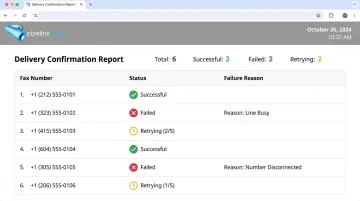
The final output is a per-recipient delivery report: which faxes succeeded, which failed, and which are still cycling through retries.
This report isn't just a receipt. It feeds directly into:
- Compliance documentation — proof of delivery for regulatory purposes
- Campaign follow-up — knowing who to contact through another channel
- List cleanup — removing dead numbers before the next send
These reports, in Pipeline Media's case, show exactly who received the fax, who didn't, and the specific reason for each failure. For industries where "we tried to notify them" needs to be provable, that level of detail is the difference between a defensible compliance record and a guess.
Where Broadcast Fax Is Used
Broadcast fax fits into workflows where a document needs to reach a large group at once, with proof that it got there. Common use cases include:
- Distributing compliance notices to a regulated client base
- Sending time-sensitive offers or promotions
- Pushing policy updates across a network of offices or partners
- Issuing recall or alert notifications quickly
It performs best under specific conditions:
- Large recipient lists (hundreds to thousands of numbers)
- Industries that require documented delivery proof
- Audiences that still treat fax as a trusted, legally recognized channel
These conditions show up differently across industries, though the mechanics behind them stay the same. Healthcare organizations use fax for lab results and clinical alerts, financial services rely on it for disclosures, and associations use it for member notices.
Pipeline Media handles broadcast fax campaigns for clients in these sectors, plus government, technology, and manufacturing. Regardless of who's on the other end, the transmission process itself doesn't change.
Choosing a Broadcast Fax Provider
Not every fax platform handles broadcasting well. Sending to 5 numbers and sending to 5,000 are different engineering problems, and providers built for the first often stumble on the second.
Baseline requirements to look for:
- High concurrent throughput (how many numbers it can dial at once, not just total capacity)
- Automatic retry logic built into the platform, not a manual afterthought
- Detailed, per-recipient delivery reporting
Beyond these technical checkboxes, there's a bigger structural question: does the provider hand you tools, or handle the work itself? A full-service model — where the provider manages list formatting, transmission, and retries end-to-end — removes the troubleshooting burden from your team entirely. Pipeline Media's approach reflects this: clients submit a list and document, and the team manages everything else, including quality testing before the job goes live.
Responsiveness matters more than it seems. Broadcasts are often time-sensitive — a recall notice or a same-day rate change doesn't wait. Pipeline Media states that a real person replies to campaign requests within minutes, which matters when the alternative is a support ticket sitting in a queue while your deadline passes.
Conclusion
Broadcast fax works through a coordinated cycle: preparation, parallel transmission, automated retries, and delivery confirmation. Treating it as a single dial-and-wait action leads to mismatched expectations.
Understanding these mechanics changes how you evaluate a provider. You'll know to ask about concurrent throughput instead of just "how fast," about retry logic instead of just "does it work," and about report detail instead of just "will I know if it sent." Pipeline Media builds its fax broadcasting service around these exact questions, sending over 1 million pages per hour, retrying problem numbers three times at no extra charge, and providing detailed delivery reports for every campaign. That level of transparency is what separates a communication system that holds up under regulatory scrutiny from one that just sends and hopes.
Frequently Asked Questions
What is the difference between broadcast fax and single fax?
Single fax is a one-to-one transmission to one number. Broadcast fax sends the same document to many numbers simultaneously through automated parallel dialing, with one consolidated delivery report covering every recipient.
Do people still use telefax?
Yes, particularly in healthcare, legal, and government sectors, where fax retains legal recognition and bypasses email spam filters. Consumer use has dropped sharply, but regulated industries haven't abandoned it.
How many recipients can a single broadcast fax campaign reach?
It depends entirely on the provider's transmission capacity. High-capacity platforms like Pipeline Media support over 1 million pages per hour, meaning large lists complete in under an hour rather than running for days.
What happens if a fax fails to send during a broadcast?
Most platforms detect failures automatically, such as busy lines or no answer, and retry a set number of times. Pipeline Media retries problem numbers up to three times at no extra charge before logging a final failure.
Is broadcast fax secure for sensitive documents?
Reputable providers, including Pipeline Media, use secure transmission practices and data handling policies designed to protect sensitive content. Confirm specific security measures with your provider before sending regulated data.
Do I need a fax machine to send a broadcast fax?
No physical machine is required. Documents are uploaded digitally, and recipients can be reached whether they use a traditional fax machine or a virtual fax inbox.