It's a fair question. Most people associate "fax blasting" with junk fax lawsuits and TCPA horror stories. But the law treats a settlement notice sent to known claimants very differently from a vendor cold-faxing a discount offer to those same numbers.
The Telephone Consumer Protection Act (TCPA) and the Junk Fax Prevention Act (JFPA) exist to stop unsolicited advertising — not case correspondence sent to people you already represent, oppose, or work with. That distinction changes the entire compliance picture.
This guide breaks down what actually applies in 2026: the difference between fax advertising law and legal-document faxing, a practical compliance checklist, the separate rules governing service and filing, and whether fax still earns its place in a modern law firm's workflow.
Key Takeaways
- Faxing legal documents to a known recipient list is generally legal under the TCPA/JFPA
- TCPA opt-out and Established Business Relationship rules apply to fax advertisements, not case-related documents
- Court rules of civil procedure, not the TCPA, govern fax filing or service, and requirements vary by jurisdiction
- Mixing marketing language into a legal fax can reclassify it as an advertisement, triggering TCPA exposure
- Fax remains standard in legal, healthcare, and government sectors for its verifiable delivery record
Fax Advertising Law vs. Legal Document Faxing: Why the Rules Are Different
The TCPA (47 U.S.C. § 227) defines an "unsolicited advertisement" as material advertising the commercial availability or quality of property, goods, or services, sent without the recipient's prior permission. The FCC's regulations at 47 CFR 64.1200(f) repeat that same definition almost word for word.
Here's the part that matters: a pleading, discovery notice, deposition schedule, or case status update sent to a party you already represent, oppose, or work with does not advertise anything. It doesn't trigger the opt-out or Established Business Relationship (EBR) requirements built for junk fax ads — because it was never an ad to begin with.
The transactional message exemption
The FCC has drawn this line explicitly. In its 2006 order, the FCC confirmed that faxes which "facilitate, complete, or confirm a transaction the recipient already agreed to" — receipts, account updates, case correspondence — are not advertisements, provided they don't promote a commercial product or service on the side.
Consider two scenarios involving the same fax list:
- A law firm faxing a settlement notice to 40 known claimants: informational, transactional, tied to an existing case relationship
- A vendor cold-faxing a discount offer to those same 40 numbers: unsolicited advertisement, full TCPA rules apply
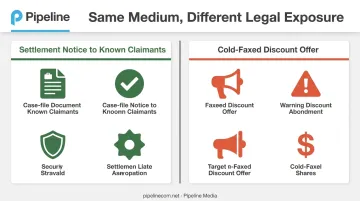
Same medium, same recipient count, completely different legal exposure.
Warning: If a legal-adjacent fax blends in ANY promotional content — "call us for a free consultation," cross-selling other practice areas, firm slogans — it can be reclassified as an advertisement. Once that happens, the full TCPA/JFPA machinery kicks in: EBR requirements, page-one opt-out notices, and statutory damages exposure.
The FCC has said "free" doesn't provide cover either. A free seminar invitation can still count as an advertisement if it's a pretext for promoting the sender's services.
Is Fax Broadcast Legal for Legal Documents in 2026? The Compliance Checklist
Yes. Broadcasting legal documents to a defined, known recipient list is legal in 2026. But "legal" doesn't mean "unregulated" — a few best practices keep senders out of gray areas.
What every fax must include
Regardless of content type, 47 CFR 68.318(d) requires every fax page (or at minimum the first page) to show:
- Date and time sent
- Identification of the sending business or individual
- Telephone number of the sending machine or business
This applies to every transmission — advertisement or not.
Confirm your basis for sending
Before broadcasting, confirm and document your legitimate basis for each recipient:
- Active representation agreement
- Documented case involvement
- Prior written consent
- Established professional relationship (co-counsel, opposing counsel of record)
Keep records of that basis. If a recipient later disputes receiving unwanted faxes, having documentation matters — even when no formal TCPA opt-out notice was legally required. Full-service providers that manage broadcast campaigns, such as Pipeline Media, typically retain delivery logs and recipient lists as part of standard reporting, which can double as supporting documentation if a dispute arises.
The misclassification trap
This isn't theoretical. In Holtzman v. Turza, 728 F.3d 682 (7th Cir. 2013), an attorney sent "Daily Plan-It" newsletters offering business and legal advice — but the newsletters also displayed his name, logo, and law practice promotion. Courts ruled the mixed content made it an advertisement. The result: 8,430 faxes × $500 statutory damages = $4,215,000.
Not every case ends this way, though. In Mauthe v. Millennium Health, 58 F.4th 93 (3d Cir. 2023), a free seminar fax survived because no reasonable recipient would view it as promoting goods or services — the content stayed clearly informational.
The financial stakes explain why courts scrutinize this distinction so closely:
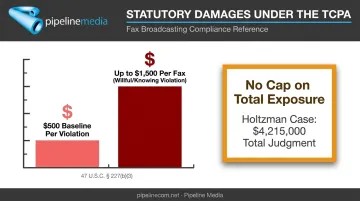
- $500 per violation under 47 U.S.C. § 227(b)(3) as the statutory baseline
- Up to $1,500 per fax when courts find willful or knowing conduct and triple the damages
- No cap on total exposure — damages scale directly with recipient list size, as Holtzman shows
If a recurring fax program mixes case updates with any marketing language, get legal counsel to review it before the next send. Keeping legal-document faxes strictly informational is the safest way to avoid that exposure entirely.
Can You Serve or File Legal Documents by Fax?
TCPA rules govern unsolicited fax ads, but a different set of rules entirely applies once you're talking about serving or filing legal documents: civil procedure.
Federal Rule of Civil Procedure 4 doesn't list fax as an independent method for original service of process. FRCP 5(b)(2)(E) permits electronic service — which can include fax — but only with the recipient's written consent.
State and local rules vary dramatically:
| Jurisdiction | Fax rule |
|---|---|
| California | Fax service allowed only by written party agreement (Rule 2.306); fax filing requires local rule permission (Rule 2.304) |
| New York Court of Claims | Fax filing permitted for submissions under 50 pages |
| U.S. District of Oregon | Fax filing barred except emergencies pre-approved by the judge |
A successful transmission confirmation does not cure an unauthorized method of service. If your jurisdiction requires e-filing or personal service, even a well-documented fax won't satisfy that requirement.
That said, fax remains widely used informally between attorneys. Notifying multiple opposing counsel that a filing has been made, even when it isn't the official service method, gives everyone a timestamped record that the notice went out. Always check the specific court's local rules before relying on fax for anything resembling formal service — bulk fax broadcast tools like Pipeline Media's are built for high-volume business notifications, not as a substitute for court-mandated service of process.
How to Send a Compliant Legal Document Fax Broadcast
Getting this right operationally comes down to five steps.
Build a verified recipient list. Use only documented representation, case involvement, or an existing professional relationship. Never use a purchased or scraped fax number list for legal documents — it undermines your consent basis and increases dispute risk.
Prepare the document cleanly. Include sender identification, case or matter reference, and zero promotional language. Legibility at standard fax resolution matters, especially for exhibits or signature pages.
Use a professional fax broadcast service that provides delivery confirmation per recipient, automatic retries on failed numbers, and audit-ready logs. This is what lets a firm demonstrate timely notice if it's ever challenged.
Send a test transmission first. Confirm formatting and legibility before the full broadcast goes out. Retain delivery confirmations as part of the case file.
Keep records of consent and delivery together — the basis for sending and the proof it arrived should live in the same file.
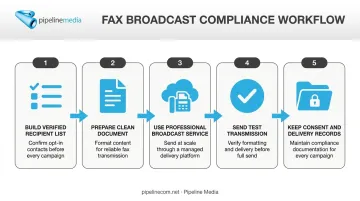
Step 3 above — using a professional broadcast service with delivery confirmation and audit logs — is where Pipeline Media fits in. The Toronto-based agency, running since 2003, handles full-service management of large distribution lists at transmission speeds exceeding 1 million pages per hour, so most recipients get the document essentially at once rather than in staggered batches.
Pipeline automatically retries failed numbers three times, free of charge. It also provides detailed post-broadcast reports showing exactly who received the document, who didn't, and why a transmission failed. For firms that need to show a court or opposing party that notice went out and landed, that reporting layer does real work. Clients simply send their list and document to broadcast@pipelinecom.net, and Pipeline's team handles setup — most jobs run in under an hour.
One caveat worth flagging: firms handling privileged or highly sensitive material should confirm directly with any fax broadcast provider what specific security protocols and confidentiality safeguards apply to their account, since requirements can vary by document sensitivity.
Is Fax Still Relevant for Law Firms in 2026?
Yes — and the numbers back it up. The global fax services market was valued at $3.31 billion in 2024, with projections reaching $4.48 billion by 2030, according to Arizton's March 2025 report. Legal, healthcare, and government sectors are specifically named as durable customer segments.
Consumer fax use has cratered, but B2B and professional-services fax hasn't followed the same decline. Courts, government agencies, and opposing counsel often still expect fax as a fallback channel — particularly for after-hours filings or jurisdictions that haven't fully modernized their e-filing infrastructure.
Legal-size documents transmit fine
Standard fax machines and online fax services can handle legal-size pages (8.5" x 14") — this is built into the international ITU-T T.4 standard governing Group 3 fax terminals. The practical catch: confirm the recipient's equipment or online fax service actually supports that page size before sending. Otherwise content can get cropped or auto-scaled down, which is the last thing you want happening to a signature page or exhibit.
Why fax persists when email hasn't replaced it
- Independently verifiable transmission record, harder to dispute than email delivery
- Recognized formally in many court and regulatory contexts
- Integrates with existing case management workflows already in place at most firms
- Fax numbers for institutions rarely change, unlike email addresses tied to individual staff turnover
For firms without an in-house fax line, a fax-to-email setup can cover this fallback channel without new hardware — Pipeline Media's service, for instance, routes incoming faxes straight to an inbox from any US or Canadian city number.
Frequently Asked Questions
Do law firms still use fax machines?
Many law firms continue using fax, often through online fax services rather than physical machines, for court communications, discovery, and time-sensitive notices. It remains an accepted, verifiable format in legal and regulatory contexts.
Is fax being phased out?
Consumer fax use has declined sharply, but professional sectors like legal, healthcare, and government continue relying on it. In B2B contexts, fax isn't disappearing anytime soon.
Can you fax a legal size document?
Yes, legal-size (8.5" x 14") documents can be faxed under the standard Group 3 fax specification. Just verify the recipient's equipment or software supports that page size to avoid cropping or auto-resizing.
Is a fax legally binding for signing or submitting legal documents?
Fax-transmitted signatures are generally accepted as legally binding across most U.S. and Canadian jurisdictions. Requirements vary by document type and region, and some documents, like wills, are excluded from electronic signature laws entirely.
Can legal documents be served via fax broadcast?
Fax service of legal documents is governed by each court's specific rules of civil procedure, which vary significantly by jurisdiction in both the U.S. and Canada. Confirm local requirements before relying on fax as your official method of service.
Does the TCPA apply to fax broadcasts of legal or case-related documents?
The TCPA's advertisement rules apply mainly to unsolicited promotional faxes. Purely transactional or case-related legal documents sent to known parties generally fall outside those specific requirements.