
Introduction
Running email campaigns in-house sounds simple until you're the one doing it. Building templates, cleaning lists, tracking unsubscribes, checking deliverability, pulling reports. It adds up fast.
Many small and mid-sized business teams struggle to keep a consistent send schedule while juggling everything else on their plate.
A 2023 survey of small-business marketers found that 70.8% still handle email marketing internally, while only 26.9% outsource it (Service Direct, 2023). Most still spend hours each week on the work.
This guide breaks down what an email marketing partner actually does, how to vet one properly, and what a full-service agency delivers compared to a self-serve platform.
Key Takeaways
- A true email marketing partner runs campaigns end-to-end, not just software access
- Compliance expertise, including CAN-SPAM and unsubscribe handling, is non-negotiable
- Full-service agencies like Pipeline Media handle setup, testing, sending, and reporting for you
- Choose based on budget fit, industry experience, and response speed
What Is an Email Marketing Partner?
An email marketing partner is an external agency or specialist that manages your campaign strategy, sending, and reporting on your behalf. You're not logging into software and building emails yourself. You send the content and list, and they take it from there.
This is different from an ESP (email service provider), which is self-serve software like Mailchimp or Constant Contact. With an ESP, you do the work; the platform just gives you tools.
What "Partner Email" Usually Means
Inside these partnerships, "partner email" usually means one of two operational setups:
- A designated contact address used to submit campaign materials and coordinate approvals
- A shared or co-managed inbox where the business and agency exchange campaign content
For example, Pipeline Media uses broadcast@pipelinecom.net as the address clients use to submit their email list, message, and graphics for a broadcast job.
Services Typically Bundled Into a Partnership
Most full-service partnerships include:
- Campaign setup and quality-control testing
- List distribution and sending
- Compliance support and unsubscribe management
- Performance tracking and delivery reporting

Why Businesses Choose to Outsource
Lack of in-house expertise is the biggest driver. Building deliverability practices, managing compliance, and interpreting bounce data takes real know-how.
Time constraints matter too. Outsourcing frees internal teams from repetitive technical work so they can focus on strategy instead of execution (Capterra, 2023).
Signs Your Business Needs an Email Marketing Partner
Not every business needs to outsource immediately. But certain warning signs point to a real capacity or ownership gap.
Watch for these red flags:
- Send schedules are inconsistent or campaigns launch late
- Open rates are dropping and nobody's investigating why
- No one internally owns compliance or unsubscribe requests
- Campaigns take days to go from draft to sent
Inconsistent sending isn't just a habit problem. Gmail's own sender guidelines warn against sudden volume spikes and irregular sending patterns. Both can hurt domain reputation and raise spam classification risk (Google, Gmail sender guidelines).
The Legal Risk Is Real
Missed unsubscribe requests aren't just annoying to recipients. The FTC's CAN-SPAM guide requires opt-out requests to be honored within 10 business days, and each violating email can carry a penalty of up to $53,088 (FTC, CAN-SPAM Compliance Guide). Hiring an outside company to send your email doesn't transfer that legal responsibility. You're still on the hook.

Compliance is one pressure point. Capacity is another—especially when email sits alongside other channels you already run. Businesses juggling fax, social, email, and PPC often benefit more from a single communications partner than from four separate vendor relationships.
How to Choose the Right Email Marketing Partner
Picking a partner without a clear process leads to mismatched expectations. Work through these steps.
- Define goals and budget first. Turn vague objectives like "more leads" into specific targets: number of qualified inquiries per month, click-through rate goals, or list growth benchmarks.
- Evaluate industry experience. Ask directly whether they've worked with businesses in your sector (healthcare, finance, retail, or similar fields).
- Check responsiveness. Does a real person answer quickly, or does every request go through a ticket queue?
- Review compliance practices. Ask specifically how they manage unsubscribe processing, data security, and CAN-SPAM requirements.
- Request sample reporting. Confirm they track open rates, click-throughs, and delivery status in detail.
- Clarify pricing and contract terms. Ask whether costs scale with list size or campaign volume, and whether there's a setup fee.
On response time, Pipeline Media commits to having a real person respond within minutes when a client initiates a campaign request, rather than routing it through an automated queue.
A strong partner should also explain exactly how they handle opt-outs and data protection. Pipeline Media manages the unsubscribe system directly and offers secure transmission options for sensitive data during transfer.
Full-Service vs. DIY: What a True Partner Delivers
A DIY ESP model puts you in the driver's seat. You build templates, manage automation rules, troubleshoot delivery issues, and interpret your own reports. That works fine if you have the time and technical comfort.
A full-service partner removes that burden entirely. You send your list and content. They handle everything else.
Here's the practical difference:
| Task | DIY ESP | Full-Service Partner |
|---|---|---|
| Template building | You build it | They build it |
| Testing before send | You test | They test and retest |
| List management | Self-managed | Handled for you |
| Compliance | Your responsibility | Managed on your behalf |
| Reporting | You interpret raw data | Delivery reports provided |

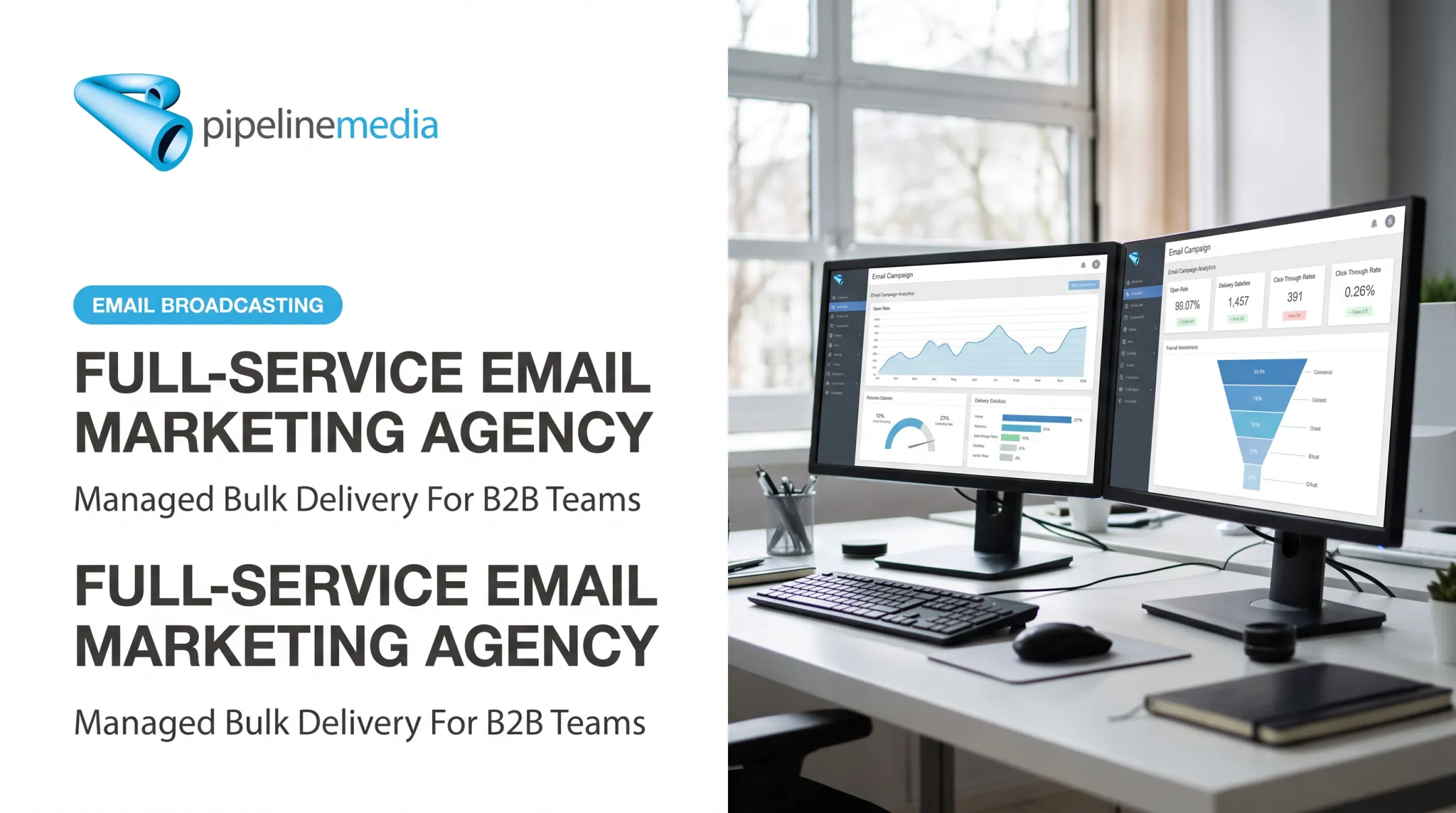
Pipeline Media's email broadcasting service illustrates this model well. Once a client submits their list, message, and graphics, the team sets up the job, tests and retests it for quality control, then sends it.
Platform capacity reaches millions of emails per hour, and most jobs run within 60 to 90 minutes. Reporting afterward covers undeliverable addresses, opens, and which links or images recipients clicked.
Pipeline Media has run this kind of full-service, hands-off communications model since 2003, working across finance, healthcare, government, retail, and other industries for more than two decades.

Common Mistakes When Selecting a Partner
Even businesses that know they need help sometimes pick the wrong fit. Watch for these pitfalls:
- Choosing on price alone. A low quote means nothing if you haven't confirmed deliverability practices or compliance capability first.
- Skipping industry fit. Generic campaigns often fail to resonate with a specific audience. Ask about relevant sector experience before signing anything.
- Not checking references. Reviews and past client feedback reveal a lot before you commit to a longer contract.
A cheap partner who mishandles unsubscribe requests or triggers spam complaints can cost far more in the long run. Penalties and a damaged sender reputation quickly outweigh savings from a slightly lower quote.
Frequently Asked Questions
What is a partner email?
A partner email is the point-of-contact address you use to submit campaign materials and manage approvals with an outsourced provider. Pipeline Media, for example, uses broadcast@pipelinecom.net for campaign submissions.
How much does an email marketing partner typically cost?
Pricing varies by scope, list size, and service model. Clutch reports agency rates commonly between $100 and $149 per hour, while full-service email broadcasting is often quoted to your campaign needs.
What's the difference between an ESP and an email marketing partner?
An ESP is self-serve software you use to build and send your own campaigns. A partner is a hands-on agency that manages the entire process, from setup to sending to reporting, on your behalf.
How do I know if my email marketing partner is compliant?
Ask how they process unsubscribes within the FTC's 10-business-day requirement and whether they use secure data transmission. Also confirm how they maintain sender authentication and list hygiene.
Can a small business afford a full-service partner?
Many full-service agencies offer scalable pricing based on list size or campaign volume, so the model stays accessible to small and mid-sized businesses.
How long does it take to launch a campaign with a partner?
Once your content and list are submitted, most full-service email broadcasts launch within 60 to 90 minutes, including setup and quality-control testing before sending.