Outsourcing communication work is now standard practice. Recent survey data shows B2B services companies hand off 48% of their digital marketing activities to outside providers, largely because internal teams lack the time or technical bandwidth to run these campaigns well (2026 CMO Survey). This guide covers what a consultation actually involves, the exact steps to book one, what to bring, and the mistakes that turn a useful conversation into a wasted call.
Key Takeaways
- A consultation is a brief, no-obligation call matching your needs to the right solution.
- Booking takes minutes by phone, email, or online form — no lengthy sign-up process required
- Prep with clear goals, current tools, and a budget estimate for an actionable call.
- Pipeline Media connects callers with a real person within minutes of reaching out.
How to Book a Consultation
Booking a consultation follows a predictable path. Getting each step right shortens the distance between "just curious" and having a workable plan.
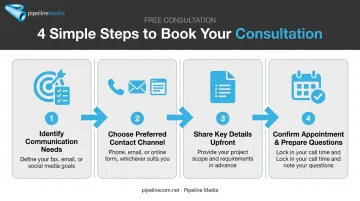
Step 1: Identify Your Communication Needs
Before picking up the phone, pinpoint the specific problem you're trying to solve. Are you trying to:
- Reduce the cost of your current fax broadcasting setup?
- Launch a new email campaign to a fresh contact list?
- Grow leads through consistent social media management?
- Run and manage PPC ads without an in-house specialist?
A clear objective helps the call move faster and produces recommendations that fit, rather than generic advice. It also helps to know whether the need is a one-time push, such as a single fax blast for an event, or an ongoing managed service that runs monthly.
Step 2: Choose Your Preferred Contact Channel
Most providers offer three ways in: phone, email, or an online request form. Pipeline Media, for example, can be reached by phone at 1-866-565-5317 (general services) or 1-866-596-4366 (social media specifically). You can also email info@pipelinecom.net or use their online consultation form.
A true full-service provider should have a real person, not a chatbot, responding to that first contact within minutes. That responsiveness is a decent early signal of what working with them will actually feel like.
Step 3: Share Key Details Upfront
The information that speeds things up is straightforward:
- Company name and industry
- Your communication goal (cost reduction, lead generation, campaign launch)
- Approximate volume — number of contacts, emails, or fax pages
- Your rough timeline
If you already have a document, contact list, or database, send it early. This lets the consultation focus on strategy instead of file logistics. Most established providers, Pipeline Media included, work with virtually any file format, so don't delay booking just because your data isn't perfectly organized. A messy spreadsheet is still a usable spreadsheet.
Step 4: Confirm the Appointment and Prepare Questions
Once you receive a time slot, confirm the date, time, and format (usually phone). Then prepare 3-5 questions covering:
- Pricing: flat rate or quote-based, and what drives the cost
- Turnaround time: how fast a campaign or setup goes live
- Compliance and data security: especially for regulated industries
- Reporting: what tracking or delivery confirmation you'll receive
If a marketing lead, IT contact, or compliance officer needs to sign off internally, loop them in before the call. It saves everyone from repeating the same conversation twice.
When Should You Book a Consultation
A consultation isn't reserved for brand-new clients. It's useful anytime your communication needs shift. Common triggers include:
- Launching a new campaign and needing a fast, reliable way to reach a large audience
- Switching from a manual, in-house process to a managed service that handles execution
- Evaluating cost savings on current fax, email, or social spend
- Scaling outreach across North America without adding headcount
These triggers point to a larger pattern: most companies wait too long to bring in outside support. According to McKinsey's 2024 research, only 27% of surveyed C-level executives report having a mature marketing operating model. Most businesses are still running manual, fragmented processes long after they've outgrown them. That gap is exactly what a consultation is meant to close.
Waiting until a deadline is imminent, such as a time-sensitive fax blast before a product launch, makes it harder to get the scheduling attention and rush turnaround you need. Book earlier than you think you need to.
What You Need Before Booking a Consultation
Preparation directly shapes how actionable the consultation's recommendations will be. Show up with vague ideas, and you'll get vague advice back.
Have these ready before the call:
- Target audience or contact list: even a rough version works
- Current communication channels: whatever you're already using
- Rough budget range: a ballpark figure works
- Desired outcome: more leads, lower costs, or better engagement
Internal readiness matters just as much. Bring a decision-maker or budget-holder into the loop, even if they don't join the call directly.
Flag any compliance requirements upfront, particularly if you operate in healthcare, financial services, or government, so the provider can address them head-on instead of circling back later.
What to Expect: Key Factors That Shape Your Consultation
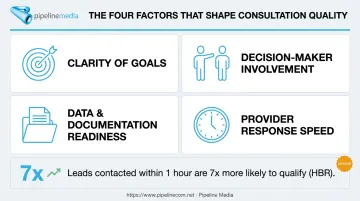
The quality of a consultation depends on a handful of controllable factors, not luck. Four factors shape the outcome most:
- Clarity of goals. Specific goals, such as fax broadcasting versus a paid social campaign, let the provider recommend the right service and pricing tier instead of generic advice.
- Decision-maker involvement. Having the person who approves budget on the call shortens the path from the first conversation to a signed engagement, without a second meeting just to get a yes.
- Data and documentation readiness. Sharing your contact list, document, or ad account upfront lets providers give accurate turnaround and cost estimates, often as same-call quotes.
- Response speed of the provider. Slow follow-up after a consultation request signals slow service overall.
Research from Harvard Business Review found that companies contacting a web-generated lead within one hour were nearly 7 times more likely to qualify that lead than those who waited even a little longer (HBR, 2011). Providers that respond within minutes — a standard practice at Pipeline Media — typically get campaigns live faster because momentum doesn't stall between the first call and the next step.
Common Mistakes to Avoid When Booking a Consultation
A few avoidable errors turn a useful consultation into a wasted half hour:
- Booking without a clear goal: you'll get a generic sales pitch instead of tailored advice
- Skipping list, document, or budget prep often forces a second call before work can start
- Not asking about compliance or unsubscribe management upfront matters most in regulated industries like healthcare or finance
- Waiting until close to a campaign deadline limits your scheduling options and rush availability
Each of these is fixable with about ten minutes of prep before you dial the number.
Frequently Asked Questions
What does "book a consultation" mean?
It means scheduling a short, typically free introductory conversation with a provider to discuss your needs, get recommendations, and determine fit — all before making any commitment.
What are the 7 steps of a consultation?
The typical flow covers: initial inquiry, scoping the call, needs assessment, information gathering, discussion of options, proposal or recommendation, and agreement on next steps.
Is a consultation with a communications agency free?
Most agencies, including full-service providers like Pipeline Media, offer complimentary initial consultations with no obligation to sign anything.
How long does a typical consultation take?
Length varies with the complexity of your needs, so there's no fixed time slot. Expect the call to run long enough to cover your goals, current setup, and next steps.
What happens after I book a consultation?
A representative reviews the details you've shared, prepares recommendations, and the call proceeds to discuss pricing, timelines, and next steps based on your specific goals.
Can I reschedule a consultation once it's booked?
Yes. Most providers allow rescheduling by contacting them via phone or email ahead of the scheduled time, no formal cancellation process required.