It's a fair question. Fax feels like a relic to a lot of people, yet it hasn't disappeared. Among U.S. hospitals, 67% reported often or sometimes sending patient records through eFax using their EHR system, according to a 2021 AHA IT Supplement data brief published by HealthIT.gov. Healthcare, finance, legal, and government still lean on it heavily.
This article breaks down what a fax number actually is, how it's formatted, how it's different from a regular phone number, and how your business can get one today, virtual options included.
Key Takeaways
- A fax number uses the same format as a phone number but routes to a fax-capable device or service instead
- Local, toll-free, and international fax numbers each serve different business needs
- Regulated industries still rely on fax for compliance and documented delivery
- Virtual fax numbers let you send and receive documents from any device, no machine required
- Providers like Pipeline Media offer virtual fax numbers starting at $10 USD/month
What Is a Fax Number? (Meaning & Definition)
A fax number is a telephone number dedicated to sending and receiving documents rather than voice calls. It can connect to a physical fax machine plugged into a landline, or to an online fax service that lives entirely in the cloud.
"Fax number" and "facsimile number" mean the same thing. Facsimile is just the formal, technical term. Both use standard telephone numbering conventions, so a fax number looks identical to a phone number on paper.
How it actually works: dialing a fax number connects two fax-capable endpoints. Instead of carrying a voice conversation, the connection negotiates a document transfer, then one machine "reads" the pages and reconstructs them on the other end.
Traditional vs. Virtual Fax Numbers
The mechanics have changed a lot over the decades:
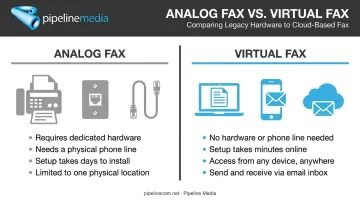
- Analog fax numbers are tied to a physical phone line and require a dedicated fax machine plugged into a wall jack
- Virtual fax numbers run through an online account, letting you send and receive faxes via computer, app, or email with zero hardware
- Signing up with an online provider, such as Pipeline Media's Fax-To-Email service, typically assigns you a dedicated number automatically, with no hardware or setup fee required
This shift from analog to virtual explains why shared voice-and-fax lines have all but disappeared. Decades ago, a single phone line often handled both. That's rare now, since most businesses keep a dedicated fax line completely separate from their voice lines, simply because it's more practical to manage.
Fax Number Formats & Examples
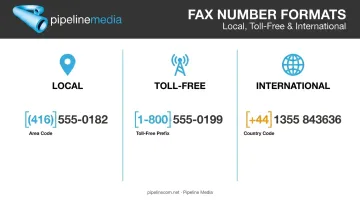
Fax numbers follow the exact same digit structure as phone numbers in their country. In the U.S. and Canada, that means the North American Numbering Plan format: a 3-digit area code plus a 7-digit local number, written as NXX-NXX-XXXX.
Local Fax Numbers
A local fax number looks like (416) 555-0182 — area code, then seven digits. Businesses often choose a local number tied to their city or region because it builds trust with nearby clients and signals a genuine local presence. Services like Pipeline Media's Fax-To-Email offer numbers tied to specific US and Canadian cities for exactly this reason, letting a business keep a local footprint even while managing faxes digitally.
Toll-Free Fax Numbers
Toll-free numbers use recognizable prefixes. The FCC currently lists 800, 888, 877, 866, 855, 844, and 833 as valid toll-free codes, and they're not interchangeable. A number like 1-800-555-0199 signals a company with national or multi-location reach, which is why larger organizations tend to favor them.
International Fax Numbers
International numbers need a country code prefix, written with a "+" symbol ahead of it. Digit counts vary by country since local numbering plans differ. Common prefixes include:
- +1 — United States and Canada
- +44 — United Kingdom
- +61 — Australia
Two real examples show how this works in practice. The UK's Foreign, Commonwealth & Development Office lists its Overseas Pension Department fax as 01355 843636 domestically, which normalizes internationally to +44 1355 843636. For a U.S. federal example, the HHS Office for Civil Rights Customer Response Center lists its fax as (202) 619-3818. Both function exactly like ordinary phone numbers.
Fax Number vs. Phone Number: What's the Difference
Here's the direct answer people usually search for: a fax number is technically a phone number in format What's different is the purpose and the equipment or service connected to it.
Decades ago, one phone line could handle both fax and voice traffic, just never at the same time. If a fax started coming in while someone was on the phone, that call had to end first. Today, nearly every business keeps the two completely separate for practical reasons.
How to Tell Them Apart
There's no visual difference in the digits themselves. You spot the distinction through labeling:
- Business cards and websites typically use "Tel:" or "Phone:" next to voice numbers
- "Fax:" appears next to the number meant for document transmission
- Without that label, a fax number is indistinguishable from a phone number at a glance
What Happens If You Dial the Wrong One
Call a fax number by mistake, and you won't hear ringing or a person answering. You'll hear tones: a 1,100 Hz CNG tone from the calling side and possibly a 2,100 Hz CED response, per the ITU-T T.30 protocol that governs fax negotiation. It's an odd, screechy sound that immediately tells you something's off.
That inability to negotiate a voice conversation points to another key limit: you can't text or chat with a fax number, since there's no messaging layer built into the protocol. What you can do is email a document to a virtual fax number, which services like Pipeline Media's Fax-To-Email convert and forward as a standard fax on the receiving end.
Why Fax Numbers Still Matter for Businesses
Regulated industries haven't abandoned fax, and there's a reason for that. HHS guidance confirms providers may share patient information for treatment purposes "by fax, email, phone, or otherwise," provided reasonable safeguards are in place, according to HHS's HIPAA FAQ on treatment communications. Fax isn't mandated, but it remains an accepted, well-understood channel.
Government agencies build fax directly into their processes too. In the US, for instance, federal procurement rules under FAR 52.214-31 allow facsimile bids when a solicitation permits them, and IDEA regulations (34 CFR 300.183) list facsimile transmission alongside mail and hand delivery for covered filings. Canadian regulatory bodies show similar patterns, treating fax as an accepted formal filing method.
Why fax keeps its footing:
- It avoids email's phishing and hacking exposure
- It sidesteps the risk of physical mail getting lost or delayed
- Every transmission generates a documented delivery record
That said, a fax confirmation only proves the machine received the pages, not that a human read them. Real compliance still depends on secure equipment placement, verified numbers, and internal policy, not the fax number alone.
For businesses sending high volumes of documents, this reliability creates a different kind of headache: manual dialing. If you're sending contracts, announcements, or forms to hundreds of recipients, dialing and confirming each fax individually eats up hours. Pipeline Media's fax broadcasting service handles that at scale, sending over 1 million pages per hour, then retrying any failed numbers three times, free of charge, before flagging them. Clients get a detailed report showing exactly who received the document and who didn't, so nobody's manually tracking delivery status line by line.
How to Get a Fax Number
You've got two real paths here, and they look nothing alike.
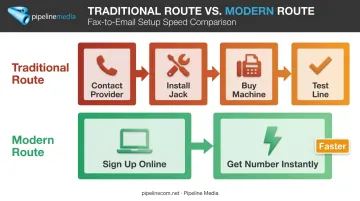
The traditional route:
- Contact a phone provider and request a line that supports fax service (Verizon, for instance, requires a Business Digital Voice line for this)
- Have a phone jack installed if one isn't already in place
- Purchase and connect a physical fax machine to that line
- Test the connection before relying on it for anything important
The modern route skips all of that. You sign up with a virtual fax provider, and a dedicated number gets assigned in minutes, no hardware, no installation, no waiting on a technician.
Choosing a Virtual Fax Number
Pipeline Media's Fax-to-Email service shows just how simple this process has become. Setup takes three steps: enter your contact details, pick a plan, then choose your fax number from almost any city across the US and Canada.
| Plan | Monthly Cost | Pages In/Out | Overage Rate |
|---|---|---|---|
| Standard | $10 USD | 100 / 100 | $0.10/page |
| Pro | $20 USD | 250 / 250 | $0.08/page |
Both tiers include:
- One dedicated fax number with no setup fee
- Cancellation whenever you want, no long-term contract
- Sending and receiving from any computer, phone, or tablet
- A real person on the line if you need help getting set up
Frequently Asked Questions
How do I find out my fax number?
If you're on a landline with a physical fax machine, dial your cell phone from that line and your fax number will display on caller ID. Otherwise, check with your phone provider directly. For virtual fax numbers, it's shown right in your account dashboard after signup — Pipeline Media's Fax-To-Email service, for example, assigns your number the moment you sign up.
Is a fax number the same as a phone number?
They share the same format, but a fax number is dedicated to transmitting documents, not carrying voice calls. Dial one by accident and you'll hear fax tones instead of a person or a ring.
What is an example of a fax number?
A local U.S. number might look like (212) 555-0182. A toll-free version would be something like 1-800-555-0199. An international UK number would appear as +44 1355 843636.
Can I use my existing phone number as a fax number?
A landline number can be repurposed by connecting a fax machine to it. A cell phone number can't be used this way. Virtual fax providers, such as Pipeline Media's Fax-To-Email plans, offer a much simpler workaround for either situation.
Can you call a fax number?
You can dial it, but you'll connect to a fax device, not a person. Expect tones, not a greeting.
Do I need a fax number to send a fax?
Recipients need one to receive your document, but some online fax services let you send without owning a personal fax number yourself.