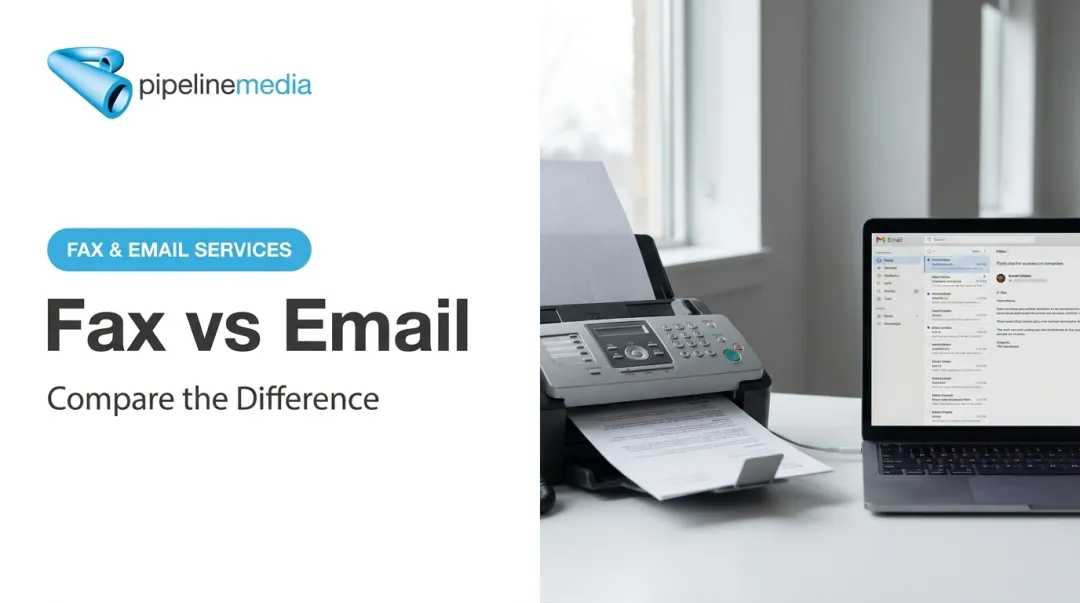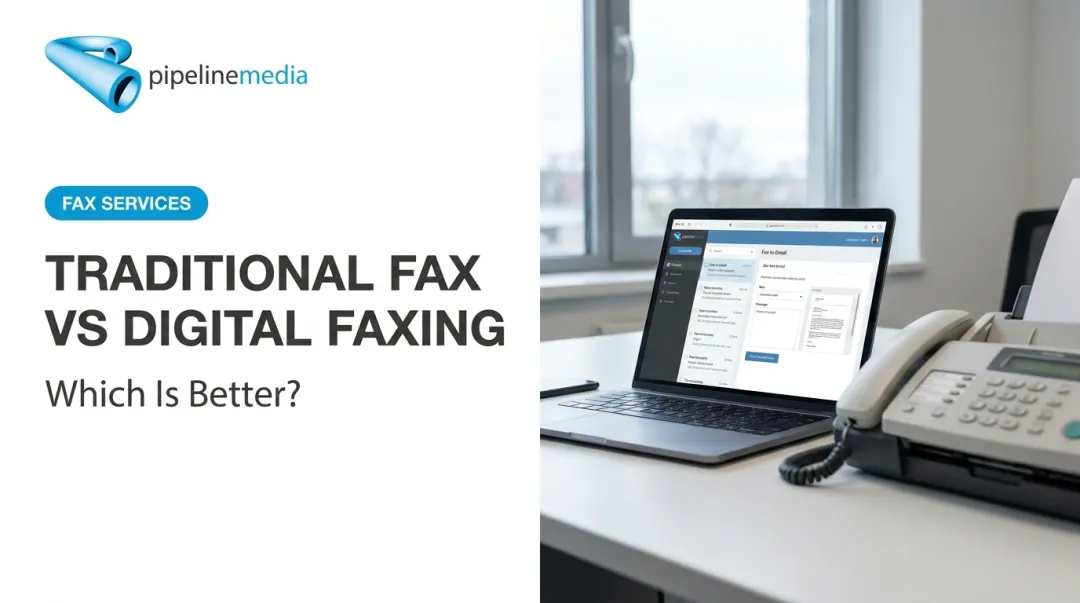
For businesses handling sensitive documents, this comparison isn't academic. The channel you choose affects security exposure, compliance risk, delivery certainty, and your monthly communication budget. A misrouted email with client financial data can trigger a breach notification. A fax sent to the wrong number causes similar headaches.
This guide breaks down cost, security, speed, legal weight, and accessibility for both channels, then gives you a framework for deciding which one fits your workflow. Spoiler: most regulated businesses end up using both.
Key Takeaways
- Email wins on speed and cost for everyday correspondence and marketing outreach
- Fax remains the go-to channel for HIPAA records, legal filings, and signed contracts
- Compliance isn't automatic for either channel; both need safeguards like verified recipient numbers and secure email practices
- Businesses can now send and receive faxes without owning hardware, thanks to fax-to-email services
- Many companies run both channels simultaneously rather than picking a single winner
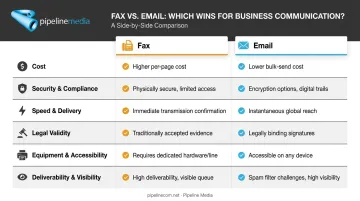
Fax vs. Email: Quick Comparison
Cost
Fax:
- Traditional fax lines require phone infrastructure and IT support
- Cloud/online fax replaces hardware with subscription pricing
- Pipeline Media's Fax-To-Email starts at $10 USD/month (Standard: 100 pages in/out, $0.10/page overage) or $20 USD/month (Pro: 250 pages in/out, $0.08/page overage)
- No setup fees, cancel anytime
Email:
- Near-zero marginal cost per message once infrastructure is in place
- Costs scale with security tools, storage, and retention requirements rather than message volume
- Bulk campaign pricing is typically vendor-specific and usage-based
Security & Compliance
Fax:
- Uses dedicated transmission lines or encrypted cloud-fax platforms rather than the open internet
- HHS permits faxing PHI when reasonable safeguards apply, such as confirming the recipient number (HHS)
- Risk still exists: wrong numbers or unattended machines can expose sensitive data (Office of the Privacy Commissioner of Canada)
Email:
- HHS also permits provider-patient email with reasonable safeguards (HHS)
- Basic SMTP lacks built-in authentication and encryption, per NIST guidance
- Business Email Compromise losses exceeded $55 billion globally between October 2013 and December 2023, according to the FBI
Speed & Delivery Reliability
Fax:
- Successful transmission confirms the document reached the receiving machine—not that a person read it
- No universal fax speed benchmark exists, but delivery is generally immediate once connected
Email:
- Instant transmission, but acceptance doesn't guarantee inbox placement
- Global inbox placement averaged just 83% in 2024, meaning roughly 17% of legitimate email never reaches the inbox at all (Validity 2025 Benchmark Report)
Legal Validity & Signatures
Fax:
- Many jurisdictions accept faxed signatures in specific contexts (Canadian bankruptcy proofs of claim, for example)
- No blanket law universally validates every faxed signature
Email:
- The U.S. ESIGN Act prevents denial of legal effect solely because a signature is electronic
- Exclusions apply (wills, certain family-law matters), and ESIGN doesn't explicitly address fax
Equipment & Accessibility
Fax:
- Traditional machines require hardware, paper, and a phone line
- Cloud fax and fax-to-email eliminate hardware entirely—send and receive from any device
Email:
- Requires only internet access and an email client
- Universally accessible across virtually every device and platform
Deliverability & Visibility
Fax:
- Delivery reports show exactly who received a document and why failures happened
- Pipeline Media retries failed numbers 3 times free of charge with detailed post-broadcast reporting
Email:
- Open and click tracking provide visibility, but spam filters and inbox placement remain a persistent challenge
- Average campaign open rates sit around 35.63% industry-wide (Mailchimp)
What is Fax?
Fax transmits scanned or printed documents over phone lines or, increasingly, through internet-based platforms. Despite predictions of its demise for decades, it remains embedded in regulated industries because of three practical advantages.
Core benefits:
- Stronger security: transmissions travel over dedicated lines or encrypted cloud platforms, not the open internet
- Higher deliverability — faxes print or upload automatically instead of risking a spam folder
- Signature support: widely accepted for contracts and official filings in specific legal contexts
These advantages explain why fax persists, but the technology itself has evolved considerably. Traditional analog machines still exist in some offices, though most modern usage now runs through cloud or online fax services and fax broadcasting platforms that remove hardware dependency entirely.
Use Cases of Fax
Fax fits naturally into workflows demanding a paper trail or verified signature:
- Contracts and legal agreements
- Medical records and insurance authorizations
- Government filings and claims documentation
- Any process requiring signature verification
Healthcare, legal, and government sectors lean on fax most heavily. The ABA's 2024 survey found electronic-fax use at 49% among solo lawyers versus 23% at large firms, suggesting fax use remains woven into legal workflows even as firms adopt digital tools (ABA 2024 Legal Technology Survey).
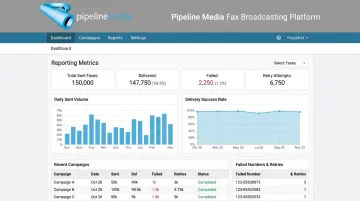
That kind of steady reliance creates a real challenge for organizations sending high volumes of faxes without wanting to maintain their own hardware. Pipeline Media's Fax Broadcasting service illustrates how businesses solve that problem at scale. The platform sends over 1 million pages per hour, letting healthcare providers, financial institutions, and government agencies distribute time-sensitive documents at scale. Every problem number gets retried three times at no extra charge, with detailed reports showing exactly who received the fax and why any attempts failed.
What is Email?
Email is internet-based messaging that transmits text, files, and multimedia instantly to anywhere in the world. It's the default channel for fast-moving business correspondence and large-scale outreach.
Core benefits:
- Near-zero marginal cost per message once systems are in place
- Instant global delivery regardless of recipient location
- Flexible file support: attach documents, images, spreadsheets, and more
- Built-in tracking: opens, clicks, and engagement data feed directly into marketing analytics
These benefits scale differently depending on volume. Standard email handles day-to-day correspondence, while email broadcasting tools are built for mass outreach, with compliance features like unsubscribe management baked in.
Use Cases of Email
Email dominates:
- Internal team communication
- Customer outreach and support
- Marketing campaigns and newsletters
- Transactional notifications (order confirmations, account alerts)
Retail, technology, and publishing rely on email almost exclusively for customer engagement. Statista estimated 376.4 billion emails sent and received per day worldwide in 2025, with that figure projected to climb toward 424 billion by 2028.
Pipeline Media's Email Broadcasting service handles this volume for clients directly. The platform sends millions of emails per hour, with most campaigns live within 60 to 90 minutes of receiving a client's list and creative assets. Built-in compliance features manage unsubscribe requests automatically, helping businesses stay aligned with regulations like CASL and CAN-SPAM without manually tracking opt-outs.
Fax vs. Email: Which Is Better?
Neither channel wins outright. The right choice depends on four factors:
- Sensitivity of the information: financial records, medical data, and legal documents carry higher stakes than a marketing newsletter
- Compliance requirements: some regulated workflows still specify fax or require signature verification
- Budget: email costs less per message; fax offers more predictable per-document handling
- Recipient infrastructure: does the other party expect (or require) a fax number?
When to choose fax: sensitive, signed, or compliance-regulated documents where a paper trail matters.
When to choose email: speed, cost-efficiency, and everyday digital correspondence at scale.
The Hybrid Approach
Fax-to-email services bridge the gap. They let businesses send and receive faxes directly through a standard email inbox—no machine required. This combines fax's security and signature acceptance with email's convenience.
Pipeline Media's Fax-To-Email service works exactly this way. Subscribers choose a dedicated fax number from almost any city in the United States or Canada, then send and receive faxes from any computer, phone, or tablet. This setup lets field teams and multi-office operations ditch physical machines entirely, since each person can send and receive faxes from wherever they're working.
Practical example: A financial services firm might fax signed loan documents and compliance filings while emailing client newsletters and account updates through the same communications stack.
Rather than juggling separate vendors for fax and email, businesses can consolidate both under one provider. Pipeline Media offers three distinct services under one roof:
- Fax Broadcast for high-volume, managed fax campaigns
- Fax-To-Email for individual dedicated fax numbers accessible from any device
- Email Broadcast for bulk email delivery with tracking and compliance management
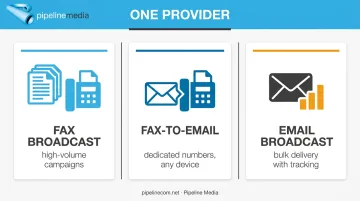
Each comes with delivery tracking and compliance support, backed by a real support team rather than an automated help desk.
If your business regularly sends both sensitive documents and marketing content, it's worth evaluating your current mix and considering whether a single full-service partner could simplify things.
Conclusion
There's no universal winner here. Fax still carries unmatched weight for security, compliance, and legal recognition. Email wins on speed, cost, and sheer everyday convenience.
The smarter question isn't "which channel is better," but "which channel fits this specific message." Getting that right reduces compliance risk, keeps communication costs predictable, and improves the odds your document actually reaches the right person. Pipeline Media manages both channels for you, handling fax broadcasting with automatic retry on failed numbers alongside tracked email delivery. That removes the hassle of running two separate systems and gives you one point of contact for every message that needs to go out.
Frequently Asked Questions
Is it better to fax or email?
It depends on the use case. Fax is better for secure, compliance-sensitive, or legally binding documents. Email is better for speed and everyday correspondence.
Can I use my email as a fax?
Yes, through fax-to-email services like Pipeline Media's Fax-To-Email subscription. These let you send and receive faxes directly from your email inbox without owning a physical machine.
Is fax more secure than email?
Fax transmissions over phone lines or encrypted cloud platforms are generally harder to intercept than standard, unencrypted email. Neither channel is automatically secure without proper safeguards.
Do businesses still use fax machines?
Many regulated industries—healthcare, legal, and government—still rely on fax, though most have shifted to cloud-based online fax rather than physical machines.
What is fax-to-email and how does it work?
Fax-to-email routes incoming faxes to your email inbox as digital files. Outgoing emails get converted and sent as faxes through the provider's servers, eliminating the need for hardware.
Is a faxed document legally binding?
Many jurisdictions recognize faxed signatures and documents as legally valid in specific contexts, making fax a preferred method for certain contracts and official filings. Requirements vary by transaction type and location.