That hesitation is worth listening to. Terms like "e-blast," "email blast," "mass email," and "bulk email" get used interchangeably, but the strategy behind the send is what separates a message that builds trust from one that gets flagged and forgotten.
This guide breaks down what an e-blast actually is, how it differs from strategic email marketing, and the best practices (plus compliance rules) that keep North American businesses out of the spam folder.
Key Takeaways
- An e-blast sends one message to a large list at once, usually without segmentation or personalization
- Email marketing is the broader discipline, covering segmented, automated, and personalized campaigns built for long-term relationships
- Poorly managed e-blasts risk landing in spam folders, triggering unsubscribes, and violating CAN-SPAM and CASL regulations
- Clean lists, segmentation, and compliance turn a risky blast into a reliable communication tool
What Is an E-Blast?
An e-blast, also called an email blast or mass email, is a single message sent to a large recipient list all at once, typically with little to no targeting. Campaign Monitor defines it as exactly that: one email, one big list, minimal personalization.
The logic behind an e-blast is speed over precision. Rather than crafting a perfectly tailored message for each subscriber, you're trying to get one piece of information in front of as many people as possible, fast.
That approach carries risk. Nearly 45% of global email traffic was classified as spam in 2025, according to Kaspersky's telemetry data. A poorly targeted blast with no permission trail can easily get swept into that category, even when the sender has legitimate intentions.
Common Use Cases for E-Blasts
E-blasts aren't inherently bad. They're the right tool for messages that need to reach everyone, regardless of individual preferences:
- Company-wide announcements or leadership changes
- Service outages or urgent operational updates
- Policy updates that apply to your entire client base
- Event invitations with a hard deadline
- General newsletters covering broad company news
Even a well-run e-blast, though, still needs basic list hygiene. Send to people who opted in. Skip the list you bought three years ago. Otherwise, you're one spam complaint away from tanking your sender reputation, even for a legitimate announcement. This is exactly why many businesses hand their bulk email off to a managed service like Pipeline Media's email broadcasting, which handles list compliance and unsubscribe management on the client's behalf.
E-Blast vs. Strategic Email Marketing: What's the Difference?
Here's where the terminology gets confusing: email marketing is the umbrella term, and e-blasts are just one tactic within it. The umbrella also covers segmented campaigns, automated drip sequences, and behavior-triggered nurture flows.
The core distinction comes down to optimization goals:
| Factor | E-Blast | Strategic Email Marketing |
|---|---|---|
| Audience targeting | Entire list, no segmentation | Segmented by behavior, interest, or lifecycle stage |
| Personalization | Minimal to none | Merge fields, dynamic content, tailored messaging |
| Typical engagement | Lower open/click rates | Significantly higher open/click rates |
| Best for | Time-sensitive, universal announcements | Ongoing relationship-building, conversions |
The financial gap between the two approaches is hard to ignore. Litmus's 2025 State of Email Survey benchmarks email marketing ROI at roughly $36 for every $1 spent, a figure widely cited across the industry (some earlier UK studies from the DMA put it even higher, near £42 per £1).
Segmentation Is the Real Lever
That ROI gap doesn't come from luck — it comes from segmentation. This is the single factor that transforms a generic blast into a high-performing campaign, and it's a core part of the managed email broadcasting work agencies like Pipeline Media handle for clients: building lists that target by behavior, interest, or lifecycle stage rather than blasting everyone at once. Mailchimp's analysis of nearly 9 million recipients found segmented campaigns generated:
- 14.31% higher open rates than non-segmented sends
- 100.95% higher click rates across the same user base
- Even bigger gains when segmenting by interest group (74.53% higher clicks)
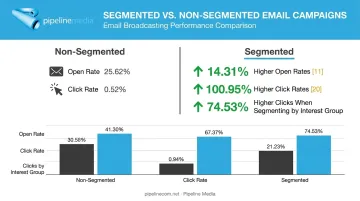
HubSpot's more recent 2023 State of Marketing Report backs this up, citing 30% more opens and 50% more clickthroughs from segmented emails. The pattern holds regardless of which year's data you pull.
Email Marketing Best Practices
Every effective send, blast or otherwise, starts with the same foundation: a clean, permission-based list. Built through genuine opt-ins, never purchased. This single factor affects deliverability more than almost anything else you'll do.
Craft Subject Lines and Content That Earn the Open
Your subject line is a promise. Break it, and you lose trust fast.
- Keep subject lines concise and specific about what's inside
- Avoid spam-trigger words ("FREE," "ACT NOW," excessive exclamation points)
- Skip misleading claims that don't match the email body
- Structure content with clear visual hierarchy: headline, short copy, one strong image, one clear call-to-action
One CTA per email works better than five. Competing buttons dilute the action you actually want readers to take.
Segment, Personalize, and Test
Even a modest segmentation strategy, splitting by purchase history, engagement level, or geography, pays off in relevance. Combine that with ongoing A/B testing on subject lines, send times, and content format to keep refining what works for your specific audience.
Don't guess. Test.
Track the Metrics That Matter
Four KPIs tell you almost everything you need to know after a send:
- Open rate – Are your subject lines and sender reputation working?
- Click-through rate – Is your content and CTA compelling enough to act on?
- Bounce rate – Is your list clean, or full of dead addresses?
- Unsubscribe rate – Is your content relevant, or wearing out its welcome?
For context, GetResponse's 2024 benchmark report, based on more than 4.4 billion sent messages, puts average performance at roughly 39.64% open rate, 3.25% click-through rate, 2.33% bounce rate, and 0.15% unsubscribe rate. Use these as a rough gut-check, not gospel; industry, list size, and even Apple's Mail Privacy Protection settings can skew open-rate numbers upward.
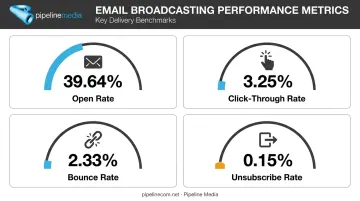
That bounce rate number points to a practice that matters just as much as tracking itself: regular list hygiene. Remove hard bounces after every send, and prune subscribers who haven't opened anything in six-plus months. Your sender reputation depends on it. Agencies managing bulk sends, Pipeline Media included, build this cleanup directly into ongoing campaign management so deliverability stays high without extra work on your end.
Staying Compliant and Out of the Spam Folder
Compliance isn't optional, and the rules differ depending on where your recipients live.
In the United States, CAN-SPAM requires:
- Accurate sender identification in the "From" and "Reply-To" fields
- Subject lines that honestly reflect the email's content
- A clear, working unsubscribe mechanism, honored within 10 business days
- A valid physical postal address in every commercial email
Violations aren't cheap. The FTC lists civil penalties up to $53,088 per violating email, and that's per email, not per campaign.
If you're emailing Canadian contacts, CASL applies too, and it's stricter. Unlike CAN-SPAM, CASL generally requires prior consent, either express (an active opt-in) or implied (an existing business relationship, typically valid for two years). The CRTC's guidance also requires:
- Clear sender identification with a valid mailing address
- Contact information that stays valid for at least 60 days
- Unsubscribe requests processed within 10 business days
Corporate penalties under CASL can reach CAD$10 million per violation. That's not a rounding error in anyone's marketing budget.
A visible unsubscribe link and prompt opt-out processing aren't just legal checkboxes. They're what keeps your audience trusting you enough to keep opening your emails.
That's not a rounding error in anyone's marketing budget, which is why unsubscribe and consent management often gets outsourced to agencies like Pipeline Media, who build compliance directly into every email campaign they run.
DIY Tools vs. Full-Service E-Blast Management
Most businesses start with a self-serve platform: load a list, pick a template, hit send. It works, until the list grows, the compliance requirements pile up, and someone on the team is spending hours every month just managing subscriber hygiene and deliverability issues instead of running the business.
That's the gap Pipeline Media's Email Broadcasting service is built to close. The model is simple: clients send their list and content, and Pipeline handles everything else.
What that "everything else" actually covers:
- Job setup and format conversion — Word docs or PDFs get converted to HTML so recipients see a properly formatted email, not an attachment
- Testing and retesting: Every job is checked before it goes out
- High-volume delivery — Sending capacity reaches millions of emails per hour, well beyond what a standard Gmail account can handle (most personal accounts cap out well under 2,000 sends)
- Personalization through merge fields: Recipient-specific data gets built into each message automatically
- Compliance and unsubscribe management — Pipeline works within current email regulations and manages the opt-out system directly
- Tracking reports: Post-send data on undeliverable addresses, opens, and link/image clicks
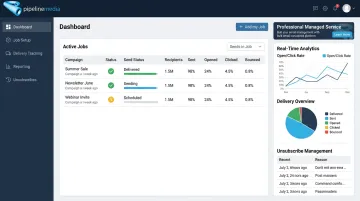
Most jobs go live within 60 to 90 minutes of submission. That turnaround matters most for organizations in regulated or high-volume sectors — financial services, healthcare, government agencies, associations. Built-in compliance handling means reliable delivery without pulling internal staff away from their actual jobs.
Frequently Asked Questions
What is an e-blast?
An e-blast is a single email sent to a large list all at once, typically without segmentation or personalization. It's also called a mass email or bulk email.
What does email marketing include?
Email marketing is the broader discipline. It includes e-blasts plus segmented campaigns, automated nurture sequences, newsletters, and transactional emails, all aimed at building customer relationships over time.
Is an email blast the same thing as email marketing?
No. An e-blast is one tactic within the larger practice of email marketing, not a synonym for the entire discipline. Strategic email marketing uses segmentation and personalization that a basic blast typically skips.
How often should a business send e-blasts?
Frequency depends on content relevance and what your audience expects. Sending too often increases unsubscribe rates and spam complaints, even when the content itself is strong.
What happens if an e-blast violates CAN-SPAM or CASL?
Both laws carry real financial penalties, up to USD$53,088 per email under CAN-SPAM and up to CAD$10 million per violation under CASL for corporations. Working with a provider that manages unsubscribe requests and compliance checks, like Pipeline Media's email broadcasting service, helps avoid these risks entirely.
How can a business improve its e-blast open and click rates?
Segment your list, personalize where possible, write subject lines that match your content honestly, and track performance after every send. Small changes in targeting tend to produce the biggest gains in engagement.