That's retail social media in 2026: not a marketing add-on, but a functioning storefront.
For most retail teams, though, this creates a real problem. Brands are expected to post daily, reply to DMs in real time, run paid ads, and prove that all of it drives revenue, while still running the actual business of buying, merchandising, and selling product.
This post breaks down what social media marketing for retail really means, why it matters, the content-mix frameworks worth knowing, how to pick the right platforms, which KPIs actually matter, and how outsourcing the day-to-day can take the weight off your team.
Key Takeaways
- Social platforms now double as discovery engines, storefronts, and support desks
- 76% of social users say social content influenced a purchase in the past six months
- Content-mix frameworks like 5-5-5 and 3-3-3 prevent feeds from feeling like nonstop ads
- Platform choice should match your product and audience, not a generic posting calendar
- Revenue-tied KPIs matter more than follower counts when proving social media ROI
What Is Social Media Marketing for Retail?
Social media marketing for retail means using platforms like Instagram, TikTok, Facebook, and Pinterest to showcase products, build community, and drive sales both online and in-store. It's grown into a functioning sales channel, not just a brand-awareness play.
The key difference from traditional retail advertising: it's two-way. A print ad or TV spot broadcasts a message and waits. A social post invites comments, shares, and direct replies within seconds, and smart retailers treat that conversation as part of the sales process.
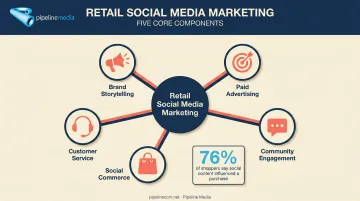
Core components of retail social media marketing include:
- Brand storytelling and lifestyle content that builds recognition
- Paid social advertising targeted at specific shopper segments
- Organic community engagement (comments, shares, replies)
- Social commerce features like shoppable posts and in-app checkout
- Customer service handled through DMs and comment threads
This spans the entire retail funnel, not just the top. A customer might discover a product through a Reel, ask a sizing question via DM, buy through a shoppable post, then post a photo review that influences the next shopper.
The data backs up how central this has become. In Sprout Social's Q2 2025 Pulse Survey of over 2,280 social media users, 76% said social content influenced a purchase in the previous six months, jumping to 90% among Gen Z. For a huge share of buyers, social media is the shopping journey.
The Role Social Media Plays in Retail Brand Growth
Social media touches retail growth at nearly every stage, from the first glimpse of a product to the review left weeks later.
Product Discovery Happens Passively
Shoppers aren't always searching for your product. Increasingly, they find it while scrolling for something else entirely. Short-form video and algorithm-driven feeds surface new brands to people who weren't looking.
TikTok Shop's own research found that 83% of surveyed shoppers discovered a new product on the platform, and 70% discovered an entirely new brand there. Among shoppers already engaged with TikTok Shop, 76% had purchased through a livestream in the past year.
Conversion Paths Are Shrinking
Social commerce tools compress the distance between "I want that" and "I bought it." TikTok Shop keeps checkout native to the app. Meta's Shops on Facebook and Instagram now route purchases through the retailer's website, but the discovery-to-cart journey still starts on the platform.
Statista estimates global social commerce revenue will reach $586 billion in 2026, climbing toward $929 billion by 2030. Those are projections, not locked-in figures, but the trajectory is unmistakable.
Trust, Engagement, and Listening Turn Followers Into Buyers
User-generated content and reviews shorten decision cycles in a way branded ads can't replicate. Shoppers scroll past polished ad creative but stop for a real customer's unboxing video or a friend's recommendation in the comments.
That same comment section doubles as a service channel. Answering a pre-purchase sizing question or a post-purchase shipping concern quickly turns a one-time buyer into a repeat one; slow or absent replies do the opposite.
Those conversations also feed the rest of the business. Comment sentiment and DM themes give retail teams a live read on what's working, what's confusing customers, and what to restock, insight that shapes merchandising and inventory decisions, not just marketing.
Content-Mix Rules Every Retail Brand Should Know
Feeds that only push products lose followers fast. A handful of popular frameworks help retail brands balance promotion with the value and personality that keep people engaged.
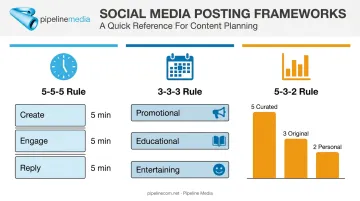
The 5-5-5 Rule
This one's about daily habits, not content categories. Each day, spend:
- 5 minutes creating or drafting content
- 5 minutes engaging with other accounts in your niche
- 5 minutes replying to comments and messages on your own posts
For a retail brand, this might mean five minutes commenting on customer photos tagging your product, five minutes browsing competitor or complementary accounts, and five minutes replying to DMs about restocks.
The 3-3-3 Rule
Originally a hashtag strategy, this rule pairs well with content variety thinking. The hashtag version pairs 3 broad tags, 3 medium-reach tags, and 3 niche tags per post to balance discoverability with relevance.
Retail brands often adapt the same "rule of three" logic to content types, mixing:
- Promotional posts featuring products, sales, or launches
- Educational content like how-to guides or size charts
- Entertaining content such as trends or behind-the-scenes clips
The 5-3-2 Rule
This weekly posting ratio splits content into three buckets:
- 5 posts of curated or industry-related content
- 3 posts of original brand content
- 2 posts of personal or behind-the-scenes content
Sample week for a retail brand:
- Monday: Repost a customer's styled outfit (curated)
- Tuesday: New arrival product shot (original)
- Wednesday: Industry trend roundup (curated)
- Thursday: Behind-the-scenes stockroom clip (personal)
- Friday: Product feature video (original)
- Saturday: Influencer or partner content (curated)
- Sunday: Team member picks their favorite item (personal)
None of these frameworks are rigid science, and sources differ on exact origins. What they share is a principle worth taking seriously: audiences disengage from feeds that feel purely transactional. A healthy mix builds the trust that eventually converts into a sale, rather than demanding one immediately.
Choosing the Right Platforms and Content Formats for Retail
Platform choice should follow your product and your audience, not the other way around.
- Instagram and Pinterest suit visually driven, lifestyle-oriented products such as apparel, home goods, and beauty
- TikTok rewards trend-driven discovery and works especially well for impulse-friendly, visually demonstrable products
- Facebook still carries weight for community groups and customer service, particularly with older demographics
Beyond picking the right platform, retailers need the right format too. Short-form video and native social commerce tools (TikTok Shop, Instagram Shops, and Facebook Shops) have become baseline expectations across nearly every platform.
Avoid posting identical content everywhere. A caption that works on TikTok's casual tone will feel stiff on LinkedIn. A polished Instagram carousel will look out of place in a Facebook Group. Build a multi-platform strategy that respects each channel's culture, then adapt formats accordingly rather than copy-pasting.
Measuring What Matters: Key Social Media KPIs for Retail
Follower counts feel good. They don't pay bills. Retailers should prioritize metrics tied directly to revenue:
- Click-through rate on product links (link clicks divided by impressions)
- Social-driven conversion rate (conversions from social divided by social traffic)
- Revenue attributed to social channels, tracked through e-commerce analytics
- Customer acquisition cost through social specifically
Early engagement signals such as saves, shares, and video completion rate are worth tracking too. They tend to predict which content will eventually convert, even before a sale happens.
The catch: there's no universal "good" benchmark number for social conversion rate or CTR that applies across all retailers. Your own historical performance is the more reliable baseline. Connect UTM tracking to your e-commerce analytics so you can trace a sale back to the post that started it, rather than guessing based on vanity metrics.
How Pipeline Media Helps Retail Brands Win on Social Media
Executing all of the above, a content mix, a platform-specific strategy, daily engagement, and revenue tracking, takes more hours than most retail teams have to spare. Someone still has to run the store.
Pipeline Media has spent over 20 years handling business communications for retail and other industries across North America. For social media specifically, the Social Media Presence package covers what most retail brands need:
- Full management across Instagram, Facebook, X, and LinkedIn
- Custom content creation and scheduled, on-brand posting
- Comment and inbox monitoring to catch customer questions
- Profile optimization for a consistent, professional look

At $500/month, this gives your retail brand a professional, consistent presence without your team managing it daily.
Pipeline's model is full-service and hands-off by design. A real person responds to requests within minutes, not days, so campaigns move quickly. If you're not sure this is the right fit for your retail brand, book a free consultation or call 1-866-596-4366 to talk through your goals.
Frequently Asked Questions
What is social media marketing in retail?
It's using platforms like Instagram, TikTok, and Facebook to showcase products, build community, and drive online and in-store sales through content, ads, and social commerce tools.
What are the 5-5-5, 3-3-3, and 5-3-2 rules, and how do they apply to retail?
The 5-5-5 rule sets a daily engagement routine, 3-3-3 balances hashtags or content types, and 5-3-2 splits weekly posts between curated, original, and personal content. Together, they keep retail feeds from feeling purely promotional.
How often should retail brands post on social media?
Daily or near-daily posting works best for retail brands, but consistency and genuine engagement matter more than volume. A steady, well-mixed schedule beats sporadic bursts of activity.
Which social media platforms are best for retail brands?
It depends on your product and audience: Instagram and Pinterest suit visual products, TikTok drives trend-based discovery, and Facebook builds community. Most retailers use a multi-platform mix rather than one channel.
How much should a retail business budget for social media marketing?
Budgets vary based on business size, goals, and whether ads are involved. Managed packages, like Pipeline Media's Social Media Presence at $500/month, offer a predictable cost instead of unpredictable in-house spending.
How can small retail businesses manage social media without a large team?
Scheduling tools and frameworks like 5-3-2 help small teams stay consistent. Outsourcing to a full-service provider such as Pipeline Media is a practical option when bandwidth runs out.