Many credit unions still treat social media like a box to check. Post something, anything, three times a week, hope engagement follows. There's rarely a clear line between that activity and member growth, and even less clarity on how it holds up during a compliance review.
This guide breaks down platform selection, content strategy, the compliance rules unique to financial institutions, paid social, measurement, and whether to run this in-house or bring in a partner.
Key Takeaways
- Content must speak to both loyal long-term members and digital-native prospects at once
- Compliance isn't optional on social: NCUA and Reg DD/Z disclosure rules still apply
- Human, staff-driven content consistently outperforms polished promotional posts
- Paid social should amplify what's already working organically, not chase cold conversions
- Small marketing teams often benefit from a managed partner to stay consistent and compliant
Why Social Media Marketing Matters for Credit Unions
Credit unions face a messaging split that most brands don't deal with. On one side sits a loyal, often older membership base that values longevity and personal service. On the other, a younger prospect pool that expects personalization, purpose-driven content, and zero friction.
Both groups are watching the same feed as fintech apps that reduce banking to a few taps and megabanks positioning credit cards as lifestyle status symbols. A credit union competing for attention there can't win on production budget. It has to win on relevance and trust.
The shift that matters most: moving from product-push posts to content built around real member moments.
- First job, first paycheck, first "what do I do with this money" question
- Applying for that first auto loan or mortgage
- Credit setbacks and the path back from them
- Everyday financial stress, not just financial wins
An Authenticity Case Worth Studying
South Carolina State Credit Union found this out directly. Their straightforward auto loan and mortgage ads pulled a couple hundred views each. Then a staff member posted a short video of herself bringing her twin granddaughters into the branch to open their first accounts.
That video pulled more than 3,000 likes and shares within two days, dwarfing anything the direct product ads generated. People engage with people, not with rate sheets.
Choosing the Right Platforms for Your Credit Union
Not every platform deserves equal investment. Match the channel to the audience you're actually trying to reach.
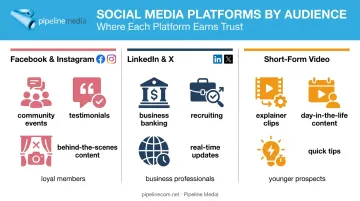
Facebook and Instagram: Community and Visual Storytelling
These two remain the workhorses for most credit unions, and for good reason. They're built for:
- Cover local events, including sponsorships, branch openings, and community fundraisers
- Share member testimonials and success stories
- Showcase behind-the-scenes staff content that humanizes the brand
Instagram in particular rewards visual consistency, while Facebook still holds strong engagement among the older, loyalty-driven member segment.
LinkedIn and X: Professional Reach and Real-Time Updates
LinkedIn is where business banking conversations happen. It's the right home for:
- Highlight commercial lending and business account content
- Post recruiting content and staff spotlights
- Share thought leadership from executives on economic trends
X works differently. It's built for real-time updates, rate change announcements, customer service responses, and quick industry commentary. Response speed matters more than production value here.
Short-Form Video: Reaching the Next Generation
Short-form video is where the growth is happening. Deloitte's research on digital media consumption shows short-form platforms have become the default entry point for younger audiences seeking financial content.
Credit unions are seeing engagement that traditional static posts simply don't generate anymore, especially with:
- 15- to 30-second explainer clips on rates, fees, or account features
- Day-in-the-life content featuring branch staff
- Quick breakdowns like "what a hard inquiry actually does to your credit score"
The format works because it respects attention spans. A 20-second video explaining why your credit score dropped after a hard inquiry gets watched. A 500-word blog post on the same topic often doesn't.
Building a Content Strategy That Resonates
Most credit union marketers reference some version of a content-mix framework: the 5-3-2 rule, the 5-5-5 rule, or the 50/30/20 rule. The exact ratios vary by who's teaching them, but the underlying logic is consistent:
- Curated or shared content: industry news, community partner posts, third-party financial tips
- Original educational content: your own explainers, staff-led tips, product-adjacent advice
- Personal or community content: staff spotlights, member stories, local sponsorships
- Promotional content: a smaller slice, reserved for actual product pushes
For a regulated financial brand, weighting these frameworks toward education and community, and away from heavy promotion, keeps content compliant and engaging.
Human Over Stock, Every Time
Stock photography of handshakes and skylines doesn't build trust. Unscripted staff moments do. That South Carolina State Credit Union video skipped polish entirely, and its raw authenticity is exactly why it worked.
Hyper-Local Is Your Advantage
National banks can't replicate a sponsorship of the local little league team or a partnership with a downtown small business. Documenting these moments consistently gives a credit union something a megabank simply can't buy: local credibility.
Keep Educational Content Tight
Single-concept explainers outperform sprawling educational campaigns. Pick one idea per post:
- Why did my credit score move this month?
- What happens if I miss an autopay?
- How does a HELOC actually work?
Stick to one idea and one clear takeaway per post. This respects the reader's time and keeps compliance review simpler too.
Build a Simple Monthly Calendar
Blend your chosen content-mix ratio with core pillars: community, education, staff, and updates. Rotate formats too (Reels, quick-tip graphics, an "Ask a Lender" series) to keep the feed feeling fresh without losing structure.
Staying Compliant: What Credit Unions Need to Know Before Posting
Credit unions don't get a compliance pass just because content lives on social media. Federal guidance is explicit on this point: consumer protection laws apply to social activity the same way they apply to print or broadcast ads.
Yes, credit unions can advertise on social media. But every post carrying a rate, term, or product claim carries disclosure obligations too.
The Rules That Actually Apply
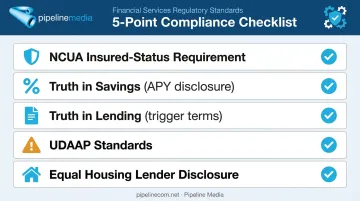
- NCUA insured-status requirement: Federally insured credit unions must display the official NCUA sign or an approved insured-status statement, with a narrow exception for ads of 30 words or fewer under 12 CFR Part 740 that most social posts won't meet.
- Truth in Savings (12 CFR 707.8): Rate claims must be stated as Annual Percentage Yield, and accounts can't be marketed as "free" if fees can apply under any condition.
- Truth in Lending (Reg Z, sections 1026.16 and 1026.24): Certain "trigger terms," like a specific payment amount or down payment, require additional disclosures to appear alongside the ad, even in a caption.
- UDAAP standards: Any claim that could mislead a reasonable consumer, even unintentionally, is scrutinized on prominence, placement, and clarity, not just literal accuracy.
- Equal Housing Lender disclosure: Required on residential loan advertising, including the appropriate logo or approved statement.
Build Compliance Into Your Daily Workflow
Review before you post. A compliance officer or marketing lead should sign off on any post referencing rates, terms, or lending products before it goes live. Document that approval, so if an examiner ever asks who approved it, you have a clear answer.
Protect member data in public channels. Never discuss account specifics in comments or DMs, even to be helpful. Redirect members to a secure channel, phone, secure message, or in-branch, every time.
Train anyone who appears on camera. Authenticity and compliance aren't opposites, but only if the person on camera knows what they can and can't say about rates, promotions, or account terms. A five-minute briefing before filming saves a much longer conversation with compliance later.
Paid Social and Measuring What Actually Matters
Extending Reach with Paid Social
Credit unions absolutely can run paid social campaigns, and should. The mistake most institutions make is treating paid spend as a substitute for organic strategy rather than an amplifier of it. Boost the post that's already resonating organically. Don't push a cold audience straight toward "apply now."
Financial advertisers face extra scrutiny on major platforms:
- Meta requires financial product advertisers to declare the Financial Products and Services Special Ad Category, which restricts detailed age, gender, and location targeting.
- LinkedIn treats lending and credit ads as restricted content requiring a review before the ad runs.
- X requires prior certification for US financial services advertisers before campaigns launch.
None of this blocks paid social. It just means campaigns need a compliance check built into the setup, not bolted on afterward.
Measuring Success Beyond Likes and Followers
Follower counts feel good. They don't pay the bills. A more useful measurement approach connects social activity to actual outcomes:
- Traffic from social posts to specific product pages
- Assisted conversions, meaning social wasn't the last touch, but it was in the path
- Account openings that can be traced back through multiple touchpoints, not just last-click attribution
There's no universal, verified benchmark for "good" social ROI across every credit union. Anyone quoting a single number without context is oversimplifying.
Focus on trend lines specific to your institution: is product-page traffic from social increasing month over month? Are DMs turning into branch visits or applications? Those internal trends tell you more than any external average.
DIY or Partner? Choosing the Right Path for Your Credit Union
Most credit union marketing teams are small, and they're already stretched thin across compliance reviews, content creation, community management, and reporting. Consistency suffers first when bandwidth runs out.
That's the gap a managed partner fills. Pipeline Media's Social Media Presence package, starting at $500/month, is built for exactly this situation. It includes:
- Manages Instagram, Facebook, X, and LinkedIn accounts
- Creates custom content with on-brand captions
- Schedules posts for consistent visibility
- Monitors comments and inbox messages
- Optimizes profiles for a professional presence

This keeps your credit union's presence active and professional without adding to your team's workload.
What to Look For in Any Partner
Whether you go with Pipeline Media or evaluate other options, prioritize:
- Experience with regulated industries: someone who understands why a caption can't say "free checking" without a footnote
- Transparent reporting: you should know what's working, not just trust that it is
- Responsive communication: compliance windows move fast, and a partner who's slow to respond creates risk, not efficiency
A partner won't remove the need for internal compliance sign-off. But the right one makes that review faster because the content arrives already built with regulatory realities in mind.
Frequently Asked Questions
What are common social media content rules (5-3-2, 5-5-5, 50/30/20) for credit union social media marketing?
These frameworks split content into curated, original, personal, and promotional categories in different ratios. For credit unions, the practical adaptation is simple: weight toward education and community content, and keep direct promotion to a small slice of the mix.
Can credit unions advertise on social media?
Yes. Credit unions can run both organic and paid social ads, but rate and product claims trigger disclosure requirements under NCUA, Truth in Savings, and Truth in Lending rules. Compliance review before posting is essential.
How often should a credit union post on social media?
Most credit unions find 3-5 posts per week per platform sustainable without sacrificing quality or compliance review time. Consistency matters more than volume; a steady cadence beats sporadic bursts.
Which social media platform is best for credit unions?
It depends on the audience. Facebook and Instagram work best for community storytelling, LinkedIn for business banking and recruiting, and short-form video for reaching Gen Z and Millennial prospects.
How much does social media management cost for a credit union?
Costs vary by scope. As a benchmark, Pipeline Media's Social Media Presence package starts at $500 USD/month and covers brand management across Instagram, Facebook, X, and LinkedIn. Paid social campaigns and lead-generation work are quoted separately based on scope.
Do credit unions need approval before posting on social media?
Yes. An internal compliance officer or marketing lead should review and document approval on any post referencing rates, terms, or lending products before it publishes. This protects the institution during regulatory audits.